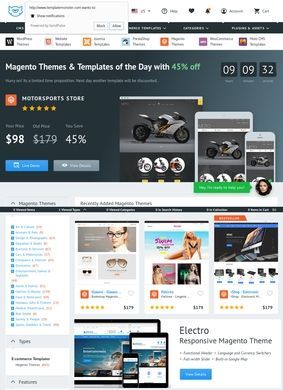
One company sells you a Magento theme, a logo, a PowerPoint deck, and a developer to install all three. Template Monster, run by Jetimpex Inc., is that company. The Magento templates that land it in this category are a single shelf in a warehouse that also stocks WordPress themes and plugins, WooCommerce and Shopify storefronts, PrestaShop and Joomla themes, raw HTML5 builds, landing pages, plus admin and newsletter layouts. For anyone shopping specifically for a Magento storefront, the upside is obvious: the same vendor can hand you the design and then build out the rest of your toolkit without sending you to four other sites.
Design assets beyond website themes
The design-asset side of Template Monster runs deep. Icons, fonts, logo templates, layered PSD files, illustrations, vectors, UI elements, animated banners, and product mockups are all on sale, which means a small shop owner who buys a theme can also grab the supporting graphics in the same checkout. Past static design, the catalog stretches into presentations for PowerPoint, Keynote, and Google Slides, and into motion work: After Effects and Premiere Pro templates, stock footage, and motion graphics. That is a strange spread for a place most people first met as a website-theme shop, and it tells you the business has been chasing whatever digital creators keep needing.
Subscription and single-purchase pricing
Pricing has two doors. You can buy items one at a time, or you can take MonsterONE, a subscription that opens the whole catalog for unlimited downloads. For a freelancer churning out client sites every month, the subscription math tends to win quickly; for someone who needs one Magento theme and nothing else, the single purchase is the saner pick. Template Monster also lists 100-plus free templates, which give a cautious buyer a real way to test build quality before any money changes hands.
Professional services for theme implementation
That combination is the part worth pausing on. Template Monster does not stop at selling files. It runs paid professional services: web design and development, website optimization and maintenance, graphic design, content writing, and a developer-for-hire arrangement where you rent the labor alongside the asset. A startup founder who buys a Magento theme but cannot wire it up has somewhere to turn within the same brand, and the maintenance offering matters for an e-commerce store where a broken checkout is lost revenue, full stop.
Quality varies across third-party sellers
The marketplace is also open on the supply side. Third-party authors can list and sell their own products through Template Monster, which is what pushes the catalog to its current size. That openness cuts both ways, and it is the honest tension in any large marketplace. More authors mean more choice and a wider price range; they also mean quality is uneven, because a polished theme from one studio sits next to a thinner effort from a solo seller on the same search page. The free downloads and the buyer reviews on individual product pages are the practical defense here, and I lean on both before trusting any single listing.
That uneven floor is exactly why a buyer should read the support terms attached to a specific item, and not assume the whole store behaves identically. A theme backed by an active author and clear documentation is a different purchase from one that has been sitting untouched. Template Monster's platform structure supports careful shopping; it does not do the shopping for you.
Who is all of this aimed at? The brief lists freelancers, small business owners, agencies, startups, and enterprises, and the product mix backs that up. The pay-per-item route fits a one-off small-business need. The subscription and the developer-for-hire options fit agencies and freelancers running volume. Enterprises are the loosest fit, since a serious enterprise build usually outgrows an off-the-shelf theme, but the custom-development service is presumably where larger clients get pulled in.
How do customer ratings compare across platforms?
On reputation, Template Monster keeps an active Trustpilot profile with customer reviews, though the exact tally was not visible during this review. On Reviews.io it sits at 3.56 out of 5 across 59 reviews. SmartCustomer shows a far larger sample, 1,682 reviews averaging 3.3 out of 5, and that bigger pool carries more weight than the smaller ones around it.
G2 lists just 3 reviews at 4.3, and WorthePenny shows 4 reviews at a perfect 5.0, but four entries prove almost nothing on their own. Read together, the scores cluster in the middling-to-fair range: a real business with genuine satisfied customers and a steady stream of complaints, which is roughly what you would expect from a marketplace this size with this many independent sellers. Nobody should walk in expecting a flawless five-star experience, and the larger samples are the ones to weight.
Getting in touch is straightforward enough. There is a contact page, a separate help desk on its own subdomain, and a customer-care email that Template Monster publishes openly. No phone number or street address appeared on the homepage, which is normal for a digital marketplace that handles support through tickets, and the help desk is the channel that actually matters when a download misbehaves at eleven at night. For a product line that is entirely online, ticket-based support is the sensible setup, and the fact that the help desk is a distinct system and not a buried form is a small point in its favor.
So where does Template Monster land for the Magento shopper? It is a credible, deep, and genuinely broad source, with the caveat that quality varies by author and the review scores sit at fair and not excellent. If you are a small business owner or a startup founder wanting a Magento storefront plus the graphics and possibly the build help to go with it, start with the free templates to gauge quality, then read the reviews and support terms on the specific theme you like before you buy, and ask the help desk directly about update and support coverage for that item. If you run an agency, price out MonsterONE against your monthly volume and compare it to buying singles. Template Monster has the range; whether it suits you depends on how carefully you shop it.