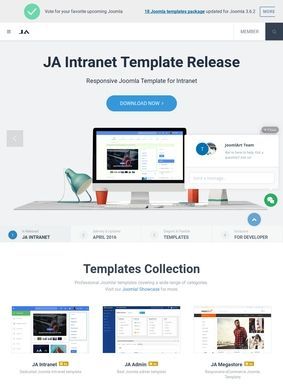
You inherit a Joomla site, or you want to build one, and the first wall you hit is the gap between a bare CMS install and something that looks finished and runs the way clients expect. That is the exact spot JoomlArt aims at. The company sells a library of more than 400 premium Joomla templates, sorted by the kind of site you are building, business, travel, restaurant, magazine, so you are picking a starting point that already has the right shape instead of fighting a blank theme into submission.
Building pages with the T4 framework
The piece doing the heavy lifting is the T4 Page Builder, a drag-and-drop builder for Joomla, with the T4 Framework sitting underneath it for people who write code and want hooks to grab onto. That pairing is worth paying attention to, because JoomlArt covers two jobs at once: a visual layer for the person assembling pages and a developer layer for the person customising them. Many Joomla template vendors ship only the design and expect the buyer to handle code-level changes alone, so a builder-plus-framework combo pays off when a site needs to grow past its first layout.
Extensions for social networks and courses
Beyond templates, JoomlArt distributes upward of 50 Joomla extensions, and a few are heavyweights in their own right. JomSocial handles social networking on a Joomla site, Guru runs as a learning management system, and Ad Agency covers ad-driven layouts. These are not throwaway add-ons; JomSocial in particular has a long history in the Joomla world. The catalogue is broad enough that a single membership could underpin a community site, a course platform, and a small company website without leaving the ecosystem.
Choosing among five membership clubs
Access is sold through membership clubs, and this is where a buyer needs to think before paying. There are five distinct template clubs on offer, JoomlArt, Gavick, Shape5, JomSocial, and iJoomla, plus an All-in-One Bundle that folds every club together. If you only ever touch JoomlArt's own designs, a single club is enough. If you are a freelancer or agency churning through varied client work, the bundle starts to make sense, since buying clubs piecemeal adds up fast. The structure rewards people who live inside Joomla full time and is probably overkill for someone building one site and walking away.
Tracking update frequency and migration support
The scale claims back up the membership pitch to a degree. JoomlArt reports more than 300,000 customers and says it ships over 600 product updates a year, which for a CMS that moves through major versions on its own schedule is the number that actually counts. A template you bought three years ago is worthless the moment it breaks on a Joomla upgrade, so an active release cadence is what keeps a club worth renewing. On that note, the company also offers migration assistance for the jump to Joomla 5 and 6, which is the upgrade most existing site owners are quietly dreading.
Support channels and reputation
Support is structured the way you would hope from a paid club: a member helpdesk, community forums, written documentation, and video tutorials. JoomlArt points to more than 4,000 premium tickets and over 7,000 forum threads resolved as evidence the channels are staffed and used. Numbers like those tell you the queue moves, though they say nothing about how a specific ticket of yours will go. A stated 100 percent money-back guarantee sits alongside all of it, which lowers the risk of joining a club until you have tested whether the templates suit your hand.
Comparing review scores across platforms
Outside opinion is where the picture gets less tidy, and an honest read has to sit with that. On Trustpilot the company carries 23 reviews, and the individual comments run mixed, with some clearly negative voices in the set. Knoji shows a steadier result, 53 reviews averaging 4.0 out of 5. Complete-Reviews is harsher, 13 reviews landing at 2.73 out of 5, while a lone review on Smart.reviews gives a perfect 5. The spread is the takeaway: JoomlArt is a long-running vendor with a real customer base, and like most long-running vendors it has accumulated both satisfied buyers and frustrated ones. The low Complete-Reviews score is worth reading through, since support friction and renewal billing are the usual sources of that kind of grievance in subscription software.
Contacting the helpdesk
Reaching the company runs mostly through the member helpdesk and a contact page, which fits a business whose customers are nearly all account holders. There is no phone number or street address shown on the homepage, so this is not a vendor you reach by picking up the phone. Social channels are present, Facebook, YouTube, Pinterest, and Twitter, along with a newsletter signup, which is the normal footprint for a software business of this type. For pre-sale questions a buyer leans on the contact page; for post-sale help the helpdesk is the front door, and the resolved-ticket figures indicate it gets staffed.
Weighing the subscription cost
What you are weighing is a deep and actively maintained Joomla toolkit against a support reputation that is solid in places and shaky in others, sold on a subscription you keep paying to stay current. For a developer or agency planted firmly in Joomla, the breadth and the update pace make a strong case for JoomlArt. The harder call is for the occasional builder who may only launch one site and never renew, since a recurring club membership is a poor fit for a one-off project no matter how good the templates are.