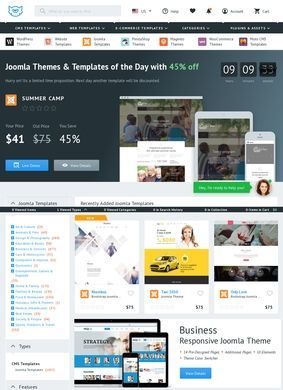
Someone building a Joomla or WordPress site on a deadline usually hits the same wall: they need a polished design now, they cannot afford a custom build, and they do not have time to learn graphic tools from scratch. Template Monster is built for exactly that moment. The marketplace sells ready-made website templates and a wide spread of digital assets, so a person who needs a working storefront or a portfolio by the end of the week can buy a theme, drop in their content, and launch without writing the front end themselves.
Catalog scale and platform coverage
The scale of the catalog is the first thing to get a handle on. There are more than 9,000 HTML templates and over 7,000 Elementor kits and plugins, plus WordPress and WooCommerce themes that cover the bulk of small-business use cases. For shops on other platforms, the inventory stretches to Shopify, Magento, and PrestaShop themes, which means a merchant is not locked into one ecosystem before they have even chosen a design. The breadth here is genuine, and it explains why Template Monster shows up under so many different template categories, including the occasional business directory listing for digital asset vendors.
Design assets beyond website themes
Beyond website themes, the store carries a lot that a small team would otherwise stitch together from several vendors. Presentation templates cover PowerPoint, Google Slides, and Keynote. The graphic side includes icons, fonts, logos, illustrations, vectors, backgrounds, and mockups. There is also a media library of After Effects templates, stock video, music, and sound effects, pulling motion and audio work into the same account a buyer already uses for their site theme.
That consolidation has a practical upside. A founder putting together a brand can pick a WordPress theme, a matching logo, a set of icons, and a pitch deck template without opening five different shopping carts. Whether the quality is even across all those categories is a fair question, and the spread of outside ratings suggests it varies. But the convenience of one marketplace handling design, code, and media is real, and it is a main reason Template Monster has stayed relevant as a one-stop source.
Subscription downloads with MonsterONE
For buyers who pull assets often, Template Monster offers a subscription called MonsterONE that grants unlimited downloads across the catalog. That model suits agencies and frequent builders far better than one-off licensing, since the per-item cost effectively drops to zero once you download enough. A solo user who needs a single theme will likely skip it, but a studio churning out client sites can justify the subscription quickly.
Custom services through TM WebStudio
Not everyone wants to assemble a site themselves, and Template Monster addresses that with a services arm called TM WebStudio. It covers web design, ongoing site maintenance, SEO, content writing, graphic design, and developer-for-hire work. So the same company that sells you a template can also be hired to install it, customize it, or maintain it afterward. For a non-technical owner who buys a theme and then realizes they are stuck, having that fallback under the same roof is a sensible safety net.
Vendor marketplace model
The platform also runs in the other direction. Authors and vendors can list and sell their own digital products through the marketplace, which is why the catalog grows the way it does. A designer with a backlog of themes gets distribution and a payment system without building their own store. That structure, buyers on one side and contributing authors on the other, is what keeps the inventory fresh, though it also means consistency depends on who made any given item. A restaurant owner and a SaaS startup are shopping the same store but landing in very different corners of it.
The customer base reflects this range. Startups, small and mid-sized businesses, and larger enterprises all use Template Monster, across verticals such as tech, fashion, real estate, restaurants, and medical practices. The category filtering is what makes that workable, and it is decent enough that narrowing from tens of thousands of items to a manageable shortlist does not take long.
Customer ratings across review platforms
The outside picture is mixed, and it deserves a straight read. Trustpilot is actively used, with Template Monster responding to reviews there. Reviews.io shows 59 reviews averaging 3.56 out of 5. SmartCustomer carries a much larger sample, 1,682 reviews, at 3.3 out of 5. G2 has only 3 reviews but a higher 4.3, and WorthePenny shows a perfect 5.0 across just 4 reviews, which is too small a sample to lean on. The pattern that matters is the larger pools: roughly mid-three-star scores from the platforms with real volume. That is a middling result, not a glowing one, and it lines up with a marketplace selling thousands of items from many different authors, where experiences range from excellent to frustrating.
A buyer should read that as a signal to vet the specific template and its author before purchase, check the demo carefully, and look at that item's own feedback where available. The aggregate score tells you the store is large and uneven, not that any single theme is good or bad.
Support and quality considerations
On support, Template Monster runs a help center on its own subdomain, which points to a real support operation behind the marketplace. A customer care email turns up in the company's Trustpilot responses, so there is a clear route to a human when an order goes wrong. A phone number is not prominent on the homepage, which some buyers will want before committing to a subscription. For a digital-goods marketplace that handles most issues through tickets, that is fairly common, but worth knowing in advance.
One caution alongside the scale: a catalog this large is only as good as the item you choose. The volume is a strength when you know what you want and a liability when you are browsing without a clear target, because quality is not uniform across tens of thousands of products. Spending time on the live demo and the asset's documentation pays off more here than on a smaller, curated store. Template Monster puts a lot in front of you, which is either exactly what you need or mildly overwhelming, depending on how specific your brief is.
When to use Template Monster
For a small-business owner or a freelance web builder who needs a credible site fast and is comfortable working from a template, Template Monster is a reasonable place to start, especially if the project involves Joomla, WordPress, or a common e-commerce platform. Filter to your platform, open the live demo of two or three candidates, read the reviews on those specific items, and if you expect to download often, price out MonsterONE against buying licenses one at a time. If building it yourself is not appealing, TM WebStudio can install and customize the theme you pick.