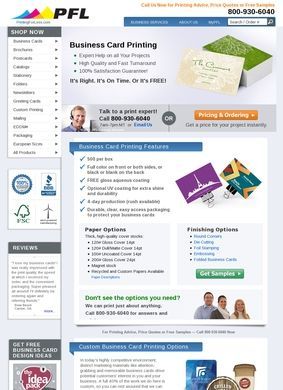
A box of PFL business cards ships with the finish already decided: matte, gloss, or a heavier stock the buyer picks before the file ever reaches a press. That small choice is the front door to Printing for Less (PFL), an online print shop that has run out of Livingston, Montana since 1996, and business cards are only the first line on a long order sheet.
The catalog reaches well past the wallet-sized stuff. Postcards, catalogs, brochures, presentation folders, newsletters, envelopes, greeting cards, and appointment cards all sit on the same menu, each with finishes a customer sets during the order.
Around 40 percent of PFL's work is described as customized print solutions, which tells you the standard templates are a starting point and the odder jobs get handled on their own terms. A buyer who wants 500 matte business cards is served by the same shop that will print a 5,000-piece catalog run, and the stocks, finishes, and formats scale with the job instead of forcing everyone through one fixed template.
What separates this operation from a plain print-on-demand listing in a business directory is how far it leans into the mail.
Where PFL goes past a stack of cards
Print is the anchor, but the business leans hard toward marketing that lands in a physical mailbox. That side has real presence on the site, and it reshapes how the whole thing reads: less a print vendor waiting quietly for files, more a shop that will build and send the campaign around the print. A buyer arrives wanting cards and can leave with a mailing plan.
The offerings split into a few clear lanes, and each one answers a different kind of customer. Some come for a single run of stationery. Others come to hand off an entire outreach effort and never touch a postal form.
Direct mail and Every Door Direct Mail
Every Door Direct Mail postcards are the headline. That format drops a printed card into every address on a chosen postal route, no mailing list required, and it is the tool a local business reaches for when it wants to blanket a neighborhood cheaply. PFL pairs those postcards with marketing kits, so the printed piece and the campaign around it come from one place.
For a dentist opening a second office or a real estate agent working a single zip code, that bundling is the practical draw, and it explains why the site reads as a marketing vendor as much as a printer. The postcards come in the standard mail sizes, and because the routes are picked on a map, a buyer can target a few streets or a whole town without ever assembling a contact list.
Design help and the fulfillment side
Buyers who show up without finished artwork get professional design assistance, and PFL cites over 50 years of combined experience across its design staff. Read that number as a self-report, because it is one, but it does point to a staffed design desk rather than a template wizard doing all the work. On the back end, the company handles mailing and fulfillment automation. For an outfit sending the same campaign on a schedule, that is the part worth having: printing, addressing, and mailing run as one chain instead of a manual handoff every cycle.
These two services are what push PFL toward the marketing-partner role the site clearly wants. Whether a given buyer needs them depends entirely on how much of the work they plan to keep in-house. A one-off business-card order barely touches either service; a recurring monthly mailer leans on both, and that is the customer the whole setup is chasing.
Who the print menu is built for
The client base PFL points to includes small shops alongside large firms, and the industry spread is wide: advertising and design agencies, healthcare, nonprofits, real estate, retail, technology companies, and universities. That range fits the product mix. A hospital ordering appointment cards and a design agency ordering short-run brochures want very different things from the same press, and the catalog is built to serve both.
Returning customers manage their orders through a separate login portal, which points to a setup shaped around repeat business more than a single walk-up purchase. That portal is where the ongoing relationship actually lives, holding past orders and reorder details so a returning customer is not rebuilding a job from scratch each time they need another run.
What Yelp, the BBB, and the testimonial pages say
Outside opinion on PFL turns out to be sparser than the size of the operation would suggest. Yelp carries 23 reviews at 3.5 stars, a middling score that reads like real customers with genuinely mixed results. The BBB lists a profile for PrintingForLess.com, Inc., and at least one review there is pointedly negative, citing a quote request that went unanswered. For a print buyer on a deadline, that specific complaint deserves more attention than the star average does.
The company's own numbers run far sunnier, and I would weigh them with real caution. A FeaturedCustomers page collects 506 customer reviews and testimonials alongside case studies and videos, but that material is vendor-hosted and has not been checked by anyone independent, so it belongs in a separate column from the Yelp figure. Employee feedback muddies things further without telling a customer much: Glassdoor shows ratings around 3.3 to 3.7 out of five across 147 reviews, with 52 percent recommending the workplace, and Indeed carries mixed accounts, one describing 60-hour weeks.
Those speak to life working at PFL, not to what a print order turns out like, and they should count for little in a purchasing call.
Reaching the company is the easy part. A toll-free line, a street address in Livingston, and a contact page are all posted in plain sight, so a buyer with a question about a rush order has a clear route to an answer before handing over a file.
Add it up and the shape is clear: a capable, long-running printer with a marketing arm bolted on, carrying a decent public rating and a large stack of testimonials it hosts itself. PFL has the range to carry a full campaign from the business cards through to the drop, and surviving in commercial print since 1996 is its own kind of evidence. The soft spot is responsiveness, and the one concrete complaint on record points straight at it.
Planning a neighborhood mailer is where Printing for Less fits best, handling the postcard design, the print run, and the drop through Every Door Direct Mail without stitching together three separate vendors. The sensible first move is to call the Livingston office with a real job in hand, ask how quickly a proof and a firm quote come back, and let that turnaround decide whether the rest of the work is worth handing over.