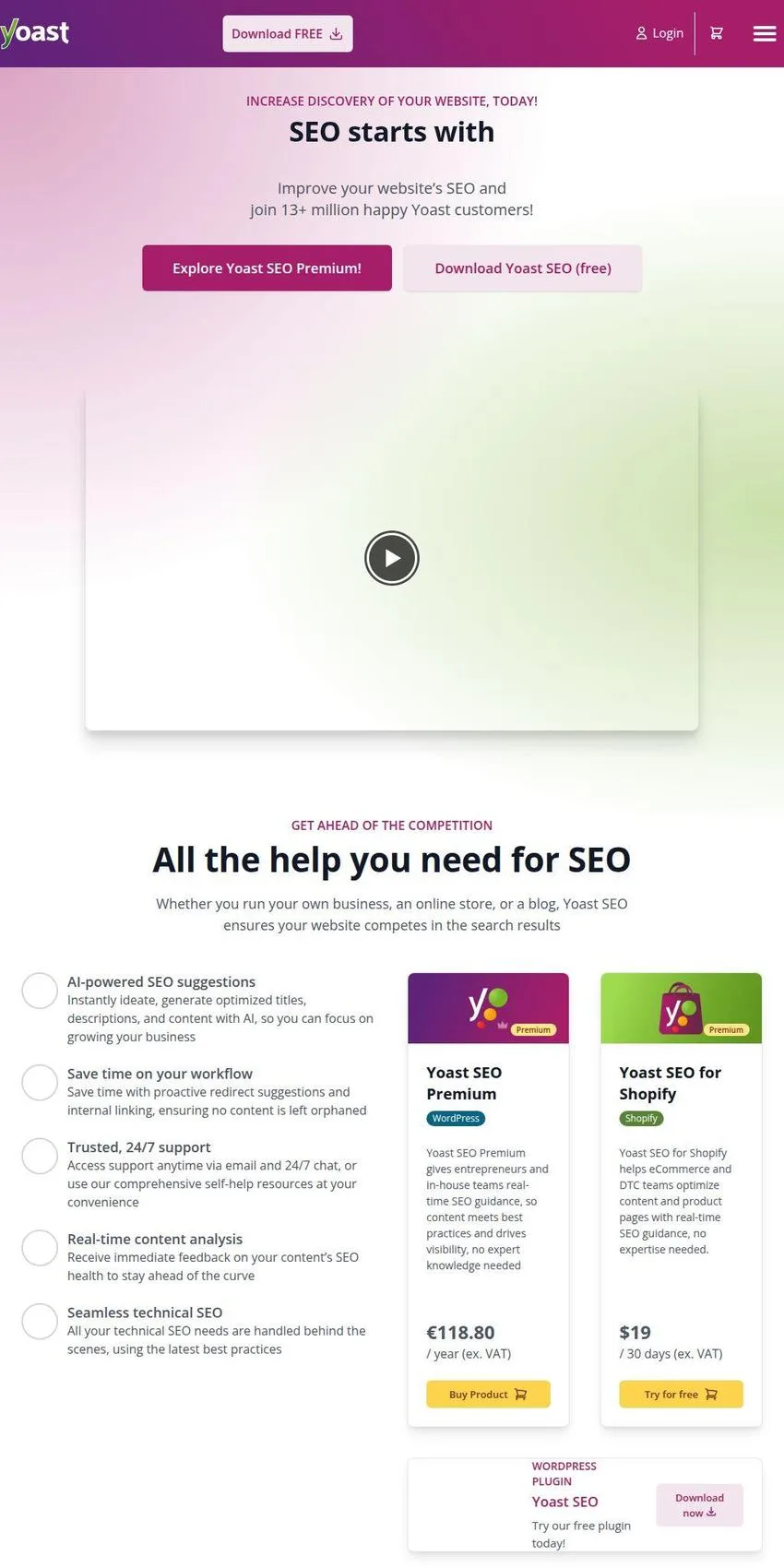
Thirteen million-plus customers is the number Yoast puts at the front of its own pitch, and for a piece of SEO software that started life as a free WordPress plugin, that reach is the single fact that explains everything else about the company. Most people meet the brand through that free plugin, installed and then half-forgotten, quietly grading their posts with a traffic-light score in the corner of the editor. The paid business is stacked on top of that enormous free base, and the whole strategy only makes sense once you see that base for how big it is.
The audience Yoast writes for is spelled out plainly: entrepreneurs, bloggers, e-commerce operators, and the wider set of content publishers who need search traffic and have neither the time nor the budget for an SEO agency. The software and the teaching are both pitched at that group, the person running their own site who wants to do the optimisation themselves. Seen through that lens, the free-plugin-plus-paid-tier model is less a sales funnel and more a way to meet those users wherever they are on the learning curve.
The product ladder is easy to read, which is more than can be said for a lot of software vendors. The free Yoast SEO plugin sits at the bottom. Above it, Yoast SEO Premium runs at $118.80 a year, Yoast WooCommerce SEO at $178.80 a year for shop owners, and Yoast SEO AI+ at $358.80 a year at the top.
There is a Yoast SEO Google Docs add-on for people who draft outside WordPress and want the same checks while they write, and a separate track for Shopify: Yoast SEO for Shopify, priced at $19 per 30 days with a free 14-day trial to test it first. The prices are stated openly on the site, and the WooCommerce and Shopify splits show a company chasing e-commerce deliberately, not treating every website as the same problem.
What the paid tiers buy
Underneath the plans, the feature set holds together. Real-time content analysis is the part users see first, scoring readability and on-page optimisation as they type, so the feedback lands while a draft is still soft enough to change. Beyond that sit technical SEO controls, internal linking recommendations that suggest where a new post should point, and redirect automation that catches broken URLs when a page is moved or deleted.
That last one is the sort of housekeeping most site owners ignore until a reorganisation quietly buries a page that used to bring in traffic. The internal linking tool addresses a related blind spot, since a site that grows past a few dozen posts tends to lose track of which pages point where, and letting old content strand itself is a quiet way to bleed away rankings that were already earned.
The AI angle is where the newer money is heading. Yoast now folds AI-powered suggestions into the writing flow, and the top AI+ tier adds brand monitoring on top of that. Whether the jump to $358.80 a year is worth it depends entirely on how much a given site lives or dies by search, and the pricing structure at least lets a buyer step up one tier at a time instead of paying for the ceiling on day one.
For a WooCommerce store, the calculation is different again. Product pages, category pages, and the sheer number of URLs a shop generates are where technical SEO stops being optional, and the dedicated WooCommerce tier is aimed squarely at that pain. The same logic drives the Shopify version, priced as a monthly subscription so a merchant can switch it on for a busy season and off again without a year's commitment.
The academy and the free base
The teaching side is a genuine part of what Yoast is, not a marketing bolt-on. Yoast SEO Academy runs both free and premium courses, and around it sit a blog of content and technical SEO articles, webinars, podcasts, and developer documentation for the people building on top of the plugin. For a small operator learning SEO from scratch, that library has real value before a single paid product enters the picture, and it is a shrewd way to keep people inside the Yoast world while they decide whether the paid tiers are worth it.
The free plugin and the free WordPress.org community forums do a lot of quiet work here. Together they let someone run Yoast SEO for years without spending anything, which is exactly how a figure like 13 million-plus gets built in the first place. The free core stays genuinely useful on its own, the teaching helps people get more out of it, and only the fraction who outgrow the free version end up paying for the rest.
Support and how to reach it
Support is tiered the same way the products are. Paying subscribers get round-the-clock help over email and chat, there is a self-service Help Center for the common problems, and free users fall back on the WordPress.org community forums where other users and staff answer questions. A contact page exists on the site, though no phone number or physical address appears on the homepage, which is unremarkable for a software company whose support genuinely runs through tickets and chat instead of a call centre. Judged on the routes that matter for this kind of product, help is easy enough to find.
Outside opinion is plentiful and broadly warm. Trustpilot has a 4-star rating across 841 reviews, a sizeable sample that says more than a handful of testimonials would, and G2 hosts a Yoast SEO page with 202 reviews of its own. TrustRadius, Capterra, and SoftwareAdvice each keep their own review pages too, with user-submitted pros and cons for anyone who wants to read the detail. The search snippets did not spell out aggregate scores for those last three, so the cleanest number to anchor a judgement on stays that Trustpilot four-star average over a large base of reviewers.
The verdict lands favourable with a real caveat about cost. Yoast does the fundamental job well, the free plugin is a fair starting point for any WordPress site, the education around it is genuinely useful, and the outside reviews back up the reach the company claims for itself. The reservation is money.
The annual prices climb quickly once WooCommerce or the AI+ tier enters the picture, and a small blogger who only ever wanted a readability check may find the free version already does most of what they need, while the paid ladder is plainly built for businesses where search traffic is the whole game and $358.80 a year reads as a rounding error rather than a real expense.






Business address
Yoast BV
Don Emanuelstraat 3,
Wijchen,
Gelderland
6602 GX
Netherlands
Contact details
Phone: +31 (0)24 82 00 337
AI website builders make it possible to go from a blank screen to a live website in minutes. Which is a great option if you want…
Good vibes can spark great ideas, and now they can even help you build a website. With vibe coding, you don’t need to start by…
Each month, we host the SEO Update by Yoast, covering the latest in search and AI. In this edition, Carolyn Shelby and Alex Moss…
The Yoast SEO Bulk Editor already helps you update titles, meta descriptions, and focus keyphrases across your whole site, filter…