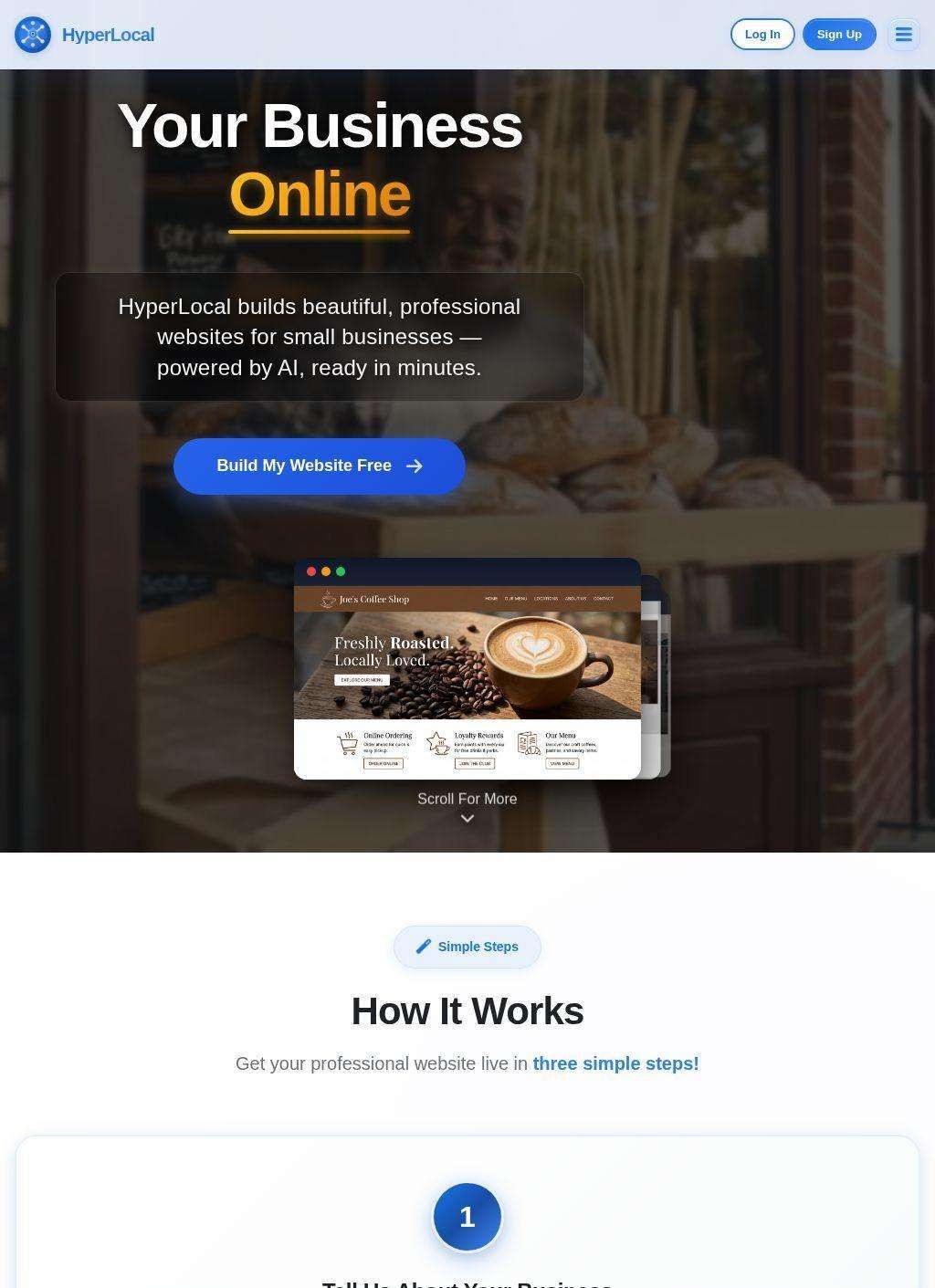
Two minutes, no code, a live site at the end of it. That is the pitch HyperLocal puts front and center, and it sets the tone for everything else the product tries to be. HyperLocal runs an AI-driven website builder pointed squarely at small businesses, the kind of owner who wants a presence online without hiring a developer or wrestling with a template library for a weekend. You describe what you do, the system assembles the pages, and you tune from there.
How the builder works
The public site keeps its structure simple. There are four main areas to move through: Features, About, Pricing, and Contact Us, plus a "Get Started" flow that drops you into a free trial. That is a lean navigation for a software product, and it fits the promise. Nobody arriving at HyperLocal with the intent to spin up a quick business site wants a maze of sub-menus. The friction the tool claims to remove is the same friction it avoids in its own layout, which is a small thing but a consistent one.
Navigation and site structure
What HyperLocal is selling, at bottom, is speed and the removal of technical skill as a prerequisite. Those are the two levers small-business owners actually care about, since most of them are running the business itself and treating the website as a chore to get past. An AI that reads a short description and returns a professional-looking site addresses a real and common frustration, and that is the wager HyperLocal is making. The demonstration value lives or dies on how good those generated pages look once you are past the two-minute headline, and that is the part a listing like this one cannot judge for you.
Speed and skill removal as core value
The outside record is harder to pin down than the pitch suggests, and it is worth explaining why. Searching the name pulls up a scatter of businesses that have nothing to do with a website builder: a restaurant in New Delhi with Tripadvisor reviews, a transportation-software company, a credit union, and a batch of Glassdoor employee ratings that belong to some other "Hyperlocal" entirely. None of that is this company. The name is common enough that the search results are genuinely muddy, and anyone doing their own homework should expect to sort through the noise, the way you would scrolling past unrelated listings in any business directory search.
What the outside record shows
The one clearly relevant third-party mention is a Capterra entry for HyperLocal, where a business owner left a detailed review giving the tool a perfect five out of five, with top marks on communication, responsiveness, and expertise. That is a real data point, and a positive one. It is also a single voice. One glowing review from an owner tells you the product can satisfy a customer, but it does not tell you how it performs across dozens of accounts, or how it handles the awkward cases, or what support looks like six months in. A sample size of one is not something to lean on hard, in either direction.
Finding relevant information online
So the honest reading is one favorable data point set against zero comparable ones, not an established track record you can verify from the outside. For a younger software product that is unsurprising, and it is not a mark against the company so much as a reason to treat the trial as the real evidence.
Limited third-party evidence available
The target user is easy to picture: a plumber, a bakery, a consultant, someone who needs a clean, credible site and needs it to exist by tomorrow, not next month. If that describes you, the free-trial path is the sensible way to test whether the generated output actually clears your bar. The claim costs nothing to check, and checking it firsthand beats any second-hand opinion, including this one.
Contact details and support access
On the matter of reaching a human, the company does better than a lot of software startups. The site lists a phone number you can call, a physical address in Cheyenne, Wyoming, and a page built specifically for getting in touch. A real street address and a working phone line are reassuring for a company asking you to build your business identity on its platform: there is somewhere to direct a question or a complaint when the automated flow cannot help. That transparency counts, and plenty of comparable tools bury it or omit it entirely.
Pricing information behind the trial
What you will not find from the outside is much detail on pricing tiers or the specifics of what the trial converts into, since HyperLocal keeps those behind the "Get Started" flow. That is normal for this kind of product, but it does mean the Pricing tab is where a serious evaluation should start, before you invest time describing your business to the builder.
Should you test the free trial?
HyperLocal is a focused product with a clear promise and a legitimate reason to exist. The pitch answers a real need, the navigation is honest about what the tool does, and the contact information is present and specific enough to build real confidence. Those are genuine points in its favor, and they should not be undersold.
The reservation is proportion. A two-minute build is a strong claim, and the outside evidence backing HyperLocal up amounts to one enthusiastic Capterra review against a wall of search results about unrelated companies. That is not damning, but it is limited, and the burden of proof sits with the trial itself rather than with anything a search engine can confirm in advance. The sensible approach is to treat the free trial as the deciding test and judge the generated pages against what would actually be accepted on a live business domain, pricing tab read closely along the way. HyperLocal has earned a fair shot at that test, provided expectations stay level until the product proves itself on the specific project it is asked to run.
Business address
Hyper Local, Inc
1712 Pioneer Ave Suite 113,
CHEYENNE,
WY
90703
United States
Contact details
Phone: 8337300003