What search engine do you turn to when Google is not available or not preferred? Bing, Microsoft's web search engine, has spent years building out a feature set that goes well past basic keyword lookups, and the result is more layered than most casual users expect.
Search features and specialized layers
The core is still search: web pages, images, videos, news, and maps, all from the same starting point. The maps layer is Microsoft's own, covering directions, satellite imagery, and local lookups. Video search is where Bing has historically stood out, surfacing thumbnails that play on hover so you can preview a clip without opening a new tab. Image search comes with filtering by size, color, type, and license, which makes it genuinely useful for researchers and designers in a way that the plain homepage does not suggest. Shopping search adds price-comparison panels when you look up a product, pulling in results from multiple retailers alongside paid listings. Flight search works similarly, generating price breakdowns without requiring a third-party booking site. These features live inside the same search bar rather than behind separate tabs.
AI integration with Copilot
The most significant change in recent years is the integration of Microsoft Copilot, the AI assistant built into the search interface. A Copilot panel appears alongside traditional results for queries that benefit from a synthesized answer, and a dedicated chat mode allows multi-turn conversations with follow-up questions. Bing now operates as both a link index and a generative AI interface, letting users decide how much they want a direct answer versus a list of sources to explore.
How does Copilot handle accuracy?
That AI layer gets used to summarize news, explain technical concepts, draft text on request, and walk through product comparisons. Source citations appear alongside AI answers, giving users a path back to the underlying web pages. For niche, rapidly evolving, or contested topics, the same risks apply here that apply to any generative AI output: plausible-sounding text that may lag behind recent events or flatten genuine complexity. Bing's answer to this has been the citation links rather than any claim of infallibility.
Advertising and developer access
Microsoft Advertising, formerly Bing Ads, places paid results within standard search pages. Developers can access the underlying index through the Bing Search API, and the engine supplies image and video data to several third-party aggregators under licensing deals. That backend role means reach extends well beyond homepage traffic. For advertisers, the platform covers audiences not reached by Google Ads alone, particularly older demographics and professional segments that index heavily toward Windows and Edge. Cost-per-click rates on Microsoft's network have historically been lower than Google's for many categories, which matters to anyone working with a tight budget. A direct import function for existing Google Ads campaigns keeps the setup barrier low.
Microsoft Rewards loyalty program
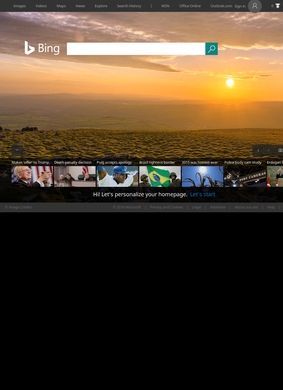
Microsoft Rewards is a loyalty layer that lets users accumulate points simply by searching through Bing while signed into a Microsoft account. Points convert to gift cards, sweepstakes entries, and Microsoft Store credit. It is an unusual feature for a search engine and one that turns routine queries into something with a marginal payoff for regular users. SafeSearch filtering and region and language customization work as expected for households with children or for users who want results localized to a specific country. The daily homepage image, sourced from photography around the world, comes with a trivia question and background notes on the subject, a small but consistent piece of content that distinguishes the landing page from a blank search bar.
Inside the Windows ecosystem
Bing is the default search engine in Microsoft Edge, which gives it a significant installed base among Windows users who never change browser defaults. The Bing Transparency Center and Microsoft's broader privacy dashboard give users controls over search history and personalization. Ad targeting, data retention, and the handling of AI-generated content are disclosed in documentation that is publicly available and maintained by a company with regulatory obligations in multiple jurisdictions.
The market position is what it is: a minority share of global search, well behind Google. That said, the product is a real alternative with a different AI integration model, a loyalty program, a strong video search layer, and tight integration with Windows and Edge. For users already inside the Microsoft ecosystem, the path of least resistance is Bing, and the features interconnect in practical ways: Copilot in Edge, Rewards points, and search history synced to a Microsoft account.
One thing worth mentioning for context is where this site fits in. Jasmine Directory lists Bing under its search engine category, and for a business directory covering web tools, omitting one of the two dominant search engines would be a gap. The listing is straightforward, pointing to the public homepage with no specialized landing page in between, which is appropriate given the scale of what is on offer.
On reputation, Microsoft is a publicly traded company subject to extensive regulatory and financial disclosure requirements. Independent coverage of Copilot and the search engine appears regularly across major technology publications. There is no shortage of third-party commentary on the product's strengths and shortcomings, and that coverage is easy to find through any search engine including Bing itself.