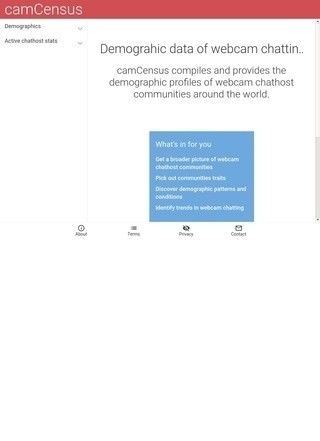
What camCensus publishes is not typical of analytics sites in this corner of the internet. A 2015-to-2023 longitudinal study of webcam chat hosts in the United States sits prominently on the platform, and that single report is enough to establish that camCensus is doing something more considered than a one-off data dump. The platform aggregates demographic and activity data about webcam chat host communities, drawing from a related service called camRoster as its underlying source feed. The subject matter is niche, but the approach is unambiguously analytical: who these hosts are, where they are concentrated, and how those patterns shift across time.
Three data categories
The data organizes into three main areas. Demographics covers gender distribution (women, men, and LGBTQI+ categories), age group breakdowns, and country-level composition of the host population. Activity Statistics addresses engagement and participation rates. Time Statistics looks at chat duration and persistence measures. Within each area, regional and demographic sub-views let you drill into specific slices instead of working only from aggregated totals. The navigation keeps this hierarchy legible; without it, dumping everything into a single flat page would make the figures nearly impossible to use. The site avoids that trap.
Privacy and data retention
One detail in the privacy policy stands out more than any dashboard feature. User access logs are retained for seven days only, which is a deliberately short window for a site dealing with a sensitive topic. Most analytics platforms keep that kind of data far longer without saying much about it. camCensus stating the retention period and keeping it short is a choice that reflects some thought about the people visiting the site alongside the people being measured. That said, the methodology for how camRoster gathers its figures, what qualifies someone as a host, and how gender and age categories are assigned does not appear in what the platform presents up front. For casual reading that gap is manageable. For citation in serious academic or policy work, the sourcing chain would need more documentation than camCensus currently makes visible.
Intended audience and analytical purpose
camCensus names its intended audience plainly: researchers, analysts, and organizations seeking behavioral and demographic insight into virtual webcam chat communities. It is a narrow target, and the platform does not try to widen it by softening the presentation. There is no consumer-facing packaging here. The tone throughout is closer to a statistics portal, and the structure follows from that consistently. Someone studying online labor patterns, gig economy participation, or the demographics of platform-based work could find something genuinely useful in what camCensus assembles, especially because so few sources track this particular corner of the internet systematically.
Eight-year trend reporting
The historical reporting is where camCensus does its strongest work. A single snapshot of demographics has limited analytical value; an eight-year trend line gives a researcher something to build an argument on. The United States report spanning 2015 to 2023 is the clearest proof that camCensus tracks change over time rather than publishing a one-off census and moving on. Whether the other regional reports receive the same longitudinal depth is not explicitly confirmed in what the site presents. The US case establishes the method, but a user would need to check directly whether coverage extends as far for other countries before assuming it does.
Outside reputation and community signal
On outside reputation, there is not much to go on. A search for reviews or ratings of camCensus surfaces nothing relevant. What does appear belongs to unrelated products that happen to share the word Census, listed on the usual software review aggregators. None of those entries refer to this platform. camCensus has no third-party rating, no visible user community, and no complaint record either. For a niche analytics tool with a specialized audience that situation is not particularly surprising, but it does mean a visitor has only the published work itself to judge the platform by. There is no community signal to lean on in either direction, so the data stands or falls on its own presentation.
From contact information to transparency
Contact information follows a similar pattern. The footer includes links to About, Terms, Privacy Policy, and a Contact page, so a defined route to whoever runs the site exists. A phone number, email address, or physical location does not appear on the landing page; those details, if they exist at all, sit behind the contact link. For a data project of this type that is a common enough setup. Someone needing to verify who is responsible for the figures will have to go looking for it instead of finding it stated immediately. The About section would be a natural place to put that kind of disclosure, and adding it there would go some way toward addressing the transparency gap that currently makes camCensus harder to evaluate than it needs to be.
Put together, camCensus is a competent, single-purpose platform. It does one thing and organizes that one thing carefully. The granularity of the sub-breakdowns, the eight-year US trend report, and the restrained log retention policy all point toward a site built by someone who thought through the design rather than slapping figures on a page. What limits the recommendation is the absence of public methodology and the complete lack of any outside track record. A reader is taking the numbers largely on trust, with camRoster as the only stated source and no external party confirming the accuracy of what camCensus produces.
What methodology documentation would clarify
The categories are clear, the historical US data is the most substantive piece of work on the site, and the privacy approach is more deliberate than average. Methodology documentation is the real gap: camCensus would gain considerably in credibility if it explained how camRoster counts hosts and assigns the demographic categories shown. Questions like whether a host is counted once per study period or per session, and how the LGBTQI+ category boundary is drawn, are the kind of thing a researcher needs answered before the figures can do serious analytical work. The dashboards load cleanly, the breakdowns are detailed, and the seven-day log retention window holds exactly as stated in the policy. On its own terms camCensus delivers what it describes. Whether that is enough depends entirely on what a visitor needs the data to do.