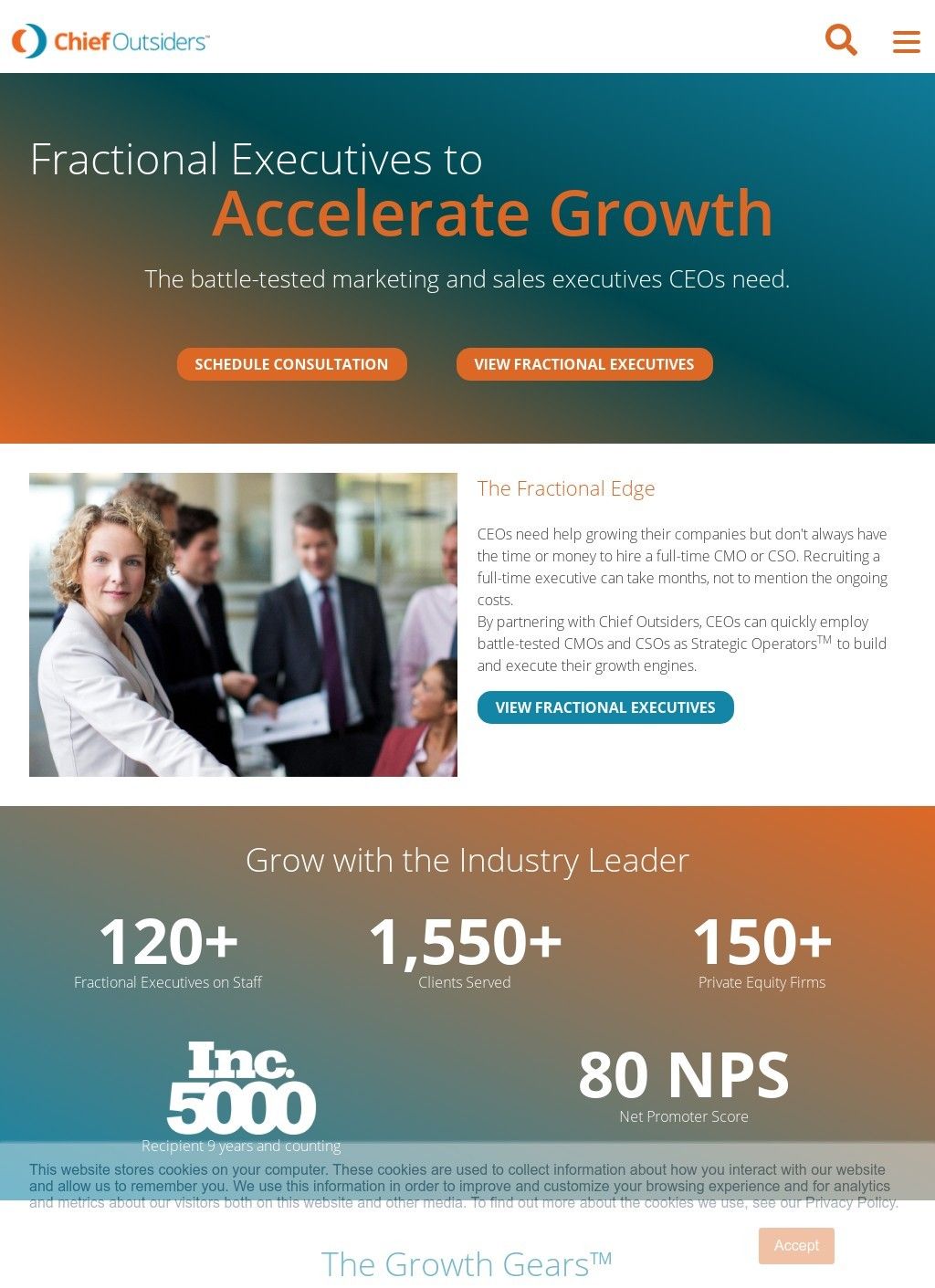
A mid-sized manufacturer hits a wall. Revenue has been flat for three quarters, the last marketing hire walked out eight months ago, and the founder knows that a full-time chief marketing officer at that pay grade is more salary than the business can defend. This is the spot where Chief Outsiders, the firm listed here under the name Fractional CMO, steps in. It places experienced marketing and sales executives into growing companies on a part-time, engaged basis, so a business gets the judgment of someone who has run marketing at real scale without adding a permanent seven-figure line to the payroll.
Fractional executives for growing companies
What Fractional CMO actually sells is two kinds of placement: a fractional chief marketing officer, and a fractional chief sales or revenue officer. These are not junior consultants handed a slide template. They take the leadership seat, set the go-to-market plan, and stay close enough to see it carried through.
Team Outsiders and interim leadership
When one leader is not enough coverage, the firm fields what it calls Team Outsiders, on-demand crews of marketing and sales specialists who execute under that executive's direction. Interim leadership rounds out the menu, and it counts for a lot when a company loses a key person and needs someone credible in the chair within weeks. The distinction Fractional CMO draws here holds up: an interim seat is a bridge, while the fractional engagement is meant to be an ongoing part of the leadership team, just at a fraction of the time and cost.
Private equity focus across seventy industries
Reach and specialization are where this entry gains weight. Chief Outsiders reports work across more than seventy industries, naming manufacturing, healthcare, SaaS, financial services, and nonprofit among them, and it says it has served over three hundred private equity firms along with their portfolio companies. That private equity figure deserves a pause. PE owners want a growth thesis executed on a defined clock, and dropping in a Fractional CMO who has done the same job in a comparable company before is a well-worn way to take risk out of the hold period. A firm that keeps getting rehired for that assignment has faced the scrutiny operating partners are known for, and that scrutiny does not tolerate padding.
Growth platform and supporting services
Beyond the executive placements, the site puts forward GrowthGears OS, described as an AI-enabled growth acceleration platform. The label carries the current fashion for stamping AI onto anything with a dashboard, so the honest read is to treat it as the structured method a placed executive brings, given a name and some software. It sits alongside advisory work in digital marketing, sales strategy, AI-business consulting, and marketing coaching. Taken together, the picture is a firm that wants to sell both the leader and the operating system that leader runs, a reasonable way to keep an engagement from collapsing the day the executive rotates out. A Fractional CMO who leaves behind a documented method and a working platform is more useful than one who takes the whole playbook out the door on their last day.
Resources for evaluating the engagement
The resource shelf is bigger than a typical consultancy bothers building: a blog, a run of podcasts, webinars, downloadable eBooks. It feeds the sales pipeline, and it lets a prospective client sample how these people think before signing anything. For a buyer weighing whether a Fractional CMO engagement is worth the fee, an afternoon reading and listening is a cheap way to test the reasoning, and the volume says the firm is comfortable putting its methods in public. Much of the writing circles the idea the Fractional CMO model is built on, that growth is a discipline installed rather than a lucky break waited for.
One thing worth keeping straight: the growth platform and the coaching are supporting acts. The product being sold is a person with a track record, and everything around it exists to make that person more effective once they are inside a client. Read the offering that way and it holds together. Read it as a software company and it will disappoint, because the software is not the point. Fractional CMO is really selling access to someone who has already made the expensive mistakes on another company's budget, and the tooling keeps that experience from evaporating when the contract ends.
Credibility from outside voices is the one area where the trail runs cold. A search for reviews kept surfacing a different, similarly named outfit branded as a Fractional CMO service, along with generic listicles of top fractional marketing companies and business directory entries, none of which name or assess Chief Outsiders.
No substantial body of third-party reviews turned up for the firm itself, and that gap is worth stating plainly. It does not mean the work is weak; a firm serving hundreds of PE relationships is clearly transacting. It means the public review footprint has not caught up with the client roster, so a careful buyer should ask Fractional CMO for references directly rather than leaning on star counts that are not there. Given how much of this work happens inside private companies and confidential PE deals, quiet is also what a person would expect, since few clients broadcast that they rented their marketing chief.
Contact is handled the way a serious B2B firm should: a published phone number, a street address in Houston on Post Oak Boulevard, and links to LinkedIn, X, Facebook, and YouTube. For a service where the pitch rests on trust in named executives, a physical office and a phone line to dial do more for confidence than testimonial copy. A Fractional CMO buyer is usually a founder or a board, and those buyers move faster when they can reach a person on the first try.
Who is this for? The fit is clearest for a company between the too-big-for-founder-led-marketing stage and the too-small-for-a-tenured-CMO stage, and for PE-backed businesses under pressure to grow inside a fixed timeline. A Fractional CMO arrangement suits exactly those companies that need senior direction more than another salaried headcount. A very early startup with no revenue to steer, or a large enterprise with a full marketing bench, is not the target. The seventy-industry claim cuts both ways here. Broad experience is useful, but a buyer should still press on whether the specific executive assigned to them has done it in their exact sector, because a Fractional CMO is only as good as the individual who shows up.
The overall impression is of a substantial, established operation that has turned a genuinely useful idea, senior marketing leadership without the full-time cost, into a repeatable service with the depth to back it up. The gaps are honest ones. The GrowthGears branding leans on AI language that will age poorly, and the light public review record puts more vetting burden on the prospective client. Neither undercuts the core: a firm that clearly knows the fractional executive model and has run it many times over. A Fractional CMO engagement lives or dies on chemistry with one person, so no amount of website copy was ever going to settle that alone. Based on what is published here, this reads as a credible option for a company that has outgrown founder-led marketing and cannot yet justify a full-time hire.
Business address
chiefoutsiders
United States