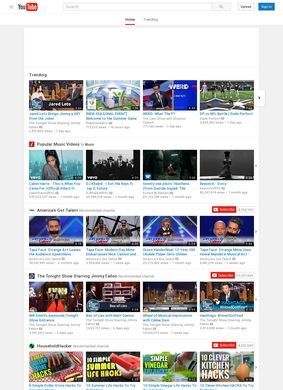
What does the single most-visited video platform on the internet give a person who lands on it for the first time? Almost everything, and that breadth is the honest starting point for any assessment of YouTube, LLC. A new visitor can watch free, ad-supported video on practically any subject, from music and gaming to news, sports, classroom-style lessons, and the how-to clips people search for when something at home breaks. Owned by Google and sitting under the Alphabet umbrella, the platform reports more than two billion logged-in monthly users and hosts in excess of eight hundred million videos. Those numbers describe the gravitational pull the service has on how a large slice of the world finds and watches things.
Video streaming for viewers
The free tier is what most people picture, but the product is wider than that. YouTube Premium strips out ads, allows background play, and lets users download clips to watch offline, which matters on a commute or a flight. The music side splits off into a dedicated streaming service with both free and paid levels, putting it in direct competition with audio-only apps. There is a live TV option for broadcast and cable channels in the United States, and a walled-off space with parental controls so younger viewers stay inside curated content. Each of these is a separate door into the same library, and a household could plausibly use three or four of them without much overlap.
Premium membership options
Creators get a different toolkit entirely, and this is where YouTube, LLC has built out its deepest set of features. Studio is the control room: it handles uploads, channel management, audience analytics, and the levers for earning money. The route to income runs through the Partner Program, where qualifying channels share ad revenue and add channel memberships, Super Chats during live streams, and merchandise shelves. The analytics depth is genuinely useful to creators because it shows how many people watched and where they stopped, which changes what someone makes next. Shorts answers the vertical, swipe-fed format that competing apps popularised, and the live-streaming side covers real-time broadcasts for everything from gaming sessions to conferences.
Creator tools and monetization
Advertisers form a third audience, treated as a distinct customer with their own products. TrueView, bumper, and display formats give brands several ways to appear, while premium placement packages target the most-watched content. This is the engine that funds the free tier: for YouTube, LLC the viewer experience and the ad business are two sides of the same coin. Developers form a fourth group, and the Data API v3 lets outside applications pull in video data, manage uploads, and weave content into their own software. That API explains why the service shows up embedded across so much of the rest of the web.
Advertising formats and placement
Put those pieces side by side and a pattern emerges: the service has stopped being a single website and become a small constellation of related products, each tuned to a particular need. A casual viewer never has to think about any of this. They open the page, the recommendation system serves something, and they watch. The layered structure is what lets the same brand serve a parent screening cartoons, a band releasing an album, a marketer buying placements, and an engineer building an app, all at once. The trade-off is complexity. Anyone trying to grasp the full set of offerings will spend time working out which product they want, since the names blur together and the boundaries between Watch, Premium, Music, and TV are not always obvious.
Search and recommendation system
For viewers, practical value comes down to depth of catalogue and the recommendation engine that surfaces it. With a library that large, the question is rarely whether a video on a topic exists; it is whether you can find the good one among the many. The search and suggestion tools do heavy lifting there, for better and occasionally for worse, since the same system that finds a perfect tutorial can also pull someone into an hour they did not plan to spend. That is the nature of an attention-driven product, and being clear-eyed about it is part of judging whether it serves a given user well.
Education sits among the most underrated uses. The volume of lecture-style content, language instruction, repair walkthroughs, and skills demonstrations turns the platform into an informal reference library that happens to be free. Quality varies wildly, because anyone can upload, so the burden falls on the viewer to weigh who is teaching and whether they know their subject. Still, for a great many practical questions, a clear demonstration has become the default first stop, ahead of written instructions, and that shift says something real about how people now prefer to learn.
The creator economy attached to YouTube, LLC deserves a sober note. The Partner Program has made full-time work possible for a meaningful number of people, but the mechanics are demanding. Eligibility thresholds, shifting monetisation rules, and an algorithm that decides reach all sit between a creator and a paycheque. The Studio analytics help, yet they also expose how much of a channel's fate rests on factors outside any individual's control. For someone weighing whether to build there, the platform offers reach no rival can match alongside dependence on a single company's policies, and both halves of that bargain are worth taking seriously before committing.
Within a business directory focused on internet and marketing companies, YouTube, LLC is hard to match for scope. Competitors exist for each slice: short video, music streaming, live TV, ad placement. Few try to hold all of them in one product, and none at this scale. That consolidation is the defining strength of the platform and, for those who worry about how much of online video flows through one company, its defining concern.
The overall picture is straightforward in one sense and open in another. As a place to watch, learn, listen, and publish, YouTube, LLC is close to unavoidable and remarkably capable across every audience it courts. The substance is real and the tooling is mature. What stays open is the personal calculation each user makes about how much time, attention, and creative dependence to hand over to a single platform. The breadth is not in question. Whether that breadth serves a user's purposes or quietly reshapes their habits is something only sustained use can answer.