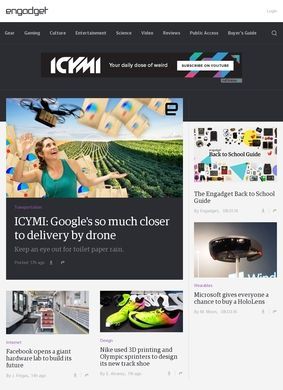
You want to buy a laptop, a pair of headphones, or whatever phone just got announced, and you have a dozen browser tabs open, half of them recycled marketing copy and half of them benchmark charts you cannot parse. The job at that moment is simple to state and surprisingly hard to satisfy: someone who handled the actual hardware, knows the category, and will tell you plainly whether the thing is worth your money. Engadget has been doing that particular job since 2004, and the depth of its review archive is the first thing that separates it from the churn of newer tech blogs.
Reviews across phones, laptops, cameras
The reviews are the backbone of Engadget, and they spread across the categories most people care about: smartphones, laptops, tablets, wearables, televisions, audio gear, and cameras. Tech shopping rarely stays in one lane, so that range pays off. Someone reading up on a new phone often ends up wondering about a smartwatch to pair with it, or a set of earbuds, and the same publication has hands-on coverage of all three. The writing leans on testing and direct use, which is the only kind of review worth reading when you are about to spend real money on a gadget. A review that reads like it was written from a spec sheet helps nobody, and that is the trap Engadget mostly avoids by putting its writers in front of the hardware.
Testing products through actual use
That hands-on habit shows most clearly in the harder categories. Cameras and televisions are difficult to judge from numbers alone, and audio gear is close to impossible. Headphones that measure well can sound wrong, and a phone screen that wins on paper can disappoint in daylight. The reviews here describe how a product behaves in ordinary use, which is the gap between a marketing claim and a purchase you do not regret.
Breaking news and daily coverage
Around that core sits a steady output of breaking news. When a manufacturer announces something, when a product slips its release date, when a company shifts strategy, the news desk covers it quickly and in volume. Daily content has been the operating rhythm for two decades, and the editorial staff is large enough to keep that pace without leaning on a single voice. That continuity is worth noting on its own.
Plenty of tech sites launched with fanfare and faded; Engadget has simply kept publishing, year after year, through several shifts in who owns it, now sitting under Yahoo. A reader does not always need the deepest analysis in the moment a product drops. Sometimes the value is just knowing it happened, accurately and fast, from a source that has covered the beat long enough to flag what is genuinely new.
Buying guides for budget decisions
The buying guides deserve separate mention because they answer a different question than the reviews do. A review tells you whether one product is good. A buying guide tells you which product in a crowded field is the right pick for a given budget or need, and Engadget structures these around categories that turn over fast. The site is editorial judgment applied to hardware rather than a directory of specs.
Deals pages with affiliate links
Sitting alongside those guides are the deals pages, tracking price drops timed to sales events. Worth being clear-eyed here: that deals coverage runs on affiliate links, meaning the publication earns a cut when readers buy through them. That is standard practice across consumer tech media and not a knock against the work, but a reader should know the incentive exists. The same caution does not transfer to the editorial reviews, and keeping those two things mentally separate is part of reading any modern tech outlet well.
Event coverage and feature reporting
Event coverage is another area where scale pays off. CES, Apple's keynotes, Google I/O, and the rest of the annual product-launch calendar get live, rolling attention, with writers on the ground sorting the genuine news from the staged spectacle. For anyone who wants to follow a major announcement without sitting through a two-hour stream, this kind of filtering has real value, and Engadget has done it at every big launch for years. The feature articles go longer and slower, stepping back from the product cycle to examine trends and the companies driving them. These pieces are where the publication stops being a buying tool and starts reading like journalism, with room to argue a point and follow a story past the day it broke.
Science reporting on AI and space
The science reporting is the part that quietly broadens what the site is. Coverage extends into space, artificial intelligence, and environmental topics, all of it adjacent to the consumer-tech beat but reaching past the next gadget release. A reader who came for a headphone review might stay for a piece on a satellite launch or a story about how a new AI model works. That spread keeps Engadget from being a pure shopping resource and pushes it closer to a general technology publication, which is a fair description of where it has landed.
Video reviews alongside written coverage
Video sits next to most of the written work, so a hands-on can be watched as well as read, useful for hardware where seeing the thing in motion tells you more than a paragraph can. Between the written reviews and the video, Engadget covers most of the ways a person decides what to buy.
On the question of standing, the record speaks for itself. Engadget has won Webby Awards and turns up routinely as a cited reference in consumer technology journalism, the sort of source other writers point to rather than dispute. Two decades of continuous daily publishing under a recognizable name is its own kind of credential, the slow accumulation of a back catalog that competitors cannot conjure overnight. When a product launches, Engadget is among the handful of outlets readers and other journalists check first, and that habit did not form by accident.
None of this makes it a neutral oracle. The affiliate model in the deals section is a real commercial pressure, and the sheer volume of daily output means not every post carries the depth of a flagship review. Quick news hits and full hardware tests live side by side, and they are not the same thing.
A careful reader learns to tell which is which. But the reviews that anchor Engadget are thorough, the category coverage is wide enough to handle most tech-buying questions, and the institutional memory is deep. For a shopper trying to decide between two cameras, or a reader who wants to keep up with where the industry is heading, this is a resource with a long and consistent track record. Few competitors can match both the breadth of categories Engadget covers and the number of years it has covered them.