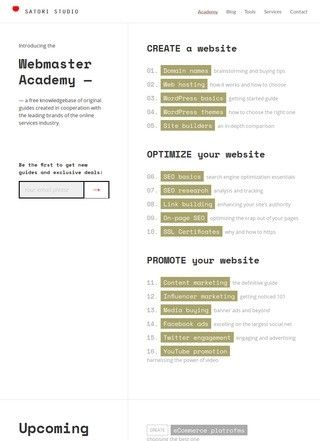
Free is the first surprise once you understand what Satori Studio is building. There is no paywall, no tripwire course, no "premium tier" waiting three clicks in. It runs a project called the Webmaster Academy, a growing knowledgebase of guides for people who want to build a website, make it rank, and then get eyes on it. The guides are assembled in partnership with recognizable names in this corner of the web, SEMrush, Template Monster, and Nightwatch among them, so the material at Satori Studio is being shaped by companies that sell the tools these guides describe.
Three tracks from domain purchase to promotion
The Academy is split into three tracks, and the split is sensible enough that a beginner would not get lost. The first, create a website, covers the ground floor: buying a domain, choosing hosting, setting up DIY servers, learning WordPress basics, working with themes, and using site builders for anyone who does not want to touch code. The second, optimize a website, is where the material gets more technical, running through SEO fundamentals, keyword and competitor research, link building, on-page work, and SSL certificates. The third, promote a website, deals with the part most guides skip or rush: content marketing, influencer marketing, social strategy for Facebook, Twitter, and YouTube, and media buying for people ready to pay for traffic.
The three tracks map to an actual life cycle. You do not usually read about hosting and media buying in the same place, because the person choosing a host is months away from thinking about paid campaigns. Putting both under one roof means the site is betting on the reader coming back at different stages, and structuring the content so it grows with them. Whether every guide lives up to that ambition is harder to judge from the outside, but the skeleton is coherent.
Blog posts and tools for site owners
The Academy is not the only thing here. Satori Studio also runs a blog that mixes product reviews with shorter webmaster tips, which is the sort of content that tends to date quickly in this field but also draws the search traffic that keeps a site like this alive. Sitting alongside it is a tools section, a common companion to any resource aimed at site owners, since the audience arriving to learn about hosting or SEO is exactly the audience that wants a calculator, a checker, or a generator to try on the spot.
There is also a stated roadmap. Upcoming guides are flagged on eCommerce platforms, accessibility, site speed, and WordPress plugins. Two of those, accessibility and site speed, are topics a lot of beginner-facing sites ignore entirely, so seeing them named as planned is a small point in the project's favor. A roadmap is only a promise until the pages actually appear, and there is no way to know from a listing how fast that pipeline moves. Still, naming the gaps is better than pretending they are already filled.
Partner brands shape the technical content
The audience Satori Studio writes for is clear throughout: aspiring webmasters and current site owners who would rather read a free guide than pay for a course or hire someone. That is a crowded space, full of blogs chasing the same keywords, and the partnership angle is probably what separates Satori Studio from the average affiliate blog that publishes for volume over depth. When SEMrush or Nightwatch has a hand in the material, the SEO and analytics content at least starts from a place of real product knowledge, even if the reader should keep in mind that partners have their own tools to sell.
That commercial undercurrent is worth naming plainly. Product reviews and brand partnerships mean some of what you read is going to nudge you toward specific paid services. It does not make the guidance worthless, and plenty of genuinely useful sites work this way, but a reader should treat the reviews as informed opinion with a stake in the outcome, not neutral verdicts. Knowing that going in changes how much weight you put on any single recommendation.
Contact form for contributors and partners
On getting in touch, the picture is modest but not empty. Satori Studio keeps a combined about and contact page with a form aimed at people pitching a topic or floating a partnership. There is no phone number and no physical address, which is normal for a content project that operates entirely online and expects most of its readers to arrive, read, and leave without ever needing to talk to anyone. The form is enough for the two groups likely to reach out: contributors with an idea and brands looking to work together. No direct email address is published, though that reads as a deliberate spam-avoidance choice more than a real gap, and the form covers the same ground.
A search for outside reviews of Satori Studio turns up nothing that points back to this site, and honesty demands saying so plainly. The name is the problem: several unrelated businesses share it, a spa in Savannah, a salon up in Machias, Maine, a yoga studio in San Francisco, and they crowd out any trace of the webmaster resource. There is no rating to report, no count of testimonials, no third-party consensus to lean on. That is not a mark against the content itself. It just means judging Satori Studio on what is in front of you: the guides, the partner names, the structure, with no outside crowd having weighed in first.
For the person it targets, the value proposition is easy to state. If you are standing at the start of a website project and want a free, organized path from buying a domain through ranking it and promoting it, few single-topic sites cover that whole arc as completely as this does, and the partner brands give the more technical tracks a credible backbone. If you are past the beginner stage, the blog and tools might earn an occasional visit, but you have probably outgrown the core guides. The three-track design rewards the newcomer most.
Set the free access next to the partnership credibility and the sensible create-optimize-promote structure, then weigh the missing outside reviews and the affiliate flavor of the blog, and what is left is a resource that looks solid for its intended reader and unproven only in the sense that no one outside has publicly graded it. The guides plainly exist, the tracks make sense, and the contact route does the one job it needs to. The roadmap is the open item: the promised guides on accessibility, speed, and eCommerce have not landed yet, and there is no published evidence here of how quickly Satori Studio ships new material or keeps the older tracks current as the underlying tools and tactics change.
Business address
Zero Axiom Ltd
Antonijas 23 - 14,
Riga,
Riga
LV-1010
Latvia
Contact details
Phone: +37188432353