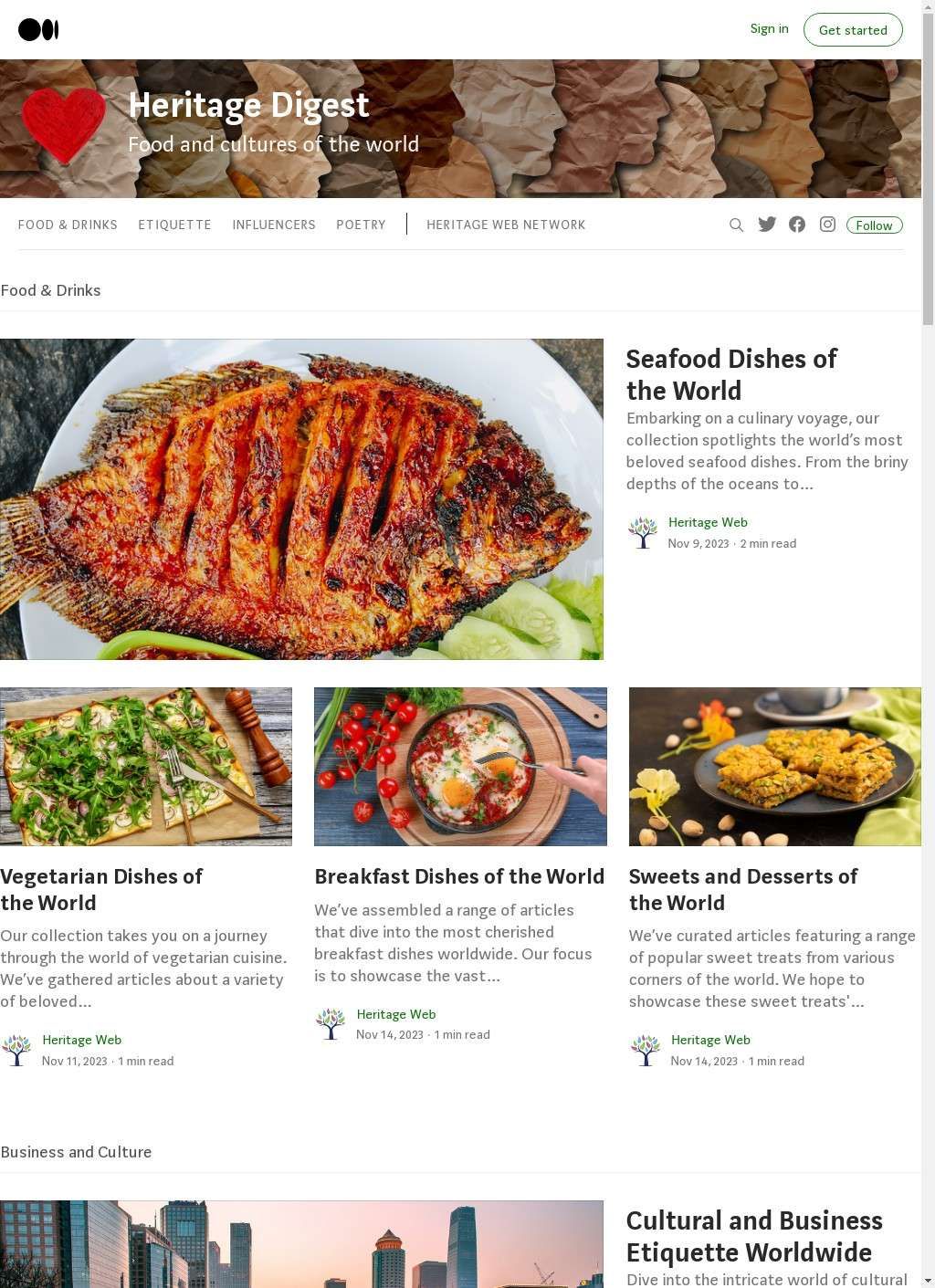
Running a blog on Medium that doubles as a weekly digest of new professional listings being added to a parent company's network is an unusual editorial premise, but it is the most accurate way to place Heritage Digest. The publication sits under the @heritageweb Medium account and is run by Heritage Web, the company behind a listings platform of the same name. Heritage Digest therefore wears two hats at once: part general-interest reading on world cultures, part promotional feed directing readers back to the parent operation.
Four content sections on food, history, culture
The editorial side is the more substantial of the two. Heritage Digest organises its writing into four named sections. Edibles handles food and culinary traditions. Culture covers how people live and express themselves. History carries narratives and accounts of past events. Communities gathers stories from groups around the world. The thread connecting all of it is people and place, aimed at an English-speaking reader with some curiosity about how the rest of the world eats, remembers, and gathers. The brief is genuinely wide, which is both the draw and the risk: a remit this broad can drift into scrapbook territory unless the writing has a consistent point of view holding it together.
Single editor managing all editorial work
One editor manages all of it. That is worth stating plainly, because it shapes what the publication can realistically do. A single-editor publication tends to have a consistent voice and a steady, modest output, but it cannot match the breadth or update frequency of a staffed magazine. Readers who want daily content should look elsewhere. Readers who want one person curating stories across food, history, and community life will find the format reasonable and the pace manageable.
Weekly listings updates from Heritage Web network
Heritage Digest's other function is more explicitly commercial. Alongside the cultural pieces, it runs weekly posts summarising new professional listings that have joined the Heritage Web network. This is not hidden, and it is not really dressed up as editorial either. It is a companion feed for anyone tracking what is being added to the Heritage Web platform. Readers who arrived for essays on regional cooking or local customs will scroll past these roundups with mild puzzlement; readers who care about the listings side will find them useful in proportion.
Tension between cultural content and promotional material
That dual identity is the central tension, and every reader has to decide how much it bothers them. The cultural content and the listings recaps serve different audiences, and grouping them under one banner means each group regularly encounters material aimed at the other. It is a defensible choice for a company that wants a single channel to do two jobs, and it keeps the parent brand in view. Whether it serves the casual cultural reader as well as it serves Heritage Web is a genuine question, and the answer is probably no.
Current follower numbers show early-stage reach
The follower numbers put the publication's current reach in perspective. The Medium account associated with Heritage Web carries 838 followers, but the Heritage Digest publication itself shows only 66. That gap points to most of the audience following the broader Heritage Web presence rather than Heritage Digest specifically, and it means the publication is still in early days rather than operating as an established outlet with a large, engaged readership. There is no shame in a modest count for a relatively new operation, but it is the honest picture.
Contact options through Linktree platform
On contacting anyone behind the publication, the Medium page does not list a direct email or phone number. It points off-platform through a Linktree link to the wider Heritage Web world, where the listings business and its other channels live. Beyond that, the standard Medium mechanisms are available: following, responses, claps. For a Medium-hosted publication this is entirely normal, and the Linktree gives a clear path to the parent platform. Readers with specific questions will need to go through Heritage Web to find them answered.
No independent reviews or external recognition
Outside reputation is harder to assess, and the publication should not be penalised for something that is simply absent. A direct search turns up no third-party reviews written about Heritage Digest specifically. Ratings visible in search results, such as Medium's own Trustpilot profile, are ratings of Medium the platform, not this particular outlet, and borrowing them would be misleading. So Heritage Digest has to be evaluated on what it publishes and on the credibility of its parent company, because no independent external verdict exists to supplement that reading.
Small publication with transparent intent
Taken as a whole, Heritage Digest is a small, single-editor Medium publication with a genuine editorial concept running alongside a promotional listings roundup. The four content categories are clearly defined, the hosting is free and familiar, and the writing is in plain English aimed at a general reader. Nothing about the presentation is oversold. What the publication lacks is an independent track record: the follower count on Heritage Digest itself is low, and there are no outside reviews to confirm the writing connects with readers beyond the Heritage Web orbit. That absence is the main limitation, and it is not a gap that internal polish can close on its own.
Readers drawn to short cultural pieces who are comfortable with the same feed occasionally advertising a listings platform will find Heritage Digest a reasonable fit. For anyone already interested in Heritage Web as a professional network, the weekly additions roundups provide a quiet view into what is joining. The publication's intent is transparent, its structure is tidy, and its four sections deliver what they promise within the limits of a one-person operation. Growth in independent readership and some outside recognition of Heritage Digest's editorial work would sharpen its standing considerably.