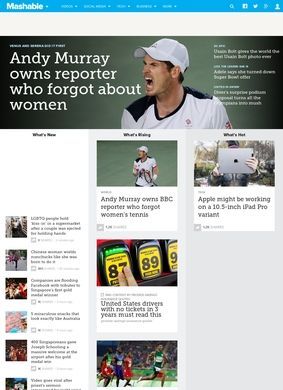
Mashable runs an annual awards program, the Mashable Choice Awards, that hands out recognition to the gadgets and services its editors rate highest across a year of testing. That detail tells you a lot about what the site has become: less a scrappy social-media blog and more a consumer-tech outlet that wants to be cited when people decide which laptop, phone, or VPN to buy. The company started in 2005, is based in New York, and now sits inside the Ziff Davis stable, which puts it among the larger established names in digital media.
Content categories across tech and culture
The bulk of what gets published falls into a few clear lanes. There is tech news, the steady stream of stories about devices, platforms, and the companies behind them. There are product reviews covering laptops, phones, VPNs, streaming services, and assorted gadgets, written by staff who do this for a living. A deals and shopping strand runs through the Mashable Shop, a video arm supplements the written work, and science, entertainment, and culture coverage rounds it out, along with the social-media commentary the brand built its early reputation on. Explainers, how-to guides, and pieces chasing whatever is trending fill the rest of the front page.
Reviews and product testing operations
That spread is the site's main strength and also the thing a careful reader should weigh. A reviews operation that covers everything from streaming subscriptions to phone hardware is useful as a first stop, though treating any single outlet's product verdicts as one input among several before spending money is the sensible approach. The masthead backs up the scale: alongside editorial staff, Mashable lists people in SEO, email, audience growth, and social roles.
Business model and affiliate relationships
That mix is honest about how a modern ad-and-affiliate media business runs in practice, and it explains the heavy presence of shopping content. Deals coverage and affiliate links sit close together here, which is normal for the format but worth naming up front. Anyone browsing a business directory and landing on a Mashable listing should know that the editorial operation and the commercial engine run side by side, and keeping them mentally separate is part of reading the site well.
Third-party ratings from multiple sources
Across third-party sources, the ratings are mixed and worth running through plainly. Trustpilot carries 116 reviews, though the snippet did not confirm an average score. SmartCustomer logs 95 reviews at a low 2.0 out of 5, while WorthePenny sits more in the middle with 375 reviews averaging 3.2. GadgetReview assigned a trust rating of 39 percent across 14 of the 15 categories it evaluated independently. None of these are catastrophic, but together they paint a site people read widely and grade with some skepticism, particularly on the commerce side where buyer expectations run high. Common Sense Media keeps Mashable on its lists but tags the news as "slightly sensationalistic," a fair-enough note for an outlet that lives partly on trending culture.
Employee experience at Glassdoor
The employee angle adds another layer. Glassdoor holds 88 reviews, with work-life balance scored around 3.7 and 51 percent of reviewers saying they would recommend the place to a friend. That is a roughly split internal verdict, the kind you would expect at a long-running media company that has weathered the industry's ups and downs. It does not tell a reader whether a given article is trustworthy, but it does paint Mashable as a real, staffed newsroom with the ordinary frictions of one, which is meaningfully different from the anonymous content operations that populate much of this category.
Contact methods for inquiries
Finding a contact route is not difficult. An About section links through to a contact page with email addresses sorted by purpose, including a general inquiries line and a separate press address. What you will not find there is a phone number or a street address, so anyone needing to reach a specific department has to work through the categorized email routes. For an operation of this scale that is unremarkable, and the press contact in particular shows that the company handles outside inquiries as a routine part of how it operates.
Strengths in consumer tech coverage
Put the pieces together and Mashable reads as a high-traffic, professionally staffed tech and culture publication with a deep archive, a working reviews and deals engine, and the affiliate-driven model that comes squarely with that territory. The credibility caveats exist but are bounded: the low GadgetReview score and the 2.0 on SmartCustomer pull against the broader sense that this is a credible newsroom. The "sensationalistic" tag is a reminder that headline energy sometimes outruns substance, which is a fair complaint about the trending-content side of the operation.
Inside the newsroom structure
What Mashable does well, it does at scale: a general reader wanting quick, readable takes on phones, laptops, streaming services, or whatever is moving through online culture will get genuine value here, especially as a starting point before going deeper into more specialized sources for the final decision. Cross-checking prices and verdicts elsewhere remains the sensible habit given the mixed commerce ratings, but as a first-pass resource on consumer tech, Mashable has the depth and the staff to back up its reputation as a serious outlet.