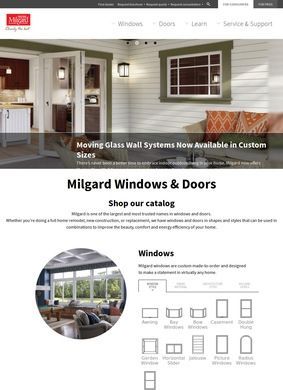
Pulling up the Milgard site with a window project in mind, the first thing that registers is how the product catalogue is organized. The V400 Tuscany Series sits near the top of the vinyl range, and comparing it against the V300 Trinsic and the V250 Style Line tells you a lot about how Milgard structures its lineup. Each tier has a number, a name, and a clear job. A homeowner can move up or down that ladder without leaving vinyl entirely. That internal logic runs through everything Milgard publishes, from the entry windows to the fiberglass and aluminum lines, and it makes the site easier to navigate than the size of the range would suggest.
Window and door product lines
Milgard manufactures residential windows and patio doors in the United States, and the audience the company writes for is broader than just homeowners. Architects, contractors, and builders or remodelers all get attention, which shapes the depth of the material available. A homeowner replacing two windows and a builder specifying glazing for a new subdivision need different things, and the documentation tries to feed both without forcing one group to wade through the other's concerns.
Vinyl, fiberglass, aluminum options
On the window side, the breakdown runs across three materials. Vinyl covers the V400 Tuscany, V300 Trinsic, and V250 Style Line series. Fiberglass is handled by the C700 Fiberglass Series. Aluminum shows up as the A250 Thermally Improved Aluminum line. Then there is the matter of how each window opens, and Milgard spells out the operating styles plainly: horizontal slider, single hung, double hung, casement, awning, picture, and a specialty category for shapes that fall outside the standard set. Anyone who has tried to figure out whether a given series comes in a casement before buying will appreciate that this is stated upfront, not buried in a sales call or a PDF that requires a login to download.
Operating styles and configurations
Patio doors get the same material-by-material treatment, and the range is wider than expected. Vinyl doors include the V400 Tuscany, the VX350 Moving Glass Walls, and the V300 Trinsic series. Fiberglass again runs through the C700 line. Aluminum carries the most options for doors, with the AX650, the AX450 Moving Glass Walls, and the A250 Thermally Improved Aluminum. The configurations cover sliding, swinging, pocket, bi-fold, and stacking arrangements, so a small back door and a wall of glass that folds away for a patio are both accounted for under one Milgard order.
From moving glass walls to standard sliders
The Moving Glass Walls products are worth singling out because they sit at a different scale from a standard slider. Offering them in both vinyl and aluminum, at two price-implied tiers within the aluminum range, shows Milgard taking the large-opening segment seriously instead of treating it as a novelty bolted onto the regular door lineup. For a remodeler opening up the back of a house, that is exactly the kind of choice that determines whether one supplier can cover the whole job.
Replacement versus new construction paths
Both replacement and new construction projects are addressed across the site. The distinction is meaningful because the framing, the install method, and often the product itself differ between dropping a window into an existing opening and building one in from scratch. Keeping both paths visible means a reader does not have to guess which set of instructions applies to their situation.
Buying tools and support resources
The tools are where the catalogue turns into something usable. A dealer locator points buyers toward where Milgard products are sold, which is relevant because availability ties to ZIP code and region. A quote request form starts the buying conversation. There is an online home visualizer running through milgard.renoworks.com, letting someone see how a style might look on their own house, and an energy calculator for weighing efficiency. That connects to the information on federal energy tax credits also published on the site. The regional caveat is honest and repeated throughout: products and availability vary by ZIP code or region, so what shows up for one shopper may differ from another's.
Warranty, installation guides, maintenance
Beyond the buying tools, the support material is substantial. Warranty registration and lookup are both available. Installation and technical documentation is published for the trades, and care and maintenance guides are provided for owners who want their windows to last. An inspiration gallery, a blog, and an FAQ round out the softer content. Milgard is upfront about the geographic variation, presenting the regional caveat consistently so buyers know to check availability for their ZIP code. A flat catalogue that ignores where the customer lives would set them up for disappointment at the dealer counter, and this approach avoids that problem.
Where the dealer relationship begins
If there is a limit to what the site can do, it is the same limit any manufacturer site has: the actual transaction, the measuring, and the install happen through a dealer, not on the page. The visualizer and the calculator get a buyer a long way toward a decision, but the page is a starting point for a project, not where it finishes. That is a structural reality of how windows are sold, not a flaw in how Milgard presents the material.
Warranty terms and customer reviews
On outside reputation, a search for Milgard turns up reviews across several consumer platforms, with a mix of strong marks from buyers who highlight the warranty service and some criticism around lead times and dealer variability. The volume is sufficient to sketch a pattern: the product line draws fewer complaints than the distribution experience in certain regions. Milgard's warranty terms are published in detail on the site, which gives buyers something concrete to reference rather than relying on a dealer's verbal summary. That is worth factoring in when comparing window brands, and it is the kind of documentation that makes warranty conversations less ambiguous down the road.
Read as a planning resource, this is a thorough reference. The series numbering gives a buyer a vocabulary to use with a dealer, the operating styles and door configurations are laid out without jargon, and the split between materials lets someone weigh vinyl against fiberglass or aluminum on their own terms before anyone tries to sell them anything. The depth aimed at architects and contractors also means a homeowner can read past their own needs and understand the Milgard product range more fully if they want to. Solid preparation for a window or door project starts here.