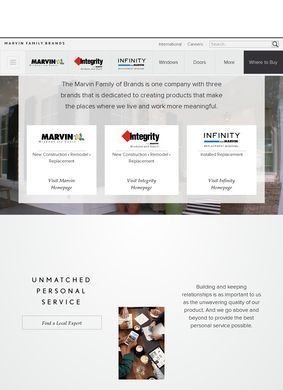
Marvin still makes windows in Warroad, Minnesota, the same small town near the Canadian border where the family started building them more than a century ago. That fact tells you a lot about the company before you read a single product page. A manufacturer with deep roots in one place, still family-owned after 110-plus years, and it has spent that time narrowing in on two things: windows and doors built to order, sold through a network of local dealers instead of off a shelf.
Nine window styles and eight door types
The catalogue backs up the longevity. There are nine distinct window styles on offer, covering the obvious workhorses (double hung, single hung, casement, glider) alongside shapes that show up less often in a standard lineup, such as corner windows, bay and bow assemblies, awning units, and direct-glaze picture windows for spans of fixed glass. Doors run a parallel range of eight types, from everyday entry, interior, sliding and swinging units up to lift-and-slide and multi-slide systems meant for big openings, plus a commercial line. If you are renovating an old house or building something contemporary with a wall of glass, the type you need is probably in here somewhere.
Material options beyond vinyl or single wood
Where Marvin gets genuinely interesting is materials. Plenty of makers stick to vinyl or a single wood option. Here you can choose natural wood, aluminum, a high-density fiberglass composite, or the company's own Ultrex fiberglass, a proprietary pultruded material that Marvin leans on heavily in its more affordable lines. Being able to pick per project, not per brand, is a real advantage for an architect or a serious homeowner, because fiberglass and wood behave very differently over decades of weather.
Five collections organized by intent
The product range is grouped into five named collections, and the naming does real work instead of just dressing up a catalogue. Ultimate is the top tier, pitched at maximum design flexibility and custom work. Modern is built around expansive glazing and thermal performance, aimed at clean contemporary builds. Vivid emphasizes large sizes and energy efficiency. A fourth named line pairs wood interiors with more traditional exterior styling, a sensible middle ground for buyers who want warmth inside and a familiar look outside. Essential is the streamlined, all-Ultrex line for buyers who want durability without the premium price of the flagship range.
That structure does something subtle but helpful. Instead of asking a visitor to compare dozens of individual SKUs, it sorts the whole offering by intent: budget-conscious, design-forward, traditional, or no-compromise. A contractor pricing a spec house and a designer specifying a coastal home with impact-rated glass can both find their lane quickly. I appreciated that the impact-rated and historic-renovation applications are called out specifically, because those are exactly the jobs where a generic window will fail an inspector or a preservation board.
Beyond the core lines, Marvin sits at the center of a small family of related brands. Infinity by Marvin and Infinity Replacement windows handle the retrofit market, and TruStile covers interior and entry doors as a dedicated door brand. There is also a connected-home technology section, which shows the company is at least trying to keep pace with automated shades and smart-glass integration rather than treating windows as static hardware.
For professionals the site offers more than showroom photos. A resource center collects energy-performance data and technical specifications, the documentation an architect needs to write a spec or hit an energy code. An inspiration gallery runs case studies of completed projects, and there is a physical brand experience center, Marvin at 7 Tide, operating in Boston for anyone who wants to handle the products in person. That blend of downloadable technical depth and a real-world space to touch the goods is more than a lot of manufacturers bother with. For those researching through a business directory, the detail here is enough to qualify Marvin as a serious option before any dealer visit.
How does the dealer network affect your purchase?
One structural point is worth being clear about: Marvin does not sell to you directly. Everything moves through a dealer network, so the website functions as a catalogue and a research tool rather than a store. For a custom, made-to-order product that arrangement makes sense, since measuring, ordering and installing windows is local work. But it does shift the buying experience away from the brand and onto whichever dealer you land with, and the quality of that dealer will shape how the whole thing actually goes.
That dealer-routed model also explains the contact setup, which is the weakest part of the experience. The homepage does not put a phone number or an email in front of you. Instead you are pushed toward a dealer locator tool and a Support Center page, with no direct line to the brand offered up front. For a company this established that feels like a deliberate funnel toward local partners, and it works fine if you know to look for the locator. A visitor expecting to reach Marvin directly will come away without a number or an address, and that is a fair thing to flag.
Mixed reputation across consumer platforms
The reputation across third-party platforms is genuinely mixed, and pretending otherwise would do a reader no favors. On PissedConsumer the picture is rough: around 226 reviews averaging roughly 1.6 out of 5. Yelp's brand-level aggregate sits at about 2.8 out of 5 across 26 reviews, while the Warroad location page collects 63 reviews of its own. Trustpilot carries reviews too, though a clear star figure did not surface. There is a brighter outlier on Angi, where a single Chapel Hill showroom scores a perfect 5, but that is one location and a small sample, so it does not change the overall picture much either way.
Those numbers deserve context. Complaint-driven platforms like PissedConsumer skew negative by design, and a custom-installed product that depends on third-party dealers and contractors will absorb a lot of frustration that has more to do with installation, lead times and warranty handling than with the windows themselves. Editorial coverage from This Old House and Ringsend.com is more measured and treats Marvin as a serious, high-quality maker. The honest read is that the product reputation among professionals is strong while the consumer-facing service experience is uneven, and a lot depends on the dealer you work with.
Set Marvin against Andersen, the other big American name in this space, and the comparison comes down to character. Both are long-established, both build across wood and fiberglass-style composites, and both run dealer networks. Marvin tends to push further on custom sizing, specialty shapes and the architect-grade end of the market, which is where its century of made-to-order work shows. If you want maximum design freedom and are prepared to vet your local dealer carefully, Marvin is a strong choice. If you simply want a known quantity through a broad retail footprint, Andersen may feel easier. The product quality here is earned where it counts, even if the service layer around it is less consistent.