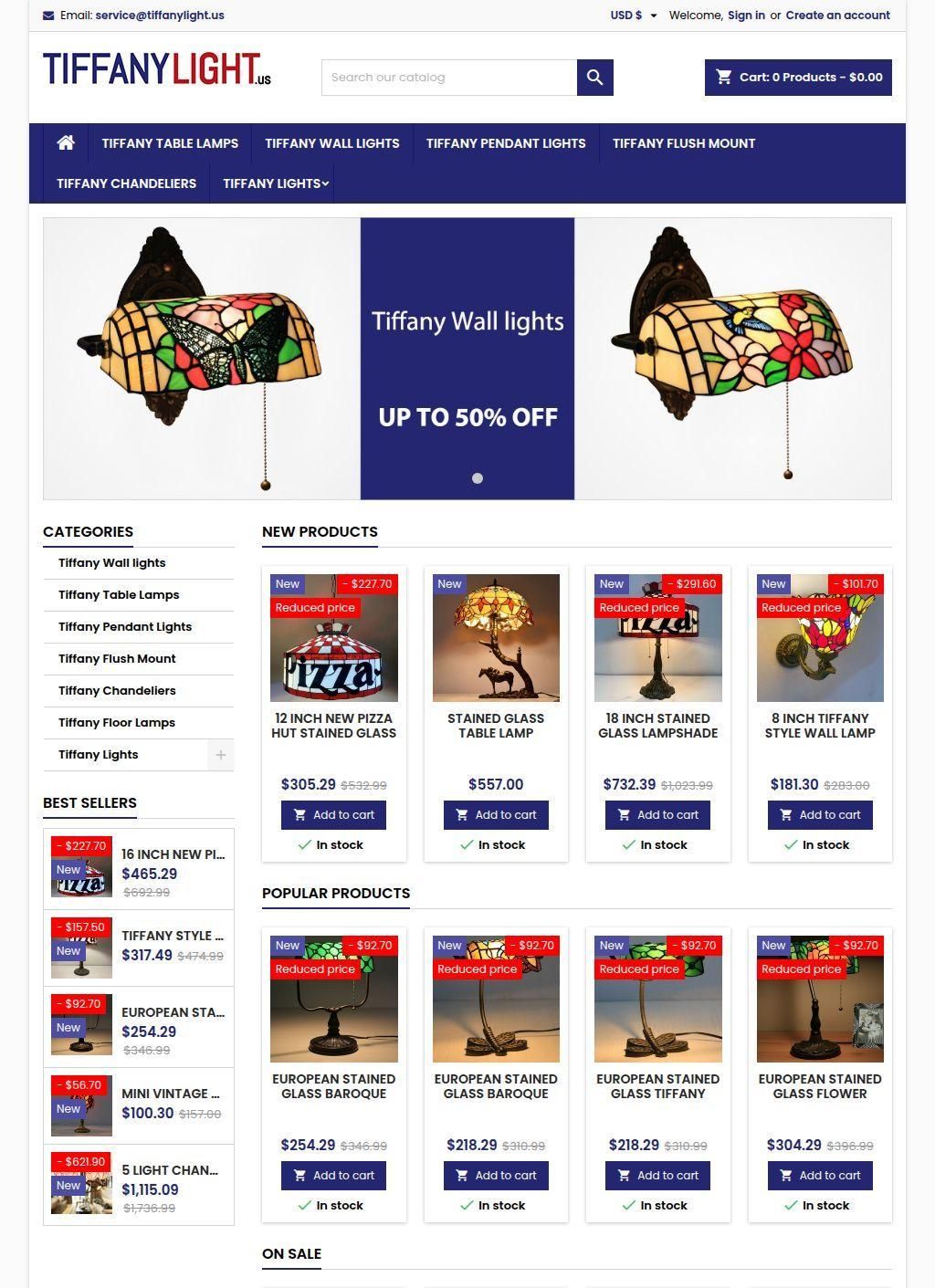
That currency switcher near the top of tiffanylight.us tells you a lot about who this shop is chasing before you have scrolled past the first row of lamps. It prices in dollars, euros, pounds and Swiss francs, which is an unusual reach for a store that presents itself as a US retailer of stained-glass lighting. That breadth of checkout currency sits oddly next to the rest of Tiffany Lighting US, where the trail back to a real company is faint. So the first impression is mixed: a polished storefront that wants to sell to half of Europe, and very little underneath it that proves who is shipping the parcel.
Product range and collection structure
What the shop sells is clear enough. The catalogue runs through table lamps, floor lamps, wall sconces, pendant lights, flush mount fixtures and chandeliers, all in the leaded, stained-glass Tiffany idiom. Pieces are grouped into named collections, so you can browse by motif: Sunflower, Rose, Baroque, a Mediterranean line. Each piece is described as handcrafted stained glass, which is the heart of the pitch. Whether that craftsmanship holds up in the hand is exactly the kind of thing a buyer cannot verify from photographs, and Tiffany Lighting US gives no maker detail, no studio, no named artisans to anchor the claim.
Handcrafted stained glass claims
For anyone who already loves this style, the range is the strongest part of Tiffany Lighting US. A shopper who wants a dragonfly or floral shade in a specific room can move quickly: pick the fixture type, then the collection, then the colourway. There is a Best Sales section and a New Products feed, the two merchandising shortcuts most of these catalogues lean on, and they do the job of surfacing pieces without much digging. The collection structure is genuinely easier to navigate than the sprawling grids many lighting sites dump on you.
Buying guides and blog content
Around the product pages sits a blog covering decorative lighting styles and buying guides. On a category like this, that content earns its keep, because a first-time buyer of Tiffany-style glass usually does not know how to judge shade size against a table, or how a leaded panel ages. Whether the articles are deep or just SEO padding is hard to say from the outside, but a buying guide aimed at a nervous newcomer is a sensible thing to host, and it slightly softens the anonymity of the rest of the operation. Tiffany Lighting US appeared in a business directory search that turned up the site, but finding much else about the company behind it took more effort.
Return policy and shipping terms
The practical commerce terms are laid out plainly. Shipping is free over $149, returns run on a 7-day window, and customer accounts keep order history. That 7-day return policy is worth pausing on. For fragile, decorative glass bought largely on how it looks lit up in your own room, a single week is tight, and it is shorter than the windows many furniture and lighting retailers now advertise. It is not hidden, which counts for something, but it puts more of the risk on the buyer than is comfortable for an object that can disappoint once it is out of the box.
Multi-currency checkout is the feature that makes Tiffany Lighting US feel built for cross-border sales. Paired with customer accounts and saved order history, the checkout machinery is more developed than the company's own visibility. The site also advertises 24/7 customer support, a claim that is easy to print and hard to confirm. The only channel backing it up is an email address, service@tiffanylight.us. Round-the-clock support usually implies live chat or a phone line staffed in shifts, and neither is in evidence here.
Company transparency issues
There is no phone number on the site and no physical street address, so the email is the single thread connecting a customer to whoever runs Tiffany Lighting US. For a store moving breakable goods internationally, with a return clock already ticking fast, the absence of a phone line or a stated location is the detail that keeps snagging attention. A contact form would cover the email-only setup well enough, but a buyer with a cracked shade in hand wants to know there is a real address the package can go back to.
The About Us page leans on heritage language, describing the business as committed to the Tiffany artistic tradition. That is reassuring in tone and empty in fact: it names no founding story, no workshop, no people. The brand borrows the prestige of the Tiffany name, as countless lamp sellers do, without showing the seams of its own operation. None of that makes the lamps bad. It does mean a shopper is trusting the photographs and the checkout, and little else.
Absence of third-party reviews
This is where Tiffany Lighting US gets harder to vouch for. A search for outside reviews of the .us domain turns up nothing on Google, Trustpilot, Yelp or the BBB. The results that do surface belong to other businesses entirely: tiffanylight.co.uk carries a small, mixed-to-negative Trustpilot presence, and it is a UK domain unconnected to Tiffany Lighting US; tiffanylightingdirect.co.uk is a separate UK retailer with its own Feefo and Google reviews; Meyda Tiffany Lighting is a physical store reviewed on Tripadvisor. These names are easy to conflate, and none of that feedback attaches to this shop.
The homepage does carry testimonials, but on-site testimonials are the one form of praise a store fully controls, and they cannot be checked against anything. The honest position is that Tiffany Lighting US has no independent track record that turned up in a search, good or bad. Plenty of legitimate niche stores fly under the review radar, and a new entry can simply be early. It does leave a first-time buyer with no outside voice to lean on.
The collection range is real, the merchandising is tidy, and the buying-guide content shows some care for the inexperienced shopper. Against that sit a fast return window, a support promise with only an inbox behind it, no phone, no address, and a complete absence of third-party verification. If the lamp arrives as pictured, none of that will matter much. The unease is over what happens if it does not, and on that question Tiffany Lighting US gives a cautious buyer almost nothing concrete to go on.
Important pages
Business address
Tiffany Light USA
United States