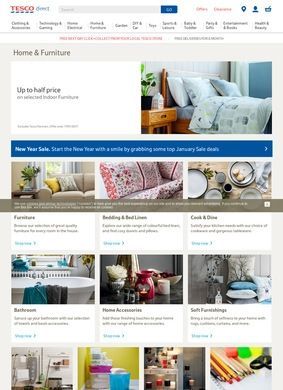
This listing was built around a furniture department that no longer exists as its own shopfront. The address points at Tesco Direct, the standalone online store the supermarket ran for non-food goods, and that operation has been wound down. A shopper who follows the old link today lands nowhere useful at all. Tesco: Furniture, as a distinct destination, is effectively gone, and what replaced it works on a completely different model.
Where the furniture lives now
Furniture shopping under the Tesco name has moved inside the grocery site, sitting in a marketplace section alongside the weekly food shop. So the browsing path that once led to a dedicated department now runs through category pages like Living Room Furniture within that marketplace. The old Tesco: Furniture link is stale now; the goods themselves carried on, just under a new roof.
The shift changed what Tesco: Furniture actually is. The old department sold a supermarket's own range, chosen and stocked by the retailer. The current section operates as a marketplace of outside brands, with the retailer providing the storefront and the checkout while other companies supply and ship the goods. For anyone who bookmarked the original store expecting a Tesco-branded catalogue, that is a meaningful change in what they are buying and from whom.
A marketplace of third-party sellers
The brands on display make the change obvious. Names that surface across the current listings include URBNLIVING, HOMCOM, COSTWAY and a label trading simply as "12," none of them the supermarket's own. Product pages spell out the arrangement plainly: items are "sold and sent by trusted sellers" and shipped directly to the customer. That is a consignment-style marketplace, closer to how a large online mall works than to a single retailer's warehouse.
For a buyer, it means the Tesco: Furniture name on the page is really a promise about the platform and the payment, while the actual maker, dispatch and after-sales handling sit with whichever seller listed the piece. The supermarket lends its checkout, its returns machinery and its reputation to the transaction, and the third party does the rest. In practice, Tesco: Furniture is the shop window and the till, and the brand a shopper is trusting for the sofa itself is the one printed lower down the page.
There is nothing wrong with that arrangement, and plenty of large retailers run the same way, but it changes the questions a careful buyer should ask. Delivery times, build quality and how a return is handled all depend on the individual seller, and two listings side by side on the same page can behave nothing alike.
Categories and colour filters
Tesco: Furniture organises its range the way any furniture site would. Living-room furniture is the anchor category, joined by benches and hall furniture, modular bookcases and shelving units, and entertainment centres for a television setup. Shoppers can narrow the results by brand and by colour, with swatches such as Black, Blue, Bronze and Brown offered as filters.
It is a conventional, workable structure, and the filtering by brand is quietly useful once you understand the marketplace model, since choosing a brand is really choosing which seller you are dealing with. Nothing about the browsing experience is unusual once you accept that Tesco: Furniture is a curated shelf of other companies' products rather than a house-designed collection.
The supermarket's own pieces
The marketplace is not the whole story. Alongside the third-party listings, the supermarket still puts its own name on some furniture and furniture-adjacent goods, which is where Tesco: Furniture keeps a foot in own-brand territory.
The clearest example sits outdoors. Coverage of a Tesco garden furniture deal describes own-brand rattan and garden furniture sets sold under the supermarket's label, the sort of seasonal patio range a big grocer rolls out for summer. There is also a Tesco Wooden Furniture Polish, an own-label care product for keeping wood looking right. It is a small detail, but it shows Tesco: Furniture still attaches to physical own-brand goods and has not become purely a hosting platform for other sellers.
Garden and rattan sets
The garden range is worth separating out, because it is the part of Tesco: Furniture most likely to be genuinely own-brand and price-led. Rattan-effect seating sets and patio pieces of the kind grocers discount heavily in season are what the coverage points to. A buyer after an inexpensive outdoor set, bought in the same trip as the groceries, is the natural customer for that corner of the range.
It behaves less like the third-party marketplace and more like the supermarket's traditional seasonal general-merchandise push, the aisle of paddling pools and barbecues that appears every May. That is familiar ground for a grocer, and it is probably the safest thing to buy here, since the returns and the accountability sit squarely with the supermarket.
What outside reviews still cover
Reputation is the murkiest part, and it is murky for a specific reason: the reviews that exist mostly attach to the old Tesco Direct storefront, not to the marketplace section that carries Tesco: Furniture today.
Reviews tied to the old storefront
Trustpilot hosts a body of reviews filed under the tescodirect.com domain, and the count runs into the high hundreds; one page references 492 reviewers, with listing pagination pointing at 487 in total. The star average did not appear in what was retrieved, so the number to hold onto is the volume, not a rating. Reevoo, a verified-customer aggregator, carries product reviews for items listed as "Tesco Standard" furniture, though again no aggregate score came through.
Over on MoneySavingExpert, a forum thread works through buyer experience with Tesco Direct furniture, including the practical question of viewing a sofa before buying, but a discussion thread is opinion swapped between shoppers, not a rating anyone can bank.
All of that describes a storefront that has since closed. It says little about whether ordering a URBNLIVING shelf through the current marketplace will go smoothly, since that transaction is really with the third-party seller, and the review trail for those individual sellers is exactly what a shopper cannot see from the Tesco: Furniture page. A big historic review count on a defunct domain can read as reassurance when it is really just history.
The high-hundreds figure on Trustpilot does suggest the old operation moved serious volume, but volume from a closed shop is a weak guide to how a purchase placed through the current marketplace will actually go.
Contact is another blank. The listed page returned a 403 and the backup fetch failed with a server error, so none of the usual signals, a phone number, an address, a contact route, could be checked first-hand. What can be said is that any real support here splits in two: the platform side handled by the supermarket's general customer service, and the item side handled by whichever seller shipped the goods.
The practical picture is a stale link, a name that now sits atop other companies' furniture, and a small own-brand corner mostly out in the garden. The reviews that pile up impressively on Trustpilot belong to a shop that has closed. Tesco: Furniture is no longer a furniture retailer in the old sense, and when a sofa arrives from a third-party seller with something wrong, the supermarket whose name is on the page and the company that actually packed the box are not automatically the same one to call.