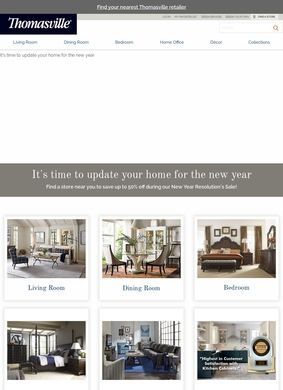
A shopper who has already settled on Thomasville lands on the homepage to price a sofa or plan a kitchen, and the first thing the site does is force a choice of lane. The navigation splits in two: Cabinetry on one side, Furniture and Rugs on the other. Choosing cabinetry hands a visitor off entirely to a separate address, thomasvillecabinetry.com, a jarring move for a brand presenting itself under one name. Staying on the furniture path keeps a visitor on site, until a line of Woodcare products routes them back out to Amazon.
The immediate experience is closer to a switchboard than a store. It directs traffic toward other destinations without offering much of its own. That could work if those destinations were rich, but the homepage itself carries almost nothing a buyer can act on. There is no product-line detail, no design service described, no delivery or financing information, and no store locator. A customer who arrived with a concrete task leaves the landing page knowing little more than which brand family they are in.
What the homepage gives a buyer
Strip the site down to what is verifiably present and the list is short. Thomasville is a furniture brand, and the page confirms that much: the brand itself, the two product directions, the Woodcare line on Amazon, an Hours section, social links to Instagram, Facebook, TikTok and Pinterest, and the standard legal pages. A trademark notice states that the Thomasville mark belongs to HHG IPCo, LLC, which quietly confirms the name sits inside a holding company's portfolio. That single line explains a lot about why the site behaves the way it does.
None of the things a furniture buyer usually wants first are here. A person deciding between two sofas needs dimensions, materials, prices, a way to see the piece in a room. Thomasville puts none of that on the front page, and the absence is hard to read as anything but a deliberately minimal landing page that assumes a shopper will go elsewhere to actually shop.
Furniture, rugs and cabinetry, split across sites
The product story is real, but it is scattered. Furniture and Rugs is the section that stays home, cabinetry lives on its own dedicated site, and woodcare is an Amazon purchase. For a shopper this fragmentation carries a practical cost: comparing a Thomasville dining set against the brand's own cabinetry means bouncing between two separate sites that do not share a cart or, from what the landing page shows, a consistent shopping flow.
Thomasville behaves less like a single retailer and more like a licensing umbrella that points a shopper toward wherever each product happens to sell. There is a logic to that if the cabinetry and the furniture are run by different operators under one licensed name, which the trademark line hints at, but the site never explains the arrangement, so the shopper is left to infer it from the way the links scatter.
A buyer who just wants a coffee table should not have to reverse-engineer a corporate structure to figure out where to click.
The Hours section is the oddest touch. Hours normally attach to a store or a phone line a customer can use, yet the page pairs them with neither a location nor a number, so they float without an obvious thing to apply to. I kept hunting for the store or the contact route those hours implied, and never found it.
That gap counts for more here than it would for many brands, because furniture is exactly the category where a buyer expects to phone someone, visit a showroom, or track a delivery, and Thomasville gives a first-time visitor no clear way to do any of it.
What the ratings say
Off the site, the picture on Thomasville gets harder. On Yelp the brand page averages 2.1 out of five across 118 reviews, with the summary calling customers generally dissatisfied. ConsumerAffairs carries user complaints centered on cabinet alignment and product-quality defects, which lines up uncomfortably with the cabinetry half of the business. PissedConsumer runs harsher still: one listing shows 263 reviews at an average of 1.7, and the same source snippet also cites a 1.7 rating based on 62 customers, two figures sitting on one page without being reconciled.
Whichever count is right, the score lands near the floor. The two platforms tell a consistent story: a 2.1 on one site and a 1.7 on another are too close together to blame on one outlier stirring up trouble. They point the same way, and the specific complaints, alignment and defects, are the sort a furniture buyer cares about most, because they surface after the money is spent and the piece is in the house.
One distinction keeps this fair. The Glassdoor numbers that also surface are employee reviews, not customer ones, so they measure the workplace and not the furniture: 2.8 for work-life balance, 2.4 for culture and values, 2.2 for career opportunities, and 28 percent of employees saying they would recommend working there to a friend. Those belong in a separate column from the buyer complaints, and folding them together would misstate the case against Thomasville. Kept apart, they still do not flatter the company, but they speak to life inside it, not to how a sofa holds up.
Set the consumer ratings beside the missing contact details and a pattern forms. Buyers report defects and alignment trouble, and the exact channel a frustrated customer would reach for, a phone number, an address, a contact page, is the thing the Thomasville homepage does not provide. Even a bare-bones business directory entry usually manages a phone number for a complaint; this homepage does not get that far.
A brand selling physical goods that people will eventually want repaired or replaced ought to make itself easy to reach, and this one does not, at least not from where a visitor starts. The result is a listing where the complaints and the silence reinforce each other.
There is a charitable reading, and it deserves airing. A holding company that licenses the Thomasville name may run genuine, well-managed storefronts that the front page simply never surfaces, and the low scores may skew toward the loudest unhappy buyers, as review platforms often do. Trademark portfolios frequently keep a deliberately bare public site and push real commerce to partners. If that is the situation, the furniture could be fine and the web presence is just doing the brand a disservice.
The trouble is that the charitable reading and the damning one look identical from the homepage, and the burden of proving which is true should sit with the seller, not the shopper.
That leaves real doubt hanging over Thomasville. The name is still a recognizable one in furniture, and there may well be perfectly good furniture behind it, sold through channels the homepage never troubles to explain. A shopper cannot verify that from the site itself, cannot easily reach anyone to ask, and cannot wave off a run of low ratings and defect complaints all pointing the same way.
Whether Thomasville is a heritage maker worth trusting or a trademark licensed out to storefronts nobody here can vouch for is a question the site leaves wide open, and nothing on that landing page comes close to settling it.