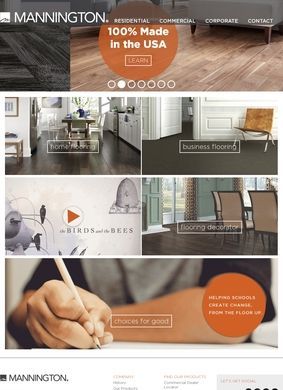
Mannington is a New Jersey flooring manufacturer that sells residential floors across several categories and has been under the same family since 1915. The company runs on a fifth-generation, family-owned story, and it points out that its styles are designed in the USA with most products made here too.
That heritage sits alongside a fairly wide catalog: luxury vinyl under the ADURA, ADURAMax, and ADURA APEX names, laminate, hardwood, luxury vinyl sheet, and resilient flooring. A shopper landing on the site can move from the marketing story into actual product lines without much friction, and the navigation does not bury the categories behind a wall of lifestyle imagery the way some flooring brands do.
What the catalog covers
The hardwood side is where the naming gets specific. Collections such as Sanctuary, Chateau, Park City, and Riverwalk give the wood ranges some identity instead of a generic "hardwood" bin, which helps when you are trying to remember what you looked at last week. Laminate and resilient sit as their own categories, and the luxury vinyl tiers are split clearly enough that you can tell ADURA APEX is meant to sit above the plain ADURA line.
For a buyer, the breadth is the first thing that registers: Mannington is trying to cover the whole spread of hard-surface flooring under one roof, from budget-friendly laminate up through engineered wood.
That breadth has a downside worth naming. When one brand spans this many categories, quality can vary line to line, and the outside reviews later in this write-up bear that out. A collection name tells you the look, not how the surface holds up after five years of a dog and two kids. The site leans on the design story more than on the technical detail a picky shopper eventually wants, so specs like wear-layer thickness and finish type take some digging.
Luxury vinyl is plainly the headline. Three ADURA variations dominate the site, and the tiering reads as a good-better-best structure aimed at different budgets and wear expectations.
Sheet vinyl rounds things out for buyers who want a continuous surface, and the resilient category overlaps with that in a way the site does not always make crisp. Someone new to flooring terms may need a minute to sort resilient from luxury vinyl, since the industry uses those words loosely and Mannington does not fully untangle them.
Tools that help you choose
Two features do real work here. The Floor Finder quiz narrows the field by asking what you care about, and the Virtual Decorator lets you drop a product into a room image so you are not guessing how a plank reads at scale. Visualization tools like this are common now, but they matter more for flooring than for most purchases, because a small sample chip tells you almost nothing about how a floor fills a whole room. Pair that with the Find a Store locator and the path from browsing to buying is reasonably short.
There is also a blog with educational content, which fits a company selling a product most people buy two or three times in a lifetime. Someone who does not know the difference between engineered and solid wood, or why an underlayment matters, can get grounded before walking into a store. It is the kind of supporting material that lowers the odds of a mismatched purchase, and Mannington keeps it reasonably free of hard-sell language.
The distribution reality and how to reach them
Mannington sells to homeowners directly in the sense that it markets to them, but the actual buying runs through flooring retailers. The store locator is the bridge, and it is the honest reflection of how this business works: you research on the manufacturer site, then buy and install through a dealer. That two-step shapes expectations: warranty and installation questions often land with the retailer first.
Reaching the company itself is straightforward. A phone line, 1-800 with weekday hours, is posted plainly, and there is a contact form alongside it. For a manufacturer that mostly works through a dealer network, having a direct number staffed during business hours is more than some competitors bother with. It also gives a buyer a fallback when a retailer stonewalls on a warranty question, which, given the complaint pattern below, is not a hypothetical worry.
Where the reputation gets complicated
This is the part a careful buyer should sit with. Outside feedback on Mannington skews mixed to negative. The BBB profile for Mannington Mills carries customer complaints centered on defective flooring and replacement disputes. ComplaintsBoard lists 23 complaints with an overall 1.5 out of 5. On FlooringReport.com, individual consumer reviews across the vinyl, wood, and tile lines run largely negative, with a run of 1-out-of-5 "Very Unsatisfied" ratings that cite scratching, warranty friction, and general quality gripes.
It is not a clean picture in the other direction either, and that cuts both ways. On trade and enthusiast corners like Reddit's r/Flooring, a Houzz forum thread, and a manufacturer review page from installer Uptown Floors, the tone warms up. Those sources describe the laminate as denser and better built than the cheap alternatives, and note the product has improved over the years. None of it comes as structured star ratings, so it reads more as installer and hobbyist opinion than as scored consumer data.
The people handling and installing floors tend to rate Mannington above the budget tier, while the aggregated consumer scores are rough, driven heavily by warranty and durability complaints. Both things can be true: a product can be solidly made and still generate a wall of angry reviews when claims get denied.
Reading the complaint pattern
The complaints cluster, and the cluster is telling. Scratching and warranty disputes come up again and again, which points less at random defects and more at a gap between what buyers expect a warranty to cover and what actually gets honored. Flooring warranties are notoriously narrow, and a lot of one-star reviews across this whole industry come from that collision. It does not excuse the pattern, but it does frame it: the anger is often about the claims process as much as the plank itself.
A buyer who takes the negative reviews seriously would do well to read the specific warranty terms closely, and to pin down with the retailer who owns a future claim.
Whether it is worth your shortlist
For a homeowner comparing mid-market floors, Mannington is a legitimate name to have on the list, with a broad catalog, useful selection tools, and a made-in-USA angle that some buyers weigh. The caution is equally real and should not be waved off: the aggregated consumer sentiment is poor, and it concentrates on exactly the things that ruin a floor purchase, durability and warranty support.
Set against a competitor like Shaw, which sells a similarly wide range through the same kind of dealer network and carries its own mixed consumer reviews, Mannington does not obviously win or lose on reputation. Where it can pull ahead is the family-owned continuity and the strength of the ADURA luxury vinyl line, which draws the warmer trade commentary. A reader who values that installer-level respect, and who reads the warranty closely before buying, will find plenty to like in Mannington.
One who buys mainly on aggregate star counts may steer toward a brand with cleaner numbers, though Shaw's own consumer reviews suggest those cleaner numbers are not easy to find anywhere in this category. In the end Mannington is a credible, long-standing manufacturer whose product earns respect from the trade and frustration from a chunk of consumers, and knowing which side you are likely to land on comes down to how carefully you read the fine print before the floor goes down.