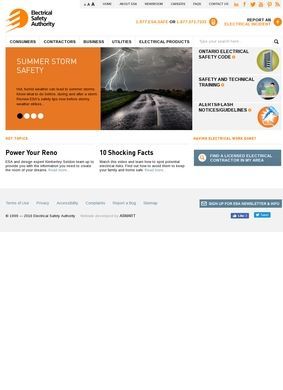
Running a podcast alongside statutory enforcement is an unusual combination, and the Electrical Safety Authority does exactly that, putting out "Grounded in Ontario" while policing electrical safety across the province. The mix sets the tone for the whole site, which is trying to talk to two very different audiences at once: the licensed trade it governs, and ordinary homeowners who have never heard of a Certificate of Acceptance until they suddenly need one.
Licensing for electrical contractors
For the trade, the substance is licensing. The Electrical Safety Authority administers the credentials that let people work legally on electrical systems in Ontario, covering Licensed Electrical Contractors and Master Electricians. The site handles exam preparation, the renewal cycle for existing licences, and the compliance enforcement that gives those licences real weight. A contractor who lets a licence lapse or skips a required notification is dealing with a body that can act on it, and the material reflects that seriousness without burying it in legalese.
Explaining certificates and inspections
Homeowners get a different door into the same organisation. The Electrical Safety Authority explains compliance inspections, walks through what a Certificate of Acceptance means, and offers electrical safety assessments. There is practical guidance on hiring a licensed contractor, framed around the moments people actually face it: a renovation, buying a house, selling one. That framing is sensible. Most people only think about electrical permits when a deal or a project forces the question, and pointing them toward licensed work at exactly that point is the most useful thing a safety regulator can do for the general public.
Inside the contractor locator tool
The contractor locator tool, hosted at its own subdomain, fits into this cleanly. Someone who has just been told they need licensed work done can check whether the person they are about to hire holds a valid credential. Pair that with the hiring guidance and the homeowner side of the Electrical Safety Authority starts to feel less like a set of warnings and more like a workable path from problem to vetted solution.
Programs for businesses and EV chargers
Businesses and property owners get their own track: the Continuous Safety Services program, electrical plan review, and guidance aimed at EV charger installations in condos and multi-residential buildings. The EV charger material is worth singling out because charging infrastructure in shared buildings is a genuinely messy area where electrical capacity, building governance, and safety rules collide. A regulator addressing it directly is filling a gap that property managers run into regularly and rarely find clear answers for.
Product recalls database
Product oversight rounds out the regulatory reach. The Electrical Safety Authority regulates the safety of electrical products and keeps a recalls database, which is the kind of resource most people never knew existed until a specific product turns up on it. A consumer checking whether a space heater or a charger has been pulled from the market has a single official place to look, rather than piecing it together from manufacturer notices.
Hazards and apprenticeship grants
Beyond the obvious duties, the programs branch out further than expected. There are powerline and storm safety resources covering seasonal hazards that most people underestimate. Special events and carnival electrical safety oversight is a narrow but real concern: temporary power at fairgrounds is exactly the sort of setup where corners get cut and no one finds out until something goes wrong. The ESA-ISEAD grant supporting Indigenous electricians entering the trade shows the Electrical Safety Authority sees part of its role as shaping who gets into electrical work, alongside enforcing rules on those already in it.
Behind the online service portals
The digital infrastructure backs all this up. An online services portal on a dedicated subdomain handles transactions, the licensing lookup tool sits on another, and an online store sells safety-related materials. Splitting functions across subdomains is a reasonable engineering choice for an organisation juggling licensing data, public content, and commerce, though it does mean a visitor can end up bounced between several properties depending on what they came to do.
The breadth is the strongest thing here, and it is also where the structure shows the pressure. An organisation that licenses electricians, inspects homes, reviews commercial plans, tracks product recalls, funds apprenticeships, and produces a podcast is carrying a lot under one banner. Each of those functions is legitimate and each clearly belongs to a safety regulator. The harder thing to judge from the outside is depth. A site can list the Continuous Safety Services program, the plan review service, and the storm safety resources and still leave a contractor or a property manager unsure how much actual guidance is behind a given page once they click in.
Can the regulator balance both roles?
There is also the tension built into the design. The Electrical Safety Authority is simultaneously the enforcer that can penalise a contractor and the friendly guide telling a homeowner how to pick one. Those roles do not always sit comfortably together. The enforcement side needs to read as firm and non-negotiable; the public guidance side needs to feel approachable. A site that leans too far either way risks losing one audience to keep the other, and from a single pass it is not obvious the Electrical Safety Authority has fully resolved which voice takes over when they pull in opposite directions.
And then there is the question of how current and complete the deeper layers stay. A recalls database is only as good as its last update. Exam preparation material is only useful if it tracks the code in force. Plan review and the safety services program are processes, and processes described on a page can lag what happens in practice.
What the Electrical Safety Authority does well is make its remit legible. Someone arriving with a vague worry about old wiring, a contractor due for renewal, or a condo board staring down an EV charger request can find the relevant track quickly. The licensing tools and the recalls database are concrete utilities, and that distinction matters for a body whose authority depends on people trusting it enough to act on what it says. A search for independent reviews of the Electrical Safety Authority turns up very little outside government and trade publications; the organisation's reputation appears to rest almost entirely on its statutory standing rather than accumulated public commentary, which is typical for a provincial regulatory body of this kind.
Whether the substance behind each program holds to the weight the organisation places on it is the part a visitor cannot verify from the offering list alone. The remit is broad, the tools exist and work, the audiences are clearly mapped. That is a reasonable foundation, but the gaps only become visible once someone is already depending on what is there.