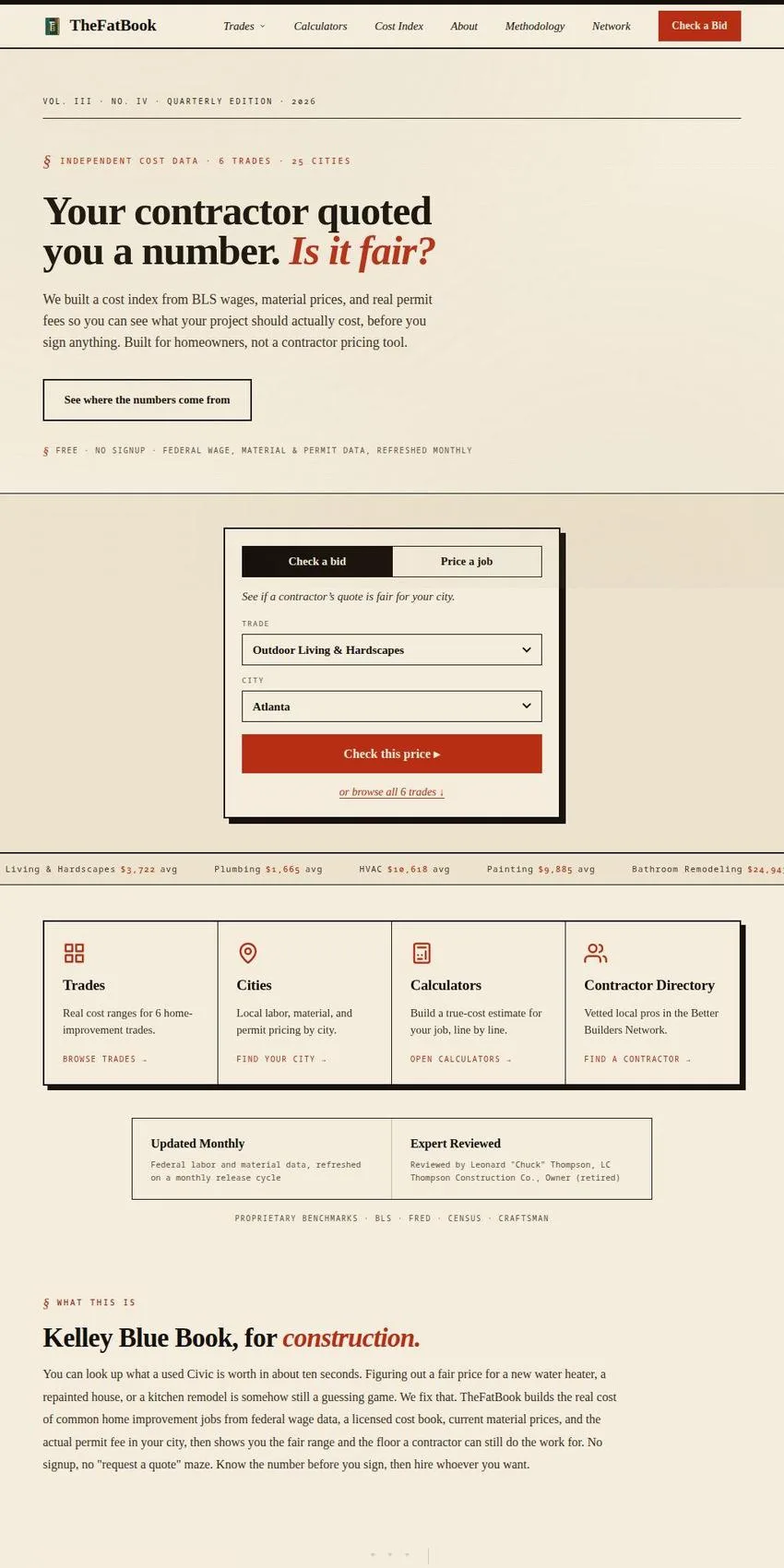
TheFatBook sits in the home improvement data niche, and its pitch fits in one sentence: it wants to be the Kelley Blue Book of construction. You can look up what a used car is worth in seconds, yet figuring out a fair price for a new water heater or a repainted house is still mostly guesswork and gut feeling. This site sets out to close that gap for homeowners, not contractors.
The platform is built around two connected tools. The Bid Fairness Checker takes the number a contractor quoted you and tells you where it lands against independent cost data for your city. The True Cost Calculator works the other direction, building an estimate for a job line by line before you've talked to anyone. Same data underneath, two different starting points.
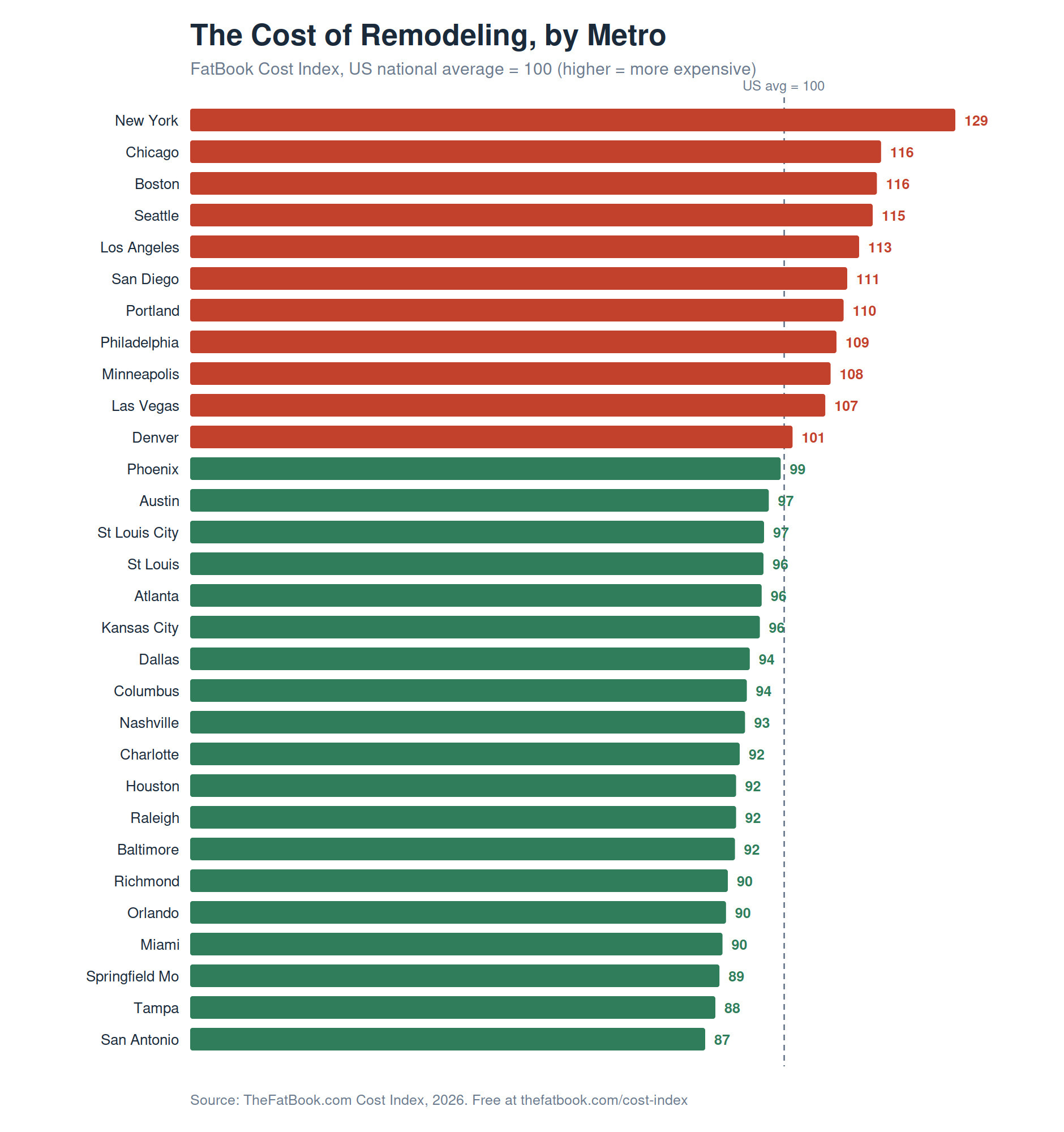
Coverage spans six trades: outdoor living and hardscapes, plumbing, HVAC, painting, bathroom remodeling, and kitchen remodeling. Each trade carries dozens of individual services, from concrete patios and tankless water heater swaps to full kitchen cabinet installs, more than 200 services in total across the catalog. All of it is priced for 25 US metro areas, from New York and Los Angeles down to smaller markets like Springfield, Missouri.
Here's the thing that separates this from the usual cost estimate sites. Most of them survey homeowners or scrape numbers from who knows where. TheFatBook builds each price from scratch, and the methodology page walks through the whole chain in a way anyone can follow. It's the kind of transparency you rarely see in this corner of the web.
The labor number starts with the Craftsman National Estimator, a licensed industry cost book that publishes the man-hours a trade actually books for a defined task. Those hours get multiplied by the median local wage from the Bureau of Labor Statistics, pulled for the exact occupation doing the work. A Chicago plumber and a Phoenix plumber don't earn the same, and the index reflects that. The wage then gets "loaded" with payroll taxes, workers' comp, and benefits, because a contractor pays well past the sticker rate for every hour on the clock.
Materials follow their own logic. Book prices get pulled to current levels using Producer Price Index series from FRED, and each material category tracks its own series rather than one blanket inflation number. If lumber spikes and copper holds steady, the deck price moves and the repipe price sits still. It's a bit like how grocery inflation works; eggs and bread don't rise in lockstep, so why would concrete and paint?
Permits get unusually careful treatment. The fees come from a dataset compiled by hand from published municipal fee schedules, the same one that powers a sister tool called PermitCalculator.com. Exemptions are tracked too, so when a city doesn't require a permit for a given job, the permit line reads zero on purpose rather than by omission. Anyone who has dealt with a city permit office will appreciate how much tedium that represents.
On top of direct costs sits overhead, set per trade using the NAHB Cost of Doing Business study, since equipment-heavy work carries different overhead than labor-heavy service calls. The result is what the site calls the "cost to deliver," the break-even a legitimate contractor can't dip below. A fair bid sits in a band above that floor, and the tools show where a quote lands within it. That framing does something quietly useful: it teaches homeowners that the cheapest bid isn't always the smart one, because a price below break-even usually means corners will get cut somewhere.
Regional adjustment is handled with similar restraint. Metro figures keep real local wages, hold materials at national pricing since a sheet of plywood costs roughly the same everywhere, and scale markup using the Department of Defense Area Cost Factors, a public construction index. The site even notes it would rather show a Sun Belt market slightly below national average and mean it than inflate numbers for drama.
Who's behind it? The cost index is built by David Olson, and the methodology is reviewed by Leonard "Chuck" Thompson, a retired high-end residential and commercial builder who ran his own construction company for decades. The disclosure around his role is refreshingly specific: he's paid a flat consulting rate, holds no equity, takes no referral cut, and has no relationship with any contractor or data source the site publishes. As a reviewer, I read a lot of "expert reviewed" badges, and this is one of the few that explains what the expert actually reviews and how he's compensated.
The data itself refreshes on a monthly release cycle, with the current index version dated and published on every page. Popular cost guides cover the jobs people ask about most, written with a practical angle, why ductwork labor eats such a big share of the bill, or why a concrete patio is really about the mix rather than the slab. Everything is free, with no signup and no "request a quote" funnel standing between you and the numbers.
There's a contractor side too, though it's kept separate from the data. The Better Builders Network is a directory of vetted local pros, and a dedicated contractor page explains how tradespeople can get involved. The site is clear that the index itself is built for homeowners and isn't a contractor pricing tool, which keeps the incentives clean.
One more detail worth flagging: the charts and figures are free to republish. Journalists, bloggers, and researchers can use any number from the index with a credit and a link back, and commercial licensing or bulk data access is available on request. That open posture suggests a team confident enough in its sourcing to invite scrutiny.
In my opinion, the most valuable thing here isn't any single number; it's the education baked into the structure. By showing labor, materials, permits, overhead, and margin as separate lines, the site turns an opaque lump-sum quote into something a homeowner can actually interrogate. You walk in knowing what questions to ask, and that alone changes the conversation with a contractor before a single dollar moves.

Business address
TheFatBook
1209 Mountain Road Pl NE, Ste N, , NM 87110,
Albuquerque,
NM
87110
United States
Contact details
Phone: 5056304468