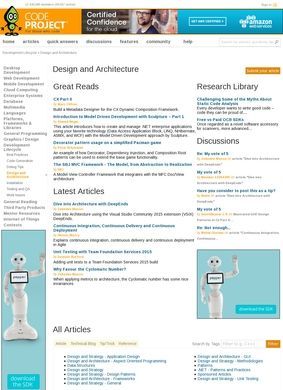
Is there still a working site behind this listing? Not anymore. The address that once pointed to the architecture knowledge base now resolves to a parked GoDaddy page, and the wider main domain has either shut down or is close to it. A fair review has to treat Code Project as a resource in the past tense, weighing what it was against the fact that the front door no longer opens.
Articles on design and architecture
For most of its life this was one of the larger independent gathering places for working programmers. The figure that gets quoted is more than 66,000 peer-written technical articles, built up by contributors rather than a paid editorial staff, and a membership that at its peak was reported in the ten-million range. Free sign-up gave you the run of the place: full articles, downloadable source, discussion threads, and Q&A. That model, where developers wrote for other developers and the better pieces rose through peer review, is the thing worth remembering about it.
Practical code with explanations
The specific path under review, the /KB/architecture/ section, was the corner devoted to software design and system structure. It collected articles on design patterns, microservices, type systems, and the broader question of how to lay out a codebase that more than one person has to live with. These were not abstract think-pieces. The typical Code Project article paired an explanation with working code you could download and run, which made the site genuinely useful to someone trying to solve a real problem on deadline.
That practical bias is what separated Code Project from a lot of reference material. A developer searching for a concrete take on the repository pattern in C++ or a walkthrough of a messaging architecture in Java would land on a how-to with a sample project attached, comment threads underneath, and an author who usually answered follow-up questions. Depth varied, as it always does with crowd-sourced writing, and some entries were little more than a code dump with a paragraph of context. But the volume meant that obscure topics often had at least one decent treatment when nowhere else did, and the archive grew dense enough that a stubborn problem could usually be matched to someone who had already written it up.
Developer reputation and references
The reputation around Code Project is the reputation of a name that developers of a certain generation simply knew. Wikipedia carries an article describing it as a major developer community, and developer-focused outlets such as DEV Community and Muck Rack reference it as an established resource. Its Facebook page sits at over 45,000 likes. There are no Trustpilot, Google, or Yelp ratings in circulation, which fits the profile: this was a content and community site, not a vendor people rated for service, so star counts were never the measure here.
Quality through peer review
The credibility Code Project built was earned through years of usable material and a contributor base that policed quality through peer review and comment threads. When a name shows up across that many independent references without anyone needing to explain who it is, the standing speaks for itself. The harder fact is what has happened to that standing since the lights started going out.
Current status of the archive
Because here the verdict turns. A resource is only worth consulting if you can reach it, and the main route is gone. The articles that made Code Project valuable are not served from the parked domain, so a search result pointing at /KB/architecture/ leads nowhere useful today. Researchers who relied on it for design references have to treat this listing as a marker of something that was, not a live destination.
Forum activity persists
There is one thread of life left. A community forum at forum.codeproject.com appears to still be active, which means some portion of the discussion side may persist even as the article archive goes dark. That is a limited remainder against what the platform used to be, and it comes with no guarantee of longevity. Whether the archived articles survive somewhere accessible, through caches, mirrors, or a successor, is an open question this listing cannot settle.
So the honest position is split. As a record of what an independent developer community could build over two decades, Code Project was a genuine heavyweight, and the architecture section in particular held code-backed, problem-solving material that takes years to accumulate and is easy to take for granted. As a place to actually go right now, it has closed its main door. The 66,000 articles were the whole point, and their current home is the unresolved part of this story. If the forum survives and someone eventually mirrors the archive, Code Project may matter again in some form; on the evidence available today, it does not.