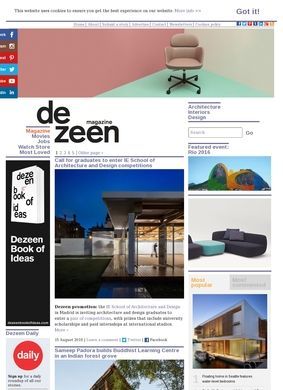
Dezeen Magazine is a London-based online publication covering architecture, interior design, and the wider design world, founded in 2006 by Marcus Fairs. The daily output is the engine of the whole operation: news on buildings and products, longer project features with full photo sets, interviews with architects and designers, and opinion pieces that take a position instead of summarising a press release. If you follow the field at all, you have almost certainly read a Dezeen Magazine story without going looking for it, because so much of the design press cites or chases what runs here first.
Design coverage beyond architecture
The editorial scope is broader than the architecture label suggests. Alongside buildings, the site runs sustained coverage of interiors, product design, graphic design, fashion, and technology, which keeps it from feeling like a trade newsletter for one profession. A reader can land on a housing scheme in one tab and a lighting collection or a typeface in the next. Video features sit beside the written pieces, so a project that benefits from movement (a kinetic facade or a workshop process) gets treated that way instead of being flattened into stills. That willingness to follow the material where it leads has kept Dezeen Magazine from hardening into a single subject over close to two decades.
Dezeen Awards judges international design work
Beyond the rolling articles, Dezeen Magazine has built out several standing sections that each do something distinct, and they are worth walking through carefully. The clearest one is the Dezeen Awards, an annual international competition spanning architecture, interiors, and design. Categories run across residential, commercial, and public architecture, plus furniture, lighting, and product design, so a small studio entering a single chair and a large practice entering a civic building are both accommodated in the same cycle. Running an awards programme at that breadth gives Dezeen Magazine a yearly judged snapshot of what the field considers strong work, and that judged layer is what most news feeds never attempt.
Dezeen Jobs board for design careers
Then there is Dezeen Jobs, the magazine's board aimed squarely at the design and architecture industry. It is the kind of utility that keeps professionals returning between the headline stories, because hiring in these disciplines is specialised enough that a general jobs site rarely serves it well. A studio looking for a junior architect and a graduate looking for a first interiors role end up in the same place, which over years builds a useful concentration of the right listings. A business directory for design talent, essentially, carved out of a publication rather than bolted on as an afterthought.
Events guide and product showroom
The third section, Dezeen Events Guide, is a global listing of design events, exhibitions, and trade shows. For anyone trying to plan a year around the major fairs or catch a smaller exhibition while travelling, a single maintained calendar saves a lot of scattered searching. I have always found this sort of consolidated guide more useful than the individual event pages it points to, because events rarely coordinate their own publicity well. Dezeen Showroom rounds out the set as a browsable product reference for design brands, sitting close to the editorial side without pretending to be it. A reader researching a specific furniture type or fixture can use it as a starting catalogue and follow the threads back into the magazine's coverage of the same makers.
Taken together, these four sections turn Dezeen Magazine from a place you read into a place you use. None of them feels bolted on, because each one draws on the same audience the articles already gather: architects, designers, students, and a general readership that cares about how things are made and how spaces work.
That audience mix shapes the tone. The writing on Dezeen Magazine stays accessible enough that someone outside the profession can follow a story about structural engineering or material reuse, while keeping enough specificity that practitioners are not bored. Striking that balance daily is harder than it looks, and it is probably the single reason the publication reaches so far beyond its core trade.
Reporting design projects worldwide
The international framing of Dezeen Magazine matters too. Coverage is not anchored to British or even European work, so a given week might pull projects from Japan, Mexico, and Scandinavia into the same stream. For a student trying to understand how design problems get solved differently across climates and cultures, that spread is genuinely instructive in a way a nationally focused outlet cannot match. Operating out of London but reporting globally is the posture, and it shows in the range of studios that appear.
How much content does Dezeen Magazine publish?
If there is a fair caution, it is one of volume. Dezeen Magazine publishes a great deal, and the speed that makes it useful as a news source also means a casual visitor can feel overwhelmed. The section structure helps here, because the Architecture, Design, and Interiors landing areas let a reader narrow to one discipline instead of taking the full feed at once. Treating it as a reference to dip into by section, or through the standing platforms, gets more out of it than trying to read the front page top to bottom.
The interviews and opinion pieces are where Dezeen Magazine does work that project documentation alone cannot. A new building can be recorded anywhere, but a sustained conversation with the people behind it, or a columnist arguing about where the discipline is heading, gives the field somewhere to think out loud. Over close to two decades, that running commentary has become part of how the design world talks about itself.
Archive as a research resource
For a student, the archive is the quiet asset. Years of project documentation, awards results, and interviews accumulate into a searchable record of contemporary design that few institutions maintain so openly. Someone researching a particular architect or tracing how a material moved from experiment to mainstream can follow that history through the magazine's back catalogue instead of reassembling it from fragments. The graphic design and fashion coverage is easy to overlook given how much attention buildings get, but it is part of what keeps the publication honest about how disciplines bleed into each other. A piece on a brand identity often sits a click away from a story about the studio that made it.
Technology coverage plays a similar connective role. New fabrication methods, materials research, and the digital tools shaping contemporary practice get reported alongside the finished work they make possible, so a reader of Dezeen Magazine sees the means and the result together. Keeping that thread visible is more useful than relegating it to a separate trade section nobody visits.
No significant user-review aggregates have accumulated around Dezeen Magazine, which is typical of media brands. The publication's standing in the field comes from its influence on how projects get covered and discussed rather than from star ratings, and that influence is easy to check by looking at what the broader design press cites. What ends up defining Dezeen Magazine is breadth held at a consistent standard: architecture, interiors, products, graphics, fashion, and technology, reported daily, judged annually through the Awards programme, and supported by a jobs board, an events guide, and a product directory that each serve the same readership for a different practical need.