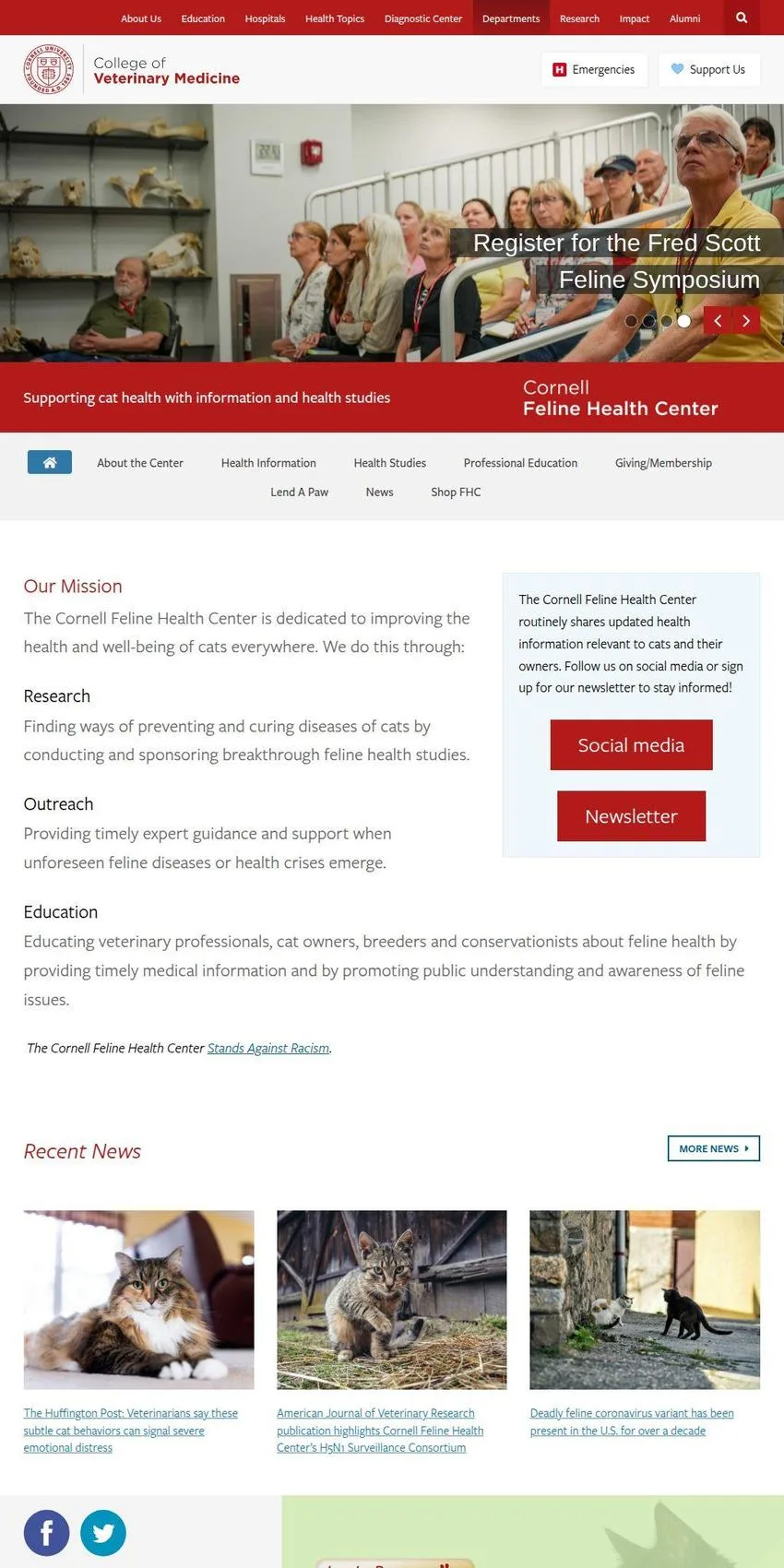
History and mission
The Cornell Feline Health Center is a research and education unit within the Cornell University College of Veterinary Medicine in Ithaca, New York. It grew out of a proposal by Dr. Fredric W. Scott, a veterinary virologist who wanted an organization devoted entirely to the study, prevention, and cure of cat diseases. In 1974 the university's trustees voted to establish the donor-supported Feline Research Laboratory within the Department of Microbiology, and Dr. Scott became its founding director, a role he held for twenty-three years. The unit took its present name in 1981.
When it opened, the laboratory was the first organization in the United States dedicated only to feline health. The center marked fifty years of work in 2024, and in 2025 the college honored Dr. Scott's legacy, crediting his role in shaping feline medicine and in building the center into a lasting institution. Its stated mission is to improve the health and wellbeing of cats everywhere by finding ways to prevent and cure their diseases, by informing veterinarians and owners with timely medical information, and by helping the profession respond when new or poorly understood illnesses appear.
The college that houses the center dates from 1894, when New York State established a veterinary college at Cornell, and it operates today as a statutory college within the State University of New York system. Its campus sits on Tower Road in Ithaca, where the center works alongside the college's teaching hospital, its diagnostic laboratory, and its academic departments. That setting gives the center access to clinicians who treat cats every day and to scientists who study animal disease at the bench.
Research on cat diseases
Much of the center's identity rests on research. Rather than running a single laboratory, it funds and coordinates studies by scientists and clinicians across the college, an approach that lets it support work on many feline conditions at once. Over its history the center has contributed to the understanding of several diseases that shape how cats are cared for today.
Feline leukemia virus was an early focus, and work connected to the center helped clarify how the virus spreads and how vaccination and testing can limit it. Feline infectious peritonitis, a disease caused by a coronavirus that was long considered untreatable, has been another major area of study. Chronic kidney disease, one of the most common serious problems in older cats, also receives attention. In recent years the center has taken part in surveillance of H5N1 avian influenza, which can infect cats, reflecting its role during emerging disease events.
Education and information for owners
The center publishes health information written for people who live with and care for cats. This includes articles on common conditions, guidance on preventive care, and material that explains symptoms owners might notice at home. The aim is to give non-specialists accurate information they can act on, and to help them judge when a veterinary visit is needed.
A regular newsletter and a library of publications carry this material to a wide readership of owners, breeders, and shelter staff. Because the information is reviewed by veterinary professionals at a university college, it offers a dependable alternative to the unverified advice common online.
The center also maintains social media accounts where it shares new articles and runs an online shop whose merchandise supports its programs. Its staff appear in national media to answer questions about cat health and behavior, and its researchers publish findings in scientific journals, which keeps the outreach connected to current science.
Support for veterinarians
The center also works with the veterinary profession. It provides continuing information for practitioners, and it acts as a point of expert guidance during feline health crises, when clinicians and the public need reliable answers quickly. This professional role sits alongside the college's teaching hospital and its training of new veterinarians, so that research findings move into clinical practice.
Funding, membership, and relevance to pet care
From the beginning the center has been donor-supported rather than funded mainly by government grants. Gifts from cat owners and supporters pay for research and outreach, and a membership and giving program called Lend A Paw lets individuals contribute. Members receive health information and help sustain the studies the center sponsors. This model ties the center's work directly to the community of people who care about cats.
For a pet sitter or boarding caregiver, the center's material is a useful reference. Someone looking after cats needs to recognize signs of common illnesses, understand how infectious diseases pass between animals, and know basic preventive measures for a multi-cat setting. The center's articles on topics such as respiratory infection, kidney disease, and vaccination give that background in plain terms. A caregiver who understands why an older cat may drink more water, or why a new cat should be kept apart from resident animals at first, can give better care and speak more clearly with owners.
Because it is part of a university and carries no commercial sponsorship, the center's guidance is not tied to selling a product. That independence, together with decades of research, makes it a steady source of feline health information for owners, sitters, and animal professionals across the country and beyond.




Business address
Cornell University College of Veterinary Medicine
Schurman Hall, 602 Tower Road,
Ithaca,
NY
14853-6401
United States
Contact details
Phone: 607-253-3000