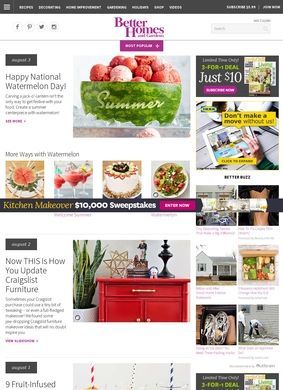
A magazine that has been in print for more than a century, and is still among the half-dozen most widely circulated titles in the United States, decided long ago that its name should also sit on a sprawling website. Better Homes and Gardens at bhg.com is the digital half of that arrangement, run by Dotdash Meredith, and it carries the same broad remit the print edition always had: what to cook, what to grow, how to fix the thing that broke, and how to make a room look better than it did yesterday.
Six content categories
The editorial scope at Better Homes and Gardens is wide but not vague. Content sorts into six recognisable buckets: home decor and decorating ideas, DIY and craft projects, gardening and outdoor living, cleaning and organising, recipes and cooking, and product reviews. For a listing filed under do it yourself, the DIY and craft material is the obvious draw, and it sits next to gardening and home repair content that overlaps with the same audience.
DIY projects and gardening guides
Someone planning a weekend project can find step-by-step instructions, and the same person can drift sideways into a recipe or a plant-care guide without leaving the site. That breadth is the point of the brand, and the site makes no attempt to be a narrow specialist. Anyone using a business directory to find how-to resources will find that Better Homes and Gardens covers more ground than most single-topic competitors.
Product testing and recommendations
One feature worth noting is the BHG Recommends program, a seal-of-approval setup where editors and staff test thousands of products every month and turn those tests into buying guides and recommendations. I tend to be wary of any media brand that also reviews products, since the incentives can pull in two directions, but a stated, repeatable testing process at that volume is a more honest footing than the usual round-up of affiliate links dressed as advice. Whether the testing is as rigorous as the label suggests is something a reader has to judge guide by guide. The structure is there, at least, and Better Homes and Gardens puts its name on it.
Digital archive and video resources
There is also a full digital archive at archive.bhg.com, which opens up past magazine issues to anyone curious about how the publication covered home and garden topics in earlier decades. That archive is the kind of asset a hundred-year-old title can offer and a newer site simply cannot, and it gives Better Homes and Gardens a depth of back catalogue that goes well beyond whatever is on the homepage this week. The YouTube channel that Better Homes and Gardens runs adds how-to video on redecorating, gardening and cooking, which suits topics where watching someone do the task beats reading about it.
Better Homes and Gardens Real Estate
One point of confusion is worth stating plainly. Better Homes and Gardens Real Estate, at bhgre.com, is a separate franchise operation and has nothing to do with the editorial Better Homes and Gardens site reviewed here. If you arrived looking to buy or sell a house under that banner, bhg.com is the wrong door. The content site licenses the same heritage name but deals in articles, recipes and projects, not property listings or agents.
Keeping the two apart matters because the reputation signals attached to the name can blur across very different businesses. A complaint about an estate agency, a print subscription, or a physically mailed product is not the same as a complaint about a recipe page or a decorating gallery, even when all of them wear some version of the Better Homes and Gardens name. The franchise, the print subscription and the free website are three different businesses sharing one masthead, and Better Homes and Gardens is best judged on the slice a given reader is using.
Subscription complaints versus free content
The outside ratings look rough at first glance and need reading with care. On PissedConsumer the brand sits at 2.6 stars across 269 reviews, and Sitejabber shows 2.4 stars from 40 reviews. Trustpilot lists a single review for bhg.com. There is a BBB profile for the magazine distributor, based in San Francisco, though it is not BBB accredited. Taken at face value those numbers are unflattering.
What the ratings actually measure
Read the substance, though, and the picture shifts. The bulk of the complaints concern physical products and magazine subscriptions: billing on auto-renewals, delivery problems, the sort of friction that attaches to any large subscription operation. Very little of it is aimed at the free editorial content that a DIY reader comes to the website for. That distinction is easy to miss when you only see the star number, and it changes how much weight the score deserves for the use case that this listing is about. A low aggregate driven by subscription billing tells you to be careful before handing over a card and recurring permission. It tells you much less about whether a tutorial on building a planter box is any good.
The transactional side of the brand has clearly annoyed a meaningful number of people, and anyone signing up for a paid subscription should go in clear-eyed about cancellation. The reference and how-to side, the part that lives on bhg.com itself, is not what those reviewers are complaining about. They are two different experiences wrapped in the same name.
From contact options to customer service
On reaching a human, the site offers little. No phone number or email address is shown prominently on the Better Homes and Gardens homepage, and contact routes are not immediately obvious. For a service business that would be a real mark against it. Here it lands more softly, because the site is built as an editorial and media destination, and most visitors never need to contact anyone to use it. The same absence would matter a great deal if you were trying to chase a subscription billing problem, which circles back to the complaints above. Free content readers will not notice; paying subscribers might wish for an easier line in.
Set against most of what turns up under do it yourself, Better Homes and Gardens brings a deeper bench than the average how-to site. The editorial operation is large, the topics are covered across written guides, archive issues and video, and the product testing program gives its recommendations a stated method. None of that makes every individual article excellent, and the sheer volume Better Homes and Gardens publishes means quality will vary from one guide to the next, the way it does at any publisher producing content at this scale.
For a DIY enthusiast the practical read is fairly clear. As a place to browse free project ideas, gardening guidance, cleaning methods and tested product picks, the site holds up and offers more range than most hobbyists would exhaust quickly. The caution sits entirely on the paid and physical side of the operation, where the subscription and product complaints cluster and where thin contact options would make sorting out a problem slower than it should be. A reader who stays on the free editorial pages of Better Homes and Gardens is using the part the negative reviews mostly leave alone. The archive going back over a hundred years and the monthly product testing are two things bhg.com has that a smaller competitor cannot easily match.