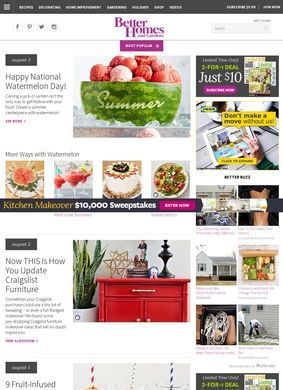
Behind bhg.com sits a print magazine that has been arriving in American mailboxes since 1922, which puts the editorial voice about a century deep before you read a single plant-care guide. That history is less a bragging point and more a practical thing: when a publication has been answering the same household questions for that long, the answers tend to be tested, revised, and stripped of guesswork. Better Homes and Gardens runs as the digital arm of Dotdash Meredith, and the web version carries that lineage without feeling like a museum piece.
Decorating and gardening coverage
What the site covers is the full sweep of running a home. Decorating and interior design get heavy treatment, with room ideas, furniture arrangement walkthroughs, and color scheme breakdowns that go past the usual mood-board level. The gardening section is one of the more substantial parts of the whole operation, holding plant care guides, landscaping advice, and separate tracks for vegetable growing and flower beds. There is a plant encyclopedia threaded through it, the sort of reference layer that turns a casual reader into a repeat visitor when a houseplant starts dropping leaves and they need a name and a fix.
Home improvement cleaning and recipes
Beyond those two flagship areas, Better Homes and Gardens spreads into home improvement and DIY projects, cleaning and organizing systems, recipes, and seasonal or holiday decorating. The recipe collections sit alongside the cooking content as a genuine vertical that Better Homes and Gardens treats with real care, and the holiday material reappears on a predictable annual cycle so the same Thanksgiving or Christmas questions get fresh treatment each year. There is also a stream of real estate and home-buying advice, rounding out the editorial range to cover the full arc from shopping for a home to running one day-to-day.
How buying guides work
The format is consistent across all of it. Step-by-step how-to guides do the instructional work, product roundups and buying guides handle the shopping side, and photo galleries plus room inspiration boards carry the visual load. I find the buying-guide approach honest in one specific way: the site does not sell anything itself, so the product recommendations link out to retailers and Better Homes and Gardens makes its money from advertising. That structure keeps the editorial picks and the checkout apart, a cleaner arrangement than sites that are quietly a storefront wearing an article's clothes. A reader looking up the best potting soil or a particular cordless drill gets a recommendation and a link, then handles the purchase wherever they like.
Built for American readers
The audience is squarely US-based, which shows up in the practical details. Plant hardiness assumptions, seasonal timing, the retailers it points to, and the home-buying advice all lean American, so a reader in another climate or market should adjust for that. Gardening content is regional by nature, and Better Homes and Gardens writes for the conditions its core readership lives in. That is a reasonable choice for a brand built on a domestic print magazine, though it is worth naming so nobody outside the States expects every frost date or product link to apply.
Licensed products sold separately
There is a commercial dimension worth understanding. The Better Homes and Gardens name extends past the website into a licensed product line, furniture, home decor, and bedding sold through Walmart under the same brand. That merchandise is a separate operation from the editorial site, and the website itself stays an ad-supported publication that points readers outward to retailers when it recommends a product. Keeping those two things straight helps: the magazine and the site are the journalism, and the Walmart line is a licensing arrangement that borrows the name.
Where the site goes deep
For depth in any single area, the site rewards a reader who digs. The gardening and plant reference material goes considerably deeper than the typical general lifestyle site manages, and the home-improvement guides carry enough sequence and photography to follow along on an actual project. The breadth can mean an individual article is more entry-level than a specialist forum, so someone deep into a niche hobby may outgrow parts of it. As a starting reference across the whole spread of home topics, though, Better Homes and Gardens is hard to beat on coverage alone, and the editorial standards behind a century-old masthead keep the accuracy consistent.
Who benefits most from this site
A new homeowner staring down a first garden, an unfamiliar appliance, or a room that needs furniture they cannot picture yet is the reader who gets the most out of Better Homes and Gardens. The step-by-step guides and buying roundups are built for exactly that moment of "where do I even start," and the holiday and planting content refreshes on schedule so the timely version is always there when the season arrives. Coverage this broad, backed by a publication this old, is a combination few home-focused sites can match.