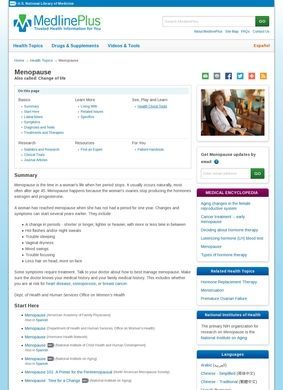
Hot flashes hit, periods turn unpredictable, sleep falls apart, and the first instinct is to type symptoms into a search bar. What comes back is usually a scramble of supplement ads, forum guesswork, and clinics hoping to sell something. That arrival point is exactly where MedlinePlus: Menopause is built to catch a person. It is a single curated page maintained by the U.S. National Library of Medicine, the part of the National Institutes of Health that has spent decades organizing medical information for ordinary readers, and it treats menopause as a process to be explained calmly, not a problem to be monetized.
Tracking the transition through hormonal stages
MedlinePlus: Menopause does not pretend the transition is a single event. It walks through the whole arc, from perimenopause through menopause and into postmenopause, and it ties the experience back to what the body is doing hormonally. Estrogen shifts, follicle-stimulating hormone, anti-mullerian hormone: these terms show up, but they are framed at a level a non-specialist can follow without a biology degree. Someone trying to understand why their cycle has gone erratic, or why sleep and temperature regulation suddenly feel out of their control, will find a plain account here.
Symptoms get concrete treatment too. Irregular periods, vaginal dryness, disrupted sleep, the hot flashes that send people searching in the first place, all of these are named and described. From there the page moves into what can be done about them, covering lifestyle changes alongside hormone therapy, and pointing to patient handouts that frame hormone therapy as a decision to weigh. That framing is worth paying attention to, because the choice around hormone therapy is genuinely personal and MedlinePlus: Menopause respects that instead of flattening it into a simple yes-or-no.
Interactive tools and research links
Further than its modest layout suggests. MedlinePlus: Menopause works largely as an intelligent set of doorways. It aggregates links from NIH agencies and other government health bodies, so a reader is not stuck with one institution's summary but can step into the source material when they want depth. The diagnostic side is covered through descriptions of relevant tests, and for people who want to act on what they read, there is an endocrinologist finder alongside Medical Encyclopedia entries that explain individual terms in detail.
There are tools that go beyond passive reading. The Endocrine Society's Menopause Map is built in as a self-assessment instrument, and a knowledge quiz lets readers check what they have absorbed. NIH videos and tutorials handle symptom management for anyone who learns better by watching than by reading dense paragraphs. For the more research-minded, MedlinePlus: Menopause opens onto MEDLINE and PubMed journal articles and clinical trial databases, which is a real bridge from consumer-level explanation toward the primary literature that clinicians use. A patient can stay at the plain-language layer. A caregiver can pull the handouts. A clinician can jump straight to the trial data. The same entry point handles all three, and nobody is forced through registration or a paywall.
That range is genuinely useful. MedlinePlus: Menopause addresses several audiences at once without splitting itself into separate products, and it does so without asking anything in return.
Long-term health risks explained
The page does not stop at the symptoms people notice day to day. It addresses the downstream health consequences that often get ignored until they become serious: bone loss and osteoporosis risk, changes in cardiovascular risk, and weight gain. These are the long-horizon issues a commercial site has little incentive to dwell on. Their presence in MedlinePlus: Menopause shows that the resource is thinking about a reader's decade ahead, well past the symptom in front of them this week.
Reach extends past English speakers as well. The page links to multilingual health information, a quiet but real advantage for anyone supporting a relative who reads more comfortably in another language. It is the sort of feature that costs a publisher effort and returns no profit, which is part of why it belongs on a government-run resource and rarely turns up elsewhere.
Editorial standards behind the content
On the question of how trustworthy the content is, the structure answers for itself. Content is editorially reviewed by NLM staff and updated on a defined schedule, so a reader is not left guessing whether they are looking at something written once and abandoned. Nothing is sold. There are no products, no upsells, no registration wall, and that absence is the whole point. When the subject is your own hormones and the treatment decisions that follow, the lack of a commercial motive is worth more than any design flourish a glossier site might offer.
If there is a limitation, it is the same one that defines the format. MedlinePlus: Menopause is a hub. Much of its value lives in where it sends you, which means a reader who wants everything delivered on one screen will end up clicking outward to NIH agencies, encyclopedia entries, and journal databases. For people who want to go deep, that is a strength. For someone who wants a single tidy answer and nothing more, the constant branching can feel like work. The page is honest about being a starting point, and it should be read as one.
MedlinePlus: Menopause is plain, evidence-based, free, and clear of the commercial noise that clutters most health searches. The verdict is not that it is exciting, because it is not trying to be. It is a well-organized clearinghouse that does the unglamorous job of pointing people toward solid information at the moment they need it most. Readers willing to follow the links and read past the first screen will get real use out of MedlinePlus: Menopause. Those hoping for a one-glance fix will find it feels like the front door to a library, and given how trustworthy the content is, that is a fair description of what MedlinePlus: Menopause offers.