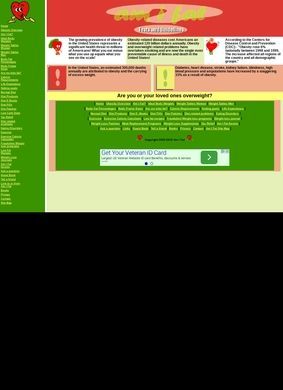
A BMI calculator sits on the front of Am I Fat?, next to a body fat percentage calculator and two sets of weight tables, one for men and one for women. The site is a self-assessment kit for anyone trying to work out where they land on the scale from healthy to overweight.
Built as a frameset, the pages have the layout of an earlier web, a menu down the side and content loading into a panel beside it. Am I Fat? is an educational site about weight and obesity, and those calculators are its main draw.
The intended visitor is easy to picture: someone who has typed a nervous question into a search bar and wants a number back. What the site gives them is a set of tools and a stack of reading, with no login, no app, and no pitch to sign up before the first result appears.
The calculators and tables
The calculator set is the reason to visit. Beyond the BMI and body fat readings, Am I Fat? offers an ideal body weight calculator, an exercise calorie calculator that estimates what a given activity burns, and a calorie requirements estimator for daily intake. The weight tables, split by sex, give a quick reference with no input at all. Together they cover most of the arithmetic a person starting a weight plan reaches for first.
Accuracy is the open question with any of these. BMI and ideal-weight formulas are blunt instruments, and Am I Fat? presents them as the standard references they are without dressing them up as more. It leans on recognised sources, citing CDC data and figures such as the $120 billion a year the United States spends on obesity-related disease.
The exercise calorie calculator is the one that invites the most fiddling. Enter an activity and it returns an estimate, which turns a static reference into something a visitor can actually play with. Try a longer walk or a harder session and the figure moves accordingly. It is a modest interactive touch on a site otherwise built to be read.
For a curious visitor, the appeal is speed. Am I Fat? returns a figure in seconds and wraps it in enough reading to act on, which is more than a bare calculator app tends to offer. The tools look their age, but the underlying formulas have not changed, so a BMI reading taken here matches one taken anywhere else.
Body frame and children's weight
Two extras widen the scope past the individual adult. A body frame sizing guide helps a user judge whether they are small, medium, or large framed, which changes how the weight tables should be read, and a children's weight assessment turns the same questions toward kids.
Am I Fat? treats family weight as part of the picture, not an afterthought, and the children's section is a quiet reminder the site aims at whole households, not dieters alone.
Beyond the numbers
The written content runs wider than the calculators. Am I Fat? carries an obesity overview, a rundown of diet types, exercise guidance, a set of low-fat recipes, and a section on eating disorders, a responsible inclusion on a site that could easily have stayed fixated on shrinking a single number. The recipes and diet breakdowns give a reader something to do once the calculators have delivered their verdict.
The obesity overview is the closest the site comes to a proper reference article. Am I Fat? frames excess weight as a health issue with real costs, citing the CDC and pointing to the money the United States loses to obesity-related disease each year. The tone lands closer to a health brief than a scold about a number on a scale. It reads as an attempt to explain why the calculators matter at all, beyond the mechanics of punching values into them.
Quality varies by section across Am I Fat?, as it tends to on reference sites this size. The obesity overview and exercise pages read as general education, the grounding a newcomer wants before making changes, while the recipe and diet-type pages are lighter and more list-like. None of it pretends to replace a doctor, and the eating-disorder page in particular reads as a genuine attempt at care, not filler.
Diet products on offer
One section shifts from advice to selling. Am I Fat? lists diet products, pills, patches, meal replacements, and supplements, which sits awkwardly against the calm educational tone of everything around it. A site that has just explained eating disorders and cited CDC figures then points a reader toward weight-loss pills, and that tension is left for the visitor to resolve.
The coverage of the products is descriptive rather than pushy, but the pivot is worth noticing before anyone acts on it. Pills, patches, and meal replacements are commodity items a visitor can buy in any pharmacy, so their presence here reads more as a revenue line than as considered advice.
Reaching the people behind it
Contact is where the site gets vague. A Contact link sits in the navigation, but no phone number, email, or postal address surfaces on the pages themselves, so a visitor knows a route is meant to exist without ever being handed the specifics. A Guest Book and an Ask a question feature suggest the site once expected two-way traffic, and both point to an owner who wanted to hear back from readers.
Those two features belong to an older idea of the web, when a small site expected to gather a little community around itself. Both still sit in the menu, and both suggest someone who once fielded questions in person, even if nothing on the page now indicates anyone is still answering them.
Outside reputation is effectively blank. A search for reviews of Am I Fat? turns up unrelated matches, a documentary, a self-help book of the same title, an AI classifier tool, and various quiz sites, none of which point back here, so there is no third-party rating to report either way. The name is common enough that the site vanishes among its namesakes.
The copyright line at the foot stopped advancing a long time ago, and the content carries the settled, untouched feel of a site left running rather than tended.