A residual limb is not a fixed shape. It swells and shrinks through the course of a day, which is why a hard socket fitted in the morning can become unwearable by early afternoon. The Ossur Direct Socket System works around this by forming a flexible, direct-contact interface between the limb and the prosthesis, dropping the rigid intermediate shell that traps the limb at one volume.
How adjustable sockets address limb volume changes
PrimeCare Orthotics & Prosthetics fits that system at its Las Cruces, New Mexico office on S Don Roser Drive, and it builds adjustable sockets specifically to track those daily volume changes. The practice puts a particular fact in front of the visitor early: Medicare coverage for adjustable sockets is now confirmed. That placement is deliberate. For a patient who has been putting off a better fitting because the cost was an open question, the answer arrives before the FAQ instead of after it.
Medicare coverage for adjustable sockets
The adjustable-socket emphasis is the part of this listing worth dwelling on, because it tells you PrimeCare Orthotics & Prosthetics understands where the patient's actual difficulty lies. The mechanical problem of a shifting limb is the daily reality of prosthesis use, and a fitter who leads with the technology that addresses it, plus the coverage that pays for it, is solving for the patient and not for the catalogue. The rest of the offering is broad, and breadth is where the picture gets more complicated.
Prosthetics by amputation level
The prosthetic catalogue at PrimeCare Orthotics & Prosthetics covers lower-limb work at every amputation level: above-knee, below-knee, hip disarticulation, and prosthetic feet. Upper-limb fittings run through arms, hands, and wrist units. Athletic and pediatric prosthetics each sit in their own sections, and that separation reflects a genuine clinical distinction. A child with a still-developing limb presents a different fitting problem than an adult, and folding both into one section would bury that difference. The orthotic range is just as wide. On the ankle-foot side there is AFO, GRAFO, and CROW boot; then knee braces; spinal orthotics including TLSO, CTLSO, and CTO; and custom foot orthotics and insoles. Pediatric and sports variants appear across both the prosthetic and orthotic lines.
Orthotics and braces
A catalogue this large risks reading as a list of everything, with no real specialism. What keeps it from doing that is the navigation. PrimeCare Orthotics & Prosthetics indexes the catalogue by condition as well as by product type, so a patient who knows their diagnosis but not the acronyms can move from "limb loss" or "spinal deformity" or "orthopedic condition" straight to the relevant section. Most device catalogues run the other way, asking the patient to learn the terminology first and find the page second. Someone recently told they need a TLSO, who cannot yet tell it apart from a CTLSO, can still land on the right entry point here. The benefit is largest at the very start of the process, when a patient is still absorbing what the surgeon said.
Diagnosis-based navigation
PrimeCare Orthotics & Prosthetics treats patients across New Mexico and Arizona and into El Paso and Ciudad Juarez. At PrimeCare Orthotics & Prosthetics, bilingual care is listed as standard, not as an add-on, and in a border region where Spanish is the first language of many patients during emotionally loaded consultations, that is a clinical detail with weight, not a demographic checkbox. The practice references an Albuquerque presence on its BBB and Yelp listings, with the Las Cruces address confirmed as the primary location.
Service area and bilingual care
Three offerings reach past straightforward device fitting. PrimeCare Orthotics & Prosthetics runs a second-opinion service for patients who already hold a fitting and want an independent assessment before going ahead with it. An FAQ written specifically for amputees and a patient success stories section fill out the rest of the patient-facing content. The second opinion is the most telling of the three. Prosthetic and orthotic work is expensive, physically intimate, and hard for a patient to judge alone, and a practice willing to invite outside review of its own fitting decisions is putting something on the line. For a patient already mid-process with a different fitter, that is a defined place to walk in, not a vague reassurance.
Second opinions and patient resources
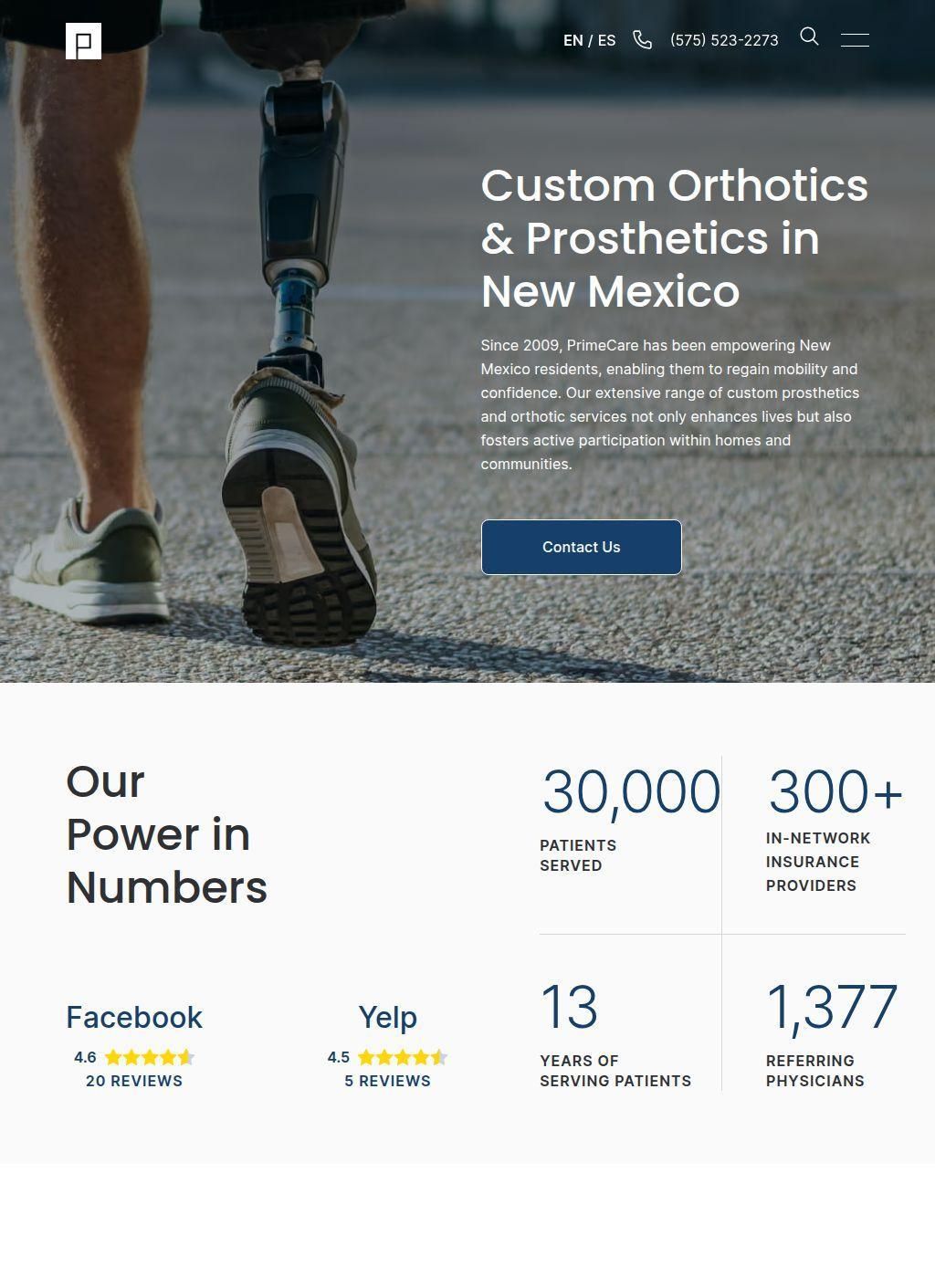
The homepage of PrimeCare Orthotics & Prosthetics carries four figures, all of them self-reported: 30,000 patients served, over 300 in-network insurance providers, 1,377 referring physicians, and 13 years in operation since 2009. The four are not equally informative. The referring-physician count and the insurance breadth tell you the most, because both are slow to accumulate and neither builds quickly. Physicians decide where their patients go, and a network of more than thirteen hundred of them does not form without sustained clinical credibility. Insurance credentialing is paperwork-heavy and methodical; three hundred-plus contracts point to real patient volume over real time. The 30,000-patient figure is the one a prospective patient can do least with, since nothing external corroborates it. The 13-year history dating to 2009 can be confirmed through state licensing records, and it lines up with the rest.
Physician referrals and insurance networks
The external review record is where the published confidence and the visible evidence part company. PrimeCare Orthotics & Prosthetics points to its Google Business Profile as the home for verified patient reviews and surfaces five of them on the homepage. Facebook shows an 88 percent recommendation rate built on six reviews. Indeed shows a 5.0, but from two employee reviews, which speaks to internal culture and not to patient outcomes. BirdEye aggregates positive testimonials with no visible star count. The BBB lists two locations, shows no accreditation, and returned no rating in available results.
BBB accreditation is a paid program many practices skip, so its absence says little either way, though the missing rating leaves the entry neutral. One marker does carry genuine local meaning: a CommunityVotes Gold award in custom foot orthotics for Las Cruces. A popular-vote award is not a clinical endorsement, but it confirms that PrimeCare Orthotics & Prosthetics has a recognisable presence in the home market, not a name nobody locally has heard of.
Sentiment across these platforms runs consistently positive. The constraint is volume: six on Facebook, five Google reviews on the homepage, two on Indeed. One unhappy patient would visibly move those averages, which makes the external picture inconclusive, not negative. Here is the honest tension in this listing. The self-reported figures describe a large, established, well-referred practice; the public reviews PrimeCare Orthotics & Prosthetics surfaces number in the single digits.
Those two things can both be accurate, and for the adjustable-socket and second-opinion work PrimeCare Orthotics & Prosthetics leads with, the published Medicare coverage and the verifiable operating history already give a prospective patient something solid to stand on. The thirteen-hundred-physician network, if it holds, is a stronger reference than any star average a clinic of this size would carry online. A patient confirming insurance coverage by phone with PrimeCare Orthotics & Prosthetics and reading whatever Google reviews exist in full will close most of the remaining distance themselves.
The contact details follow the pattern of a clinic that routes intake through staff and not through an open inbox: PrimeCare Orthotics & Prosthetics lists a phone number, a street address, Monday-through-Friday 9-to-5 hours, and a contact form on the homepage, with no public email address shown.
Important pages
Business address
PrimeCare Orthotics & Prosthetics
1401 S Don Roser Dr. Ste E2,
Las Cruces,
NM
88011
United States
Contact details
Phone: 575-523-2273