Not every healthcare website is written for patients. This one talks to doctors, hospital administrators, and practice owners. APEX Health Network, short for Amputation Prevention Experts, sells the management side of wound care. The page explains what it takes to build and run a wound care center inside an existing practice.
Wound care has lived mostly inside hospitals for decades. APEX makes the case that a private group or a multispecialty clinic can offer the same advanced treatments. That shift, moving the care closer to where the patient already goes, sits at the center of the whole offering.
The first step described is a question rather than a contract. APEX says it helps a practice work out whether wound care actually fits what they already do. As a reviewer, I found that a fair place to begin, since a wound program is not a small add-on for any clinic.
Once a practice decides to move ahead, the project gets looked at again with hyperbaric oxygen therapy in mind. The site uses the phrase one-stop shop for the result. Patients with diabetic foot ulcers, along with other conditions that respond to HBOT, could then be treated in a single location.
APEX manages both freestanding centers and hospital based ones. The protocols follow published evidence, and the stated aim is healing that runs efficiently without ballooning costs. Once a program is live, the company describes its role as a partner in keeping things compliant.
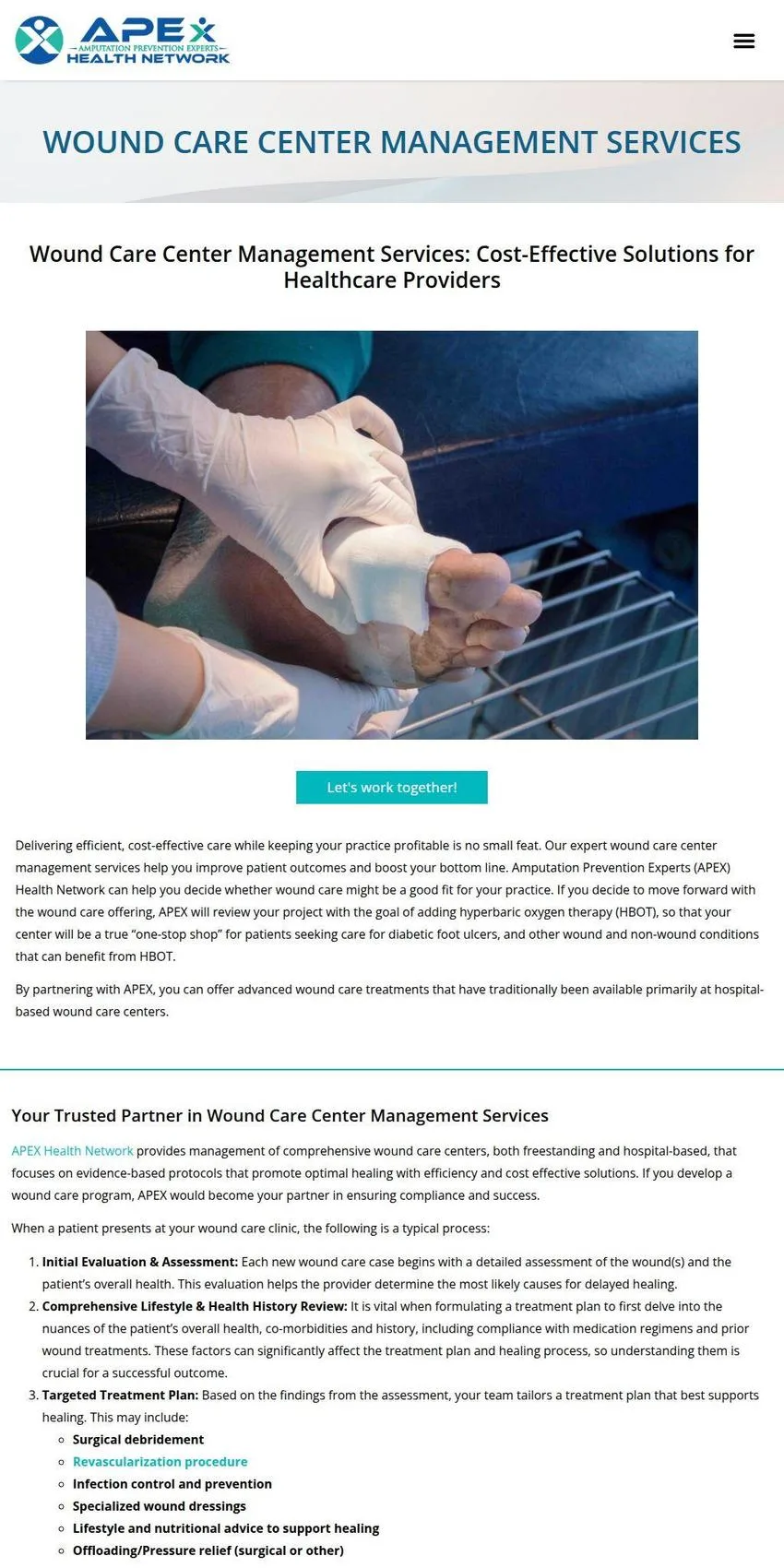
The page then walks through what happens when a patient arrives. Every new case opens with a close look at the wound and at the person's general health. The goal is to work out why healing has stalled in the first place.
After that comes the history. Other conditions, medication habits, and earlier wound treatments all get reviewed before a plan is written. Think of a mechanic asking for the service book before lifting the hood. The logic is much the same: the backstory shapes the repair.
Treatment options listed on the page include surgical debridement, revascularization, infection control, specialized dressings, nutrition advice, and pressure relief through offloading. Which ones get used depends on what the assessment turned up. Care is built around one patient rather than one recipe.
The wound types covered run fairly wide. Pressure ulcers, diabetic foot ulcers, arterial or ischemic ulcers, venous ulcers, and post-surgical wounds that will not close all appear on the list. Venous ulcers, the site explains, come from poor circulation in the veins and tend to show up on the lower legs.
So what does a practice actually gain? Patients stay in a setting they already know instead of driving between clinics for pieces of the same problem. Healing tends to move quicker when one team handles the full case. Visits, procedures, and follow-up surgeries also generate professional revenue for the providers doing the work.
The hyperbaric section reads like a project plan. APEX works out space and oxygen requirements, sources the chambers, and hires the hyperbaric technologist. Physicians supervising HBOT need a 40-hour training course, which the company can arrange. Safety checks and accurate documentation for billing and collections finish off that part.
Hyperbaric medicine also gets treated as its own service elsewhere on the site, and the scope there starts earlier. A feasibility study looks at market demand and financial projections before anything is built. Facility design, chamber selection, installation, licensure, CMS credentialing, and UHMS accreditation follow, along with custom policies and clinical protocols.
Limb preservation is the third strand, and the most specialized of the group. A Limb Preservation Center concentrates on chronic wounds that too often end in a major lower limb amputation. Staff receive training in prevention protocols, specialists are pulled in within useful time frames, and outcomes are tracked to improve quality. Podiatric foot and ankle surgeons work beside endovascular specialists, and patients typically go through two or three surgical procedures.
The fourth service is quieter but practical. A Center Performance Analysis studies a clinic that already exists rather than one being planned. APEX asks for twelve months of new patient numbers, hyperbaric dive counts, the charge master, and monthly revenue and expense reports. It works like a physical for the center itself, not the patient.
Who is behind all this? Leadership pairs healthcare business experience with clinical depth: a president who co-founded an earlier wound care and hyperbaric management company, a board certified vascular surgeon serving as chief medical officer, and a nurse executive with three decades in wound care. The medical advisory panel adds academic names from USC, UT Health San Antonio, and UCSF.
Support does not stop at opening day, according to the site. The academic team stays reachable for quality review, performance improvement plans, and questions about specific cases or care plans.
Business address
United States