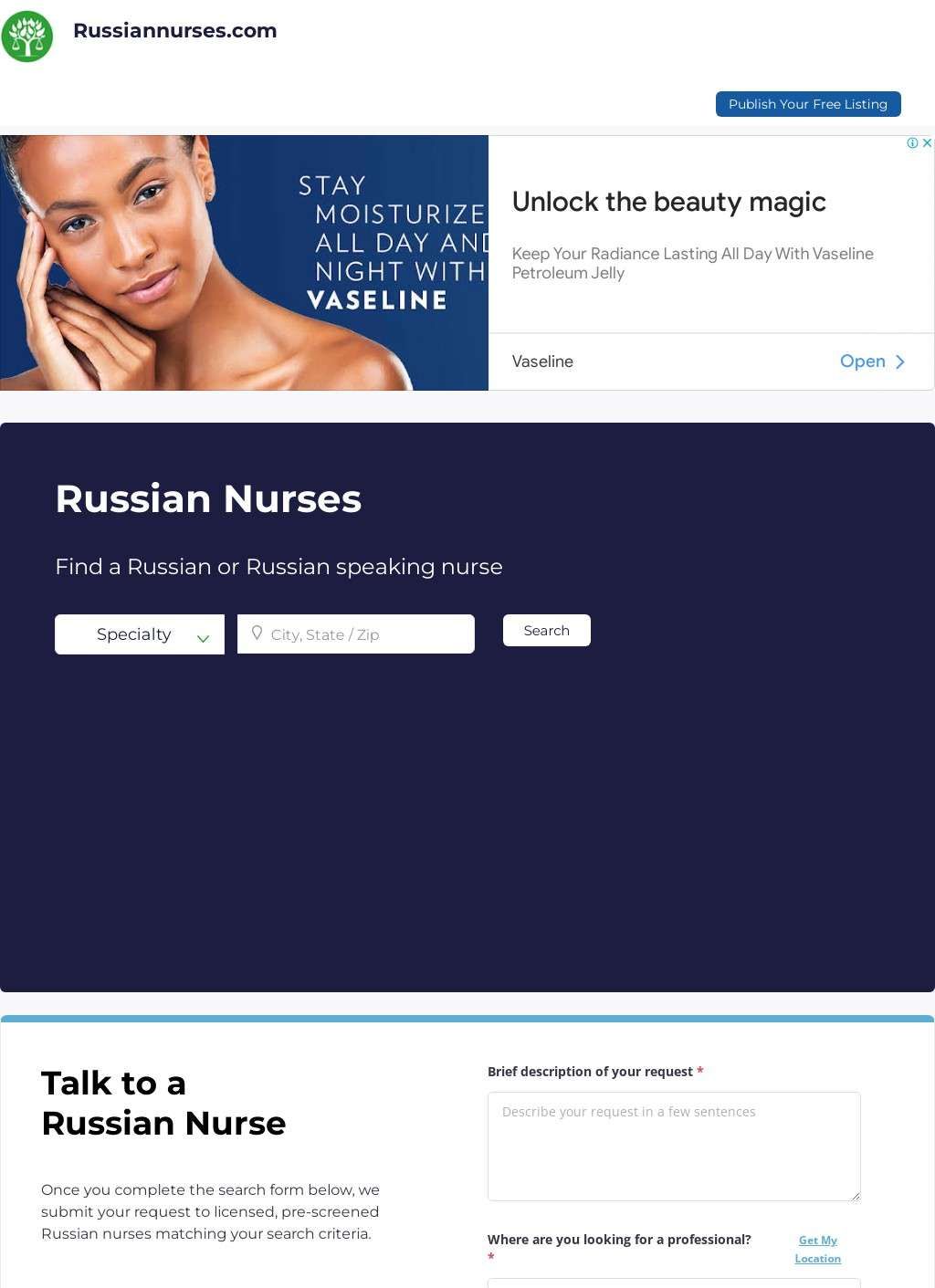
Russian Nurses exists for a narrow and underserved situation: a patient or family that needs a licensed nurse who speaks Russian, and finds that general search engines return agencies with no real answer. That is the narrow problem Russian Nurses sets out to solve. The answer is a referral service that points healthcare seekers toward licensed, Russian-speaking nurses across a set of defined specialties. Russian Nurses is not a hospital, an agency, or a single practice. It is a matchmaking layer that sits between the person who needs care and the nurse who can provide it, with language as the organizing principle.
Six nursing specialties covered
The specialty list is concrete enough to judge. Six areas are covered: hospice care, in-home nursing care, nurse practitioner services, pediatric nursing, registered nursing, and travel nursing. That spread is sensible for a service built around language. A family arranging hospice for an elderly relative who never learned English, a household that wants an in-home nurse who can talk to grandparents directly, parents looking for a pediatric nurse their child trusts: all of them hit the same wall, and a single platform that handles each case has obvious value. The travel nursing inclusion is the one that reaches a different audience, since that is more about nurses finding placements than patients finding care, which tells you Russian Nurses serves two sides at once.
Cities and states with listings
Geography is handled with some ambition. There are dedicated pages for major U.S. cities and states, with New York, Los Angeles, Chicago, Dallas, and Miami named among them, and coverage extends to Canada and Russia. City-level and state-level pages are the right structural choice for a referral service, because nursing is local and a patient in Miami has no use for a nurse listed in Chicago. Whether every one of those pages is populated with real listings is the open question any visitor should keep in mind, and it is the difference between a directory that works and one that only looks complete from the navigation menu.
How the search request works
The mechanics are spelled out clearly. A user fills out a search request form describing what they need. That request is then forwarded to matching nurses, and the stated response window is two business days. Separately, a patient who messages a listed nurse directly is promised a reply within 24 hours. Two different timelines for two different actions is a reasonable design, though a two-business-day wait will feel long to a family in an urgent hospice or pediatric situation. That gap between expectation and need is worth weighing before relying on the form as the only route.
License verification and screening claims
On the trust side, Russian Nurses makes two specific claims: that it verifies nurse licenses annually, and that its listings are pre-screened. Annual license verification is a meaningful promise if it is genuinely carried out, because a lapsed or revoked license is exactly the kind of risk a patient cannot easily check alone. The site states the practice; it does not show the audit trail behind it, so a cautious user would still confirm a given nurse's credentials through the relevant state board before any care begins. The claim is a starting point, not a substitute for that check.
Paid listings for nurses
Russian Nurses also runs as a paid listing service from the nurse side. Nurses register accounts and manage paid listings, which is a normal model for this kind of operation but does shape how the site should be read. Inclusion reflects a nurse who chose to pay and list, screening notwithstanding, so the directory shows a self-selected subset, not the full field of Russian-speaking nurses in any given city.
Extra features like ask a nurse
A few extra features round out the offering. There is an "Ask a Nurse" section, a monthly newsletter, and the usual social presence on Facebook, Twitter, LinkedIn, and Instagram. The "Ask a Nurse" feature is the most interesting of these, because it means Russian Nurses wants to be a resource people return to, not a one-time lookup. A newsletter and social accounts are standard, and they matter mostly as a sign that someone is maintaining the project and keeping it current.
Missing contact information
The site is thinner on contact details than it should be. A contact page is linked in the footer, which is the expected place for it, but the homepage shows no phone number and no physical address. For a service whose entire pitch rests on connecting people with healthcare providers, the absence of a visible phone line is a real friction point. Some users arranging care for a relative want to talk to a person before they trust a web form with a two-day reply window, and there is no obvious way to do that here. The web form is the primary channel, backed by the 24-hour direct-message promise to nurses, and for a platform built around responsiveness, a number on the page would do more to reassure a first-time visitor than any claim on the page can.
Absence of third party reviews
As for outside opinion, a search for Russian Nurses turned up no notable third-party reviews on the usual platforms. That is not damning, since plenty of legitimate niche services operate below the radar of Google reviews or Trustpilot, but it does mean a prospective user cannot lean on a body of stranger feedback to decide. The credibility of Russian Nurses, for now, rests on its own stated practices: the license verification, the pre-screening, the response promises, and whether those are honored when a real request goes through.
Taken together, the proposition is coherent and the niche is genuine. There is a real population that needs Russian-speaking nurses, that population is poorly served by general search, and a platform organized around specialty and city is a logical way to serve it. The pre-screening and annual verification claims, if honored, address the single biggest worry a patient has about a stranger from the internet entering their home or caring for their child. The honest reservations are the quiet ones: no visible phone number, no address, no outside track record, and a response window that may not suit an urgent case. None of those sink the idea, but they do mean a user should treat the first contact as a trial run rather than a guarantee.
The structure of Russian Nurses is sound, the specialties are specific, and the geographic reach is broad enough to be useful in the major markets where Russian-speaking communities actually cluster. What a visitor cannot tell from the homepage is depth: how many nurses are really listed in their city, how quickly the form is answered in practice, and how rigorously that annual verification is enforced. Russian Nurses gives a clear path to send an inquiry and a set of promises about what happens next, and whether those promises hold is something only a live inquiry can answer.