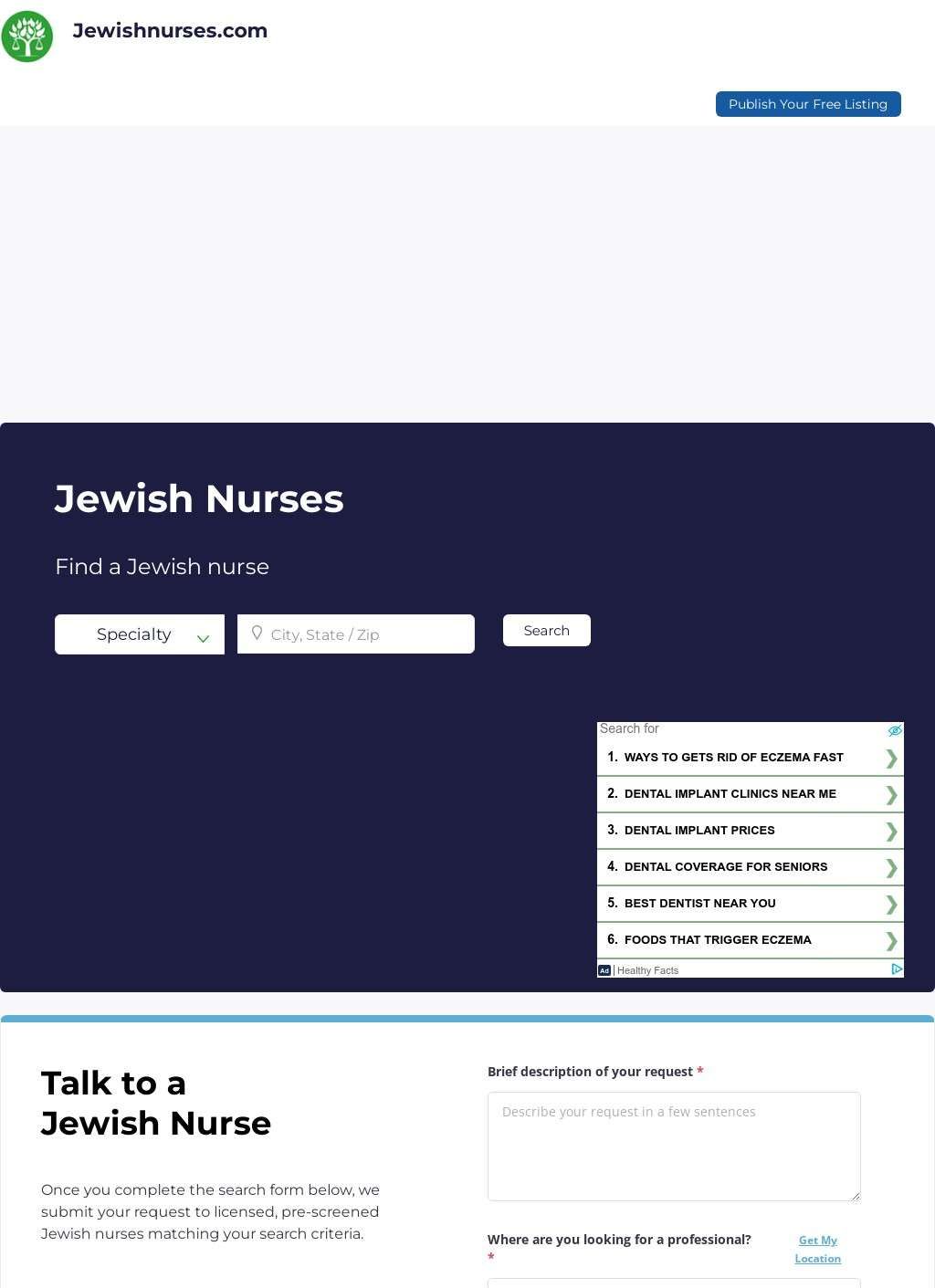
In-home nursing is a sector where the major platforms compete on the size and speed of their rosters: Care.com, Trusted Health, and the national staffing agencies publish nurse counts, star ratings, and response-time statistics. Jewish Nurses operates with none of that infrastructure. It is organized around a single axis, cultural and linguistic match for Jewish families, and it publishes no public performance data. For a service placing nurses in patients' homes, the gap between what those other platforms offer in terms of verifiable track record and what Jewish Nurses offers is not incidental.
How the referral process works
Requests go through a referral form, not a self-serve booking engine. A user submits name, phone, email, and care details; the platform reviews that, then forwards the request to pre-screened nurses who fit the criteria. Phone and email verification codes authenticate both sides before any message passes between patient and nurse. Communication then happens inside the platform, which keeps health details and a home address within a system that has already done some filtering. For families placing a stranger in an elderly parent's home, the controlled channel is appropriate to the weight of the situation.
Services offered across care types
The service covers hospice care, in-home nursing care, nurse practitioner services, pediatric nursing, registered nurse placements, travel nursing, and a Hebrew-speaking nurse track. The same platform can field a short pediatric visit, a long-term in-home arrangement, or end-of-life hospice support without routing every family to a single service type.
Geographic coverage and roster depth
On geography, Jewish Nurses claims coverage across all U.S. states, with named pages for states including Oregon and New Jersey, more than twenty U.S. cities including New York, Los Angeles, Chicago, Miami, and Boston, plus Canadian and Israeli coverage. The directory structure is built to scale by location. The genuinely open question is roster depth in any given city: a referral model's usefulness to a family in a smaller market depends entirely on how many nurses are actually enrolled there, and Jewish Nurses publishes no nurse counts by location. A family in a secondary market accepts real uncertainty at intake.
License verification and annual renewal
On credentialing, Jewish Nurses states that licenses are verified and that this verification runs annually. An annual re-check is a meaningful commitment for an in-home care context. The claim is stated by the platform itself, not independently audited, but a credible operator publishing a renewal cycle is at least staking something on it.
Access channels and contact options
No physical address and no direct phone number appear on the homepage or landing pages. Everything routes through the online request form, with a contact page link and a help center link in the footer. For a service where the form is the designed entry point, that layout is internally coherent. A user who wants to speak to a person before submitting health information will not find that option. For someone with a high caution threshold, that absence is a structural problem, not a minor inconvenience.
Behind the matching flow
The matching flow is described clearly enough: what gets screened, how the verification steps work, that nurses are pre-screened before a referral goes out. What is invisible is the organization behind it: company size, how long requests typically take to match, how many nurses declined or disqualified in the last year. Jewish Nurses presents a process while keeping the institution itself opaque.
Independent ratings and reviews
Independent ratings for this specific platform are absent. Searches return a Jewish nursing and rehabilitation center on Glassdoor, a national Jewish health organization on Indeed, and a cluster of Jewish hospitals. The Orthodox Jewish Nurses Association operates at a different domain entirely and is a separate organization. None of these entries represent feedback on Jewish Nurses the referral platform.
For a product retailer, no public reviews is a minor inconvenience. For a service that places nurses in private homes with elderly or ill family members, the absence of any external corroboration of the screening and matching process is a different kind of problem. A newcomer is trusting the platform entirely on its own account of itself. No independent voice has confirmed that the license-check cycle actually runs, that the matching process works as described, or that families who used the service found it reliable.
From specificity to accountability
Against the generic agency or the large gig-care marketplace, Jewish Nurses occupies a real gap: no other referral platform is organized around cultural and linguistic fit for Jewish families specifically. A family that needs a Hebrew-speaking nurse for a parent in hospice is not well served by a roster where "Hebrew-speaking" is one filter among dozens. That specificity is the platform's genuine argument for existing.
But specificity of mission does not substitute for evidence of execution. The published specialties, the geographic breadth, and the annual license-check commitment are all self-reported by a platform with no public track record, no reviewable history, and no way for a prospective user to reach anyone before submitting personal health data. Jewish Nurses asks for a level of trust that the available evidence does not justify. The unresolved doubt is not about the niche it occupies; it is about whether the screening process it describes is actually happening, and nothing outside the platform itself currently answers that.