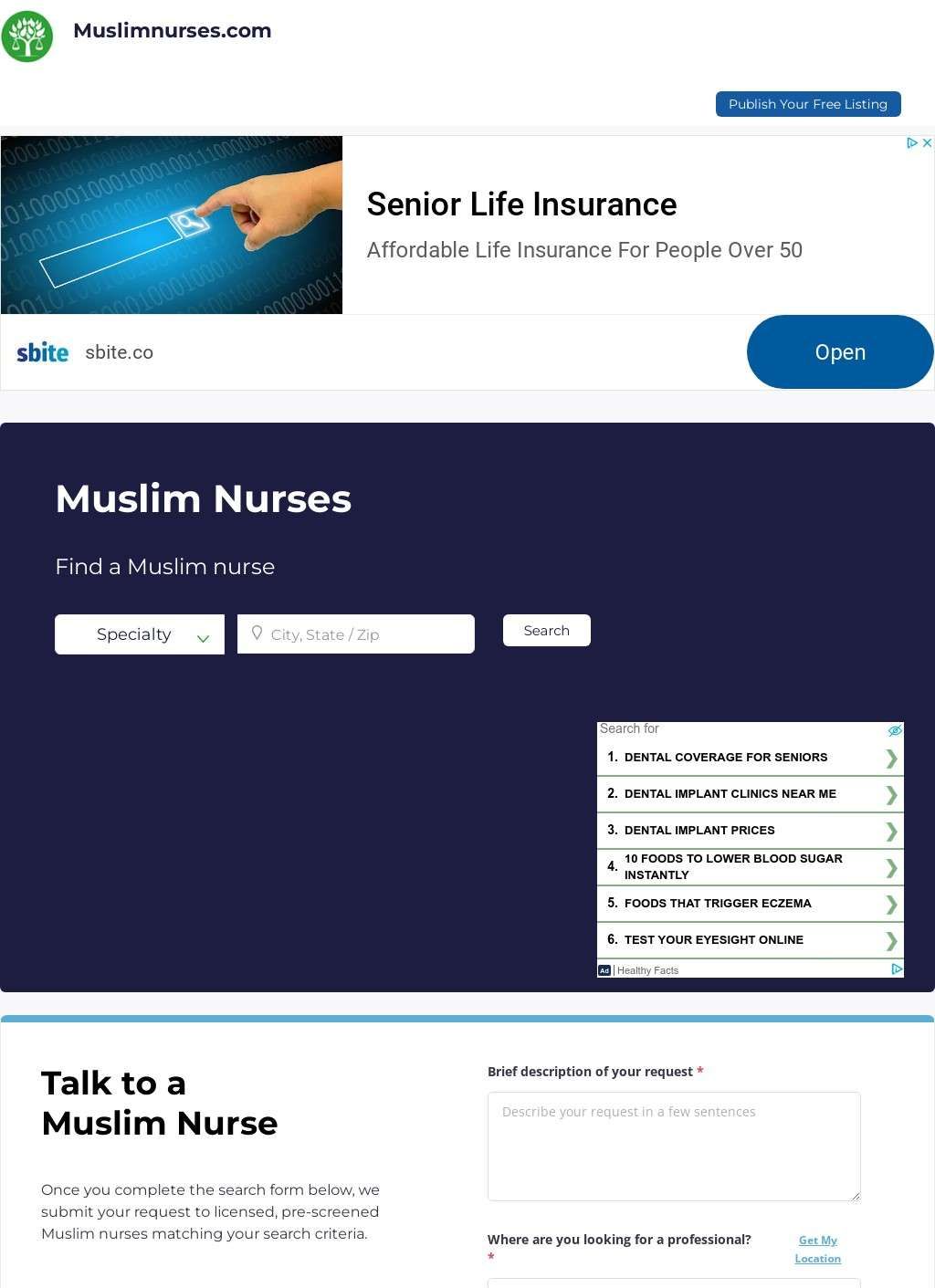
Muslim Nurses is a directory and matching service that connects patients and healthcare facilities across the United States and Canada with Muslim nursing professionals. The premise is narrow and clear: someone who wants a nurse who shares their faith, or who speaks Arabic, can search Muslim Nurses instead of hoping a general staffing agency happens to have the right person. The site organizes that pool into six specialty areas, so a search starts from a concrete need and skips the open-ended browse.
Six nursing specialties and language matching
Those six categories are Hospice Care, In-Home Nursing Care, Nurse Practitioner, Pediatric Nursing, Registered Nurses, and Travel Nursing. Alongside them sits a separate Arabic Speaking Nurses category, which is a sensible split given that language fluency and religious alignment are related but not identical needs. A family arranging hospice care at home is solving a very different problem from a clinic that needs a travel nurse for a short contract, and the structure here respects that. Each path leads to professionals filtered for the same underlying reason: care that fits a patient's cultural and religious context without the patient having to explain or justify it first.
Muslim Nurses picks the settings where cultural fit matters most to a patient, which is home care, pediatric care, end-of-life care, and the like, and builds the whole business directory around those. It is not trying to cover every corner of nursing, and the category list makes that scope legible at a glance.
Annual license verification for every nurse
The detail that gives the platform more credibility than a plain listing wall is its license verification. Muslim Nurses states that it checks every nurse's license annually. That is a meaningful claim because a directory of healthcare workers lives or dies on whether its credentials check out and stay current. Annual re-checking, if it runs as described, catches the case where a license lapses after a profile goes up, which a one-time check would miss entirely. I found this the most reassuring single detail on the site, ahead of any geographic or category breadth, because it speaks to the one thing a patient cannot verify independently. For a faith-specific service where trust is doing a lot of the work, putting verification in writing is exactly the right instinct.
Service coverage in major metropolitan areas
Geographically the service points at major population centers. On the US side it names New York, Los Angeles, Chicago, Dallas, and Houston; in Canada it covers Toronto among other cities. That is a reasonable starting footprint for a faith-specific directory, since Muslim communities and the healthcare infrastructure that serves them concentrate in those metros. It also sets honest expectations. Someone in a small town several hours from any of those cities should not assume a match is waiting, and the city-led framing puts that limitation in plain view instead of dressing it up as a national-sounding promise. Muslim Nurses gains credibility by stating where it actually operates.
The flip side of targeting major cities is depth. A platform that lists a handful of nurses across twenty scattered places helps almost no one, while one that holds real numbers in New York or Toronto can actually fulfill a request. The site does not report how many professionals sit behind each city, so depth is the open question a prospective user would want to test by running a live search. The categories and cities are the scaffolding; whether the rooms behind them are furnished is something only a real query answers, and that count is the one figure Muslim Nurses would do well to surface up front.
Contact options for patients and organizations
Muslim Nurses builds two contact routes into the workflow, tied to different needs. A patient or organization can submit an inquiry through the contact form and is told to expect a reply within two business days. Someone who wants to reach a specific verified professional can message that nurse directly, with a stated reply window of 24 hours. Putting a faster clock on direct messages makes sense for healthcare, where the person who has already found their match is usually closer to an urgent decision than the person still browsing. A monthly newsletter signup rounds out the options for anyone who wants to follow the service without an immediate need.
For reaching the Muslim Nurses company itself, every route runs through a form. There is no phone number, no physical address, and no direct company email published anywhere on the site. For a service that handles healthcare arrangements, the absence of a published phone line is something a cautious user will notice, since a sensitive or time-pressured situation is often easier to resolve by voice. The form-only setup is workable and increasingly common, and a missing email address is no real concern given how routinely businesses drop it to dodge spam. A phone number and a stated address would do more to settle nerves than anything else on the page.
One technical point worth naming: the support links redirect to help.heritageweb.com, which indicates that Muslim Nurses runs on the HeritageWeb platform instead of bespoke infrastructure. That is neither good nor bad on its face. It means the site sits on a shared directory engine, which usually brings stable, tested mechanics for search, profiles, and messaging, while the curation and verification policy are what the operators layer on top. A user ought to know the plumbing is third-party; the value-add is the vetted, faith-specific pool that Muslim Nurses assembles on it. Whether Muslim Nurses renews its HeritageWeb subscription or moves to custom infrastructure is invisible to the end user, and the verification commitment is what counts.
On outside standing, a search turned up no third-party reviews tied to muslimnurses.com on Google, Trustpilot, Yelp, Facebook, or the BBB. What surfaced instead were academic pieces on PubMed, nursing trade publications, and Reddit threads about Muslim nurses as a topic, none of them pointing at this site. So Muslim Nurses has no public reputation trail to lean on yet, positive or negative. That is common for a focused niche directory that has not accumulated a review history, and it means a prospective user is judging the platform on what the site itself presents and verifies, with no crowd of past customers to corroborate or contradict it. The annual verification is the strongest thing Muslim Nurses has going for it at this stage, and it is a concrete promise rather than a vague quality claim.
Taken together, the offering has a coherent logic. The category split matches how people actually search for care, the annual license check addresses what patients cannot verify themselves, and the dual reply windows treat browsing and urgent matching as distinct situations. The weak spots are the absence of a phone number and address, the unreported depth behind each city, and the empty third-party review record. None of those is fatal, and a phone line plus a few published outcomes would close most of the distance. Muslim Nurses is a purpose-built starting point in the major US and Canadian metros for anyone whose search for a nurse runs on faith or language, and the verification policy is what separates it from a simple list of names.