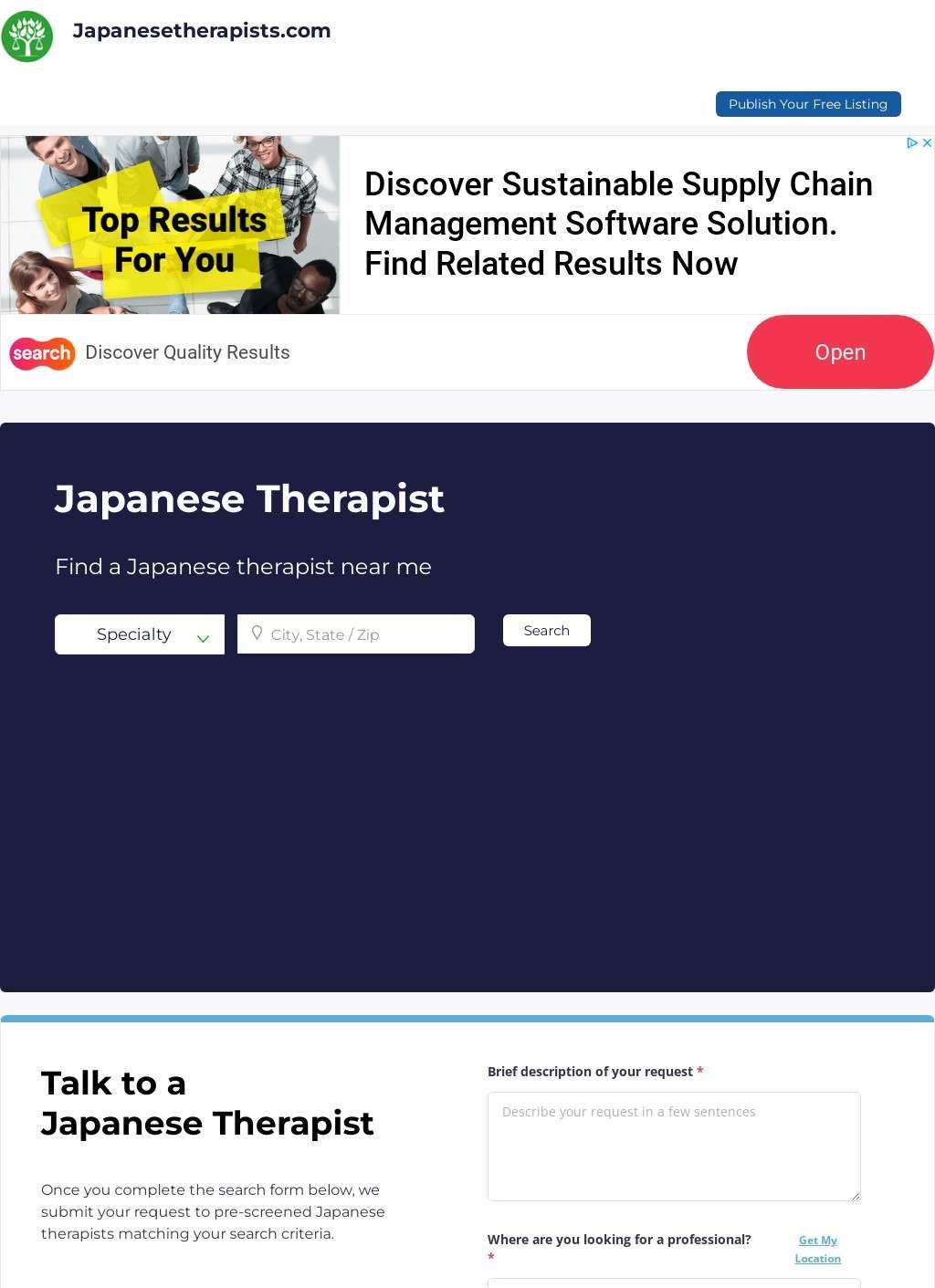
Finding a therapist who shares your language and cultural background is harder than it looks. Cold-calling practices that may not accept new clients, or scanning general directories full of professionals with no Japanese-language capacity, wastes time that someone already struggling can't really afford. Japanese Therapists is a matching service built around that specific problem. The name is accurate: Japanese Therapists connects people with Japanese and Japanese-speaking mental health professionals across the United States, Canada, and Japan. A visitor fills out a request form describing what they are dealing with, and the platform comes back with matched therapists within two business days. That single function, narrowed to one community, is the whole point of the place.
City coverage across major metros
The geographic reach is more concrete than a tagline. City-level pages cover major metros including New York, Los Angeles, and Atlanta, so a search does not dump every listing on the continent into one undifferentiated pile. Someone in a smaller city may find coverage thinner, which is the natural ceiling on any niche matching service, but the structure at least tries to keep results local instead of theoretical.
Range of practice areas
The range of practice areas is wide for a directory this focused. Listings cover anxiety, depression, addiction, family counseling, psychotherapy, adolescent issues, eating disorders, CBT, and anger management. That spread is useful because language-matched care often forces a tradeoff: you find someone who speaks Japanese but does not handle your particular issue. Japanese Therapists tries to hold both ends, cultural fit and clinical specialty, in the same search.
Weighing the request-form approach
The request-form model deserves honest appraisal. Instead of browsing and contacting individual therapists yourself, you describe your needs and wait for the match. For people who find the process of vetting a clinician exhausting, that hand-off is a real convenience. For someone who would rather scan profiles and reach out directly, the two-business-day turnaround introduces delay and a layer of mediation they may not want. Neither preference is wrong, and the form does not stop a determined visitor from working through city pages independently.
Checking therapist credentials before listing
The vetting claims are the strongest thing here, and they are specific enough to take seriously. Before a listing goes live, Japanese Therapists checks judiciary records in the therapist's state of licensure for grievances or disciplinary actions, validates the license information, and reviews each listing once a year. That is a higher bar than the typical open directory where anyone with a credit card can buy a profile. In a field where a bad match carries real personal cost, screening against state disciplinary records is work most directories simply skip.
Limits of the screening process
Two caveats keep this in proportion. The checks are described by the operator itself, and there is no outside audit of how rigorously they are applied. And because therapists can claim free listings and manage their own leads through the platform, coverage skews toward professionals who chose to be there, not a comprehensive census of every Japanese-speaking clinician in a given city. The annual review is a sensible cadence, though a license problem can surface in the eleven months between checks. None of this undercuts the screening; it just sets realistic expectations about what a pre-screened listing does and does not guarantee.
On the data side, the site states it is HIPAA compliant for user information, which is the appropriate posture for a service that collects descriptions of someone's mental health concerns through a form. A matching tool handling that kind of intake should say so plainly, and this one does.
Infrastructure behind the platform
There is also a structural detail that explains some of the polish. Japanese Therapists runs on the Heritage Web platform, with support routed through help.heritageweb.com, meaning it belongs to a family of niche directories built on shared infrastructure. The upside is a maintained, professionally run backend rather than a hobby site that may vanish. The flip side is that the platform, not a dedicated Japanese-community organization, is the entity behind the curtain, so the cultural specificity lives in the listings and the screening, not in a deep institutional connection to the community it serves.
Contact options are limited. There is no phone number or direct email address; reaching the service runs through the web-based request form, plus footer links to Contact and Help pages, with support handled through the Heritage Web portal. For a matching tool, a form-first approach is defensible since the form is the product. Someone who wants to ask a quick question before sharing personal details, or who simply prefers to speak to a person, will find that route harder than it should be. It is a measured shortcoming, not a dealbreaker, but it does ask for a degree of trust upfront.
Independent reviews remain scarce
Independent reputation is sparse. A search surfaces the site's own pages and some unrelated Yelp entries for Japanese therapists in Los Angeles, but no substantive reviews of Japanese Therapists as a platform or a service in its own right. Plenty of useful niche tools fly under the review radar, so this is not automatically a problem, but it does mean a prospective user is largely taking the site's screening claims on faith rather than a track record they can read elsewhere.
The verdict is honest and qualified. For the person this is built for, someone seeking a Japanese-speaking therapist in a covered city, Japanese Therapists offers something genuinely useful: real specialty range, a credible screening process described in concrete terms, and a low-effort entry point. The form-only contact and the sparse outside footprint create genuine friction, and the platform-operated structure means the cultural depth lives in the matching, not the brand identity. The published evidence is enough to try it if you fit the use case; not quite enough to rely on it as the only route.