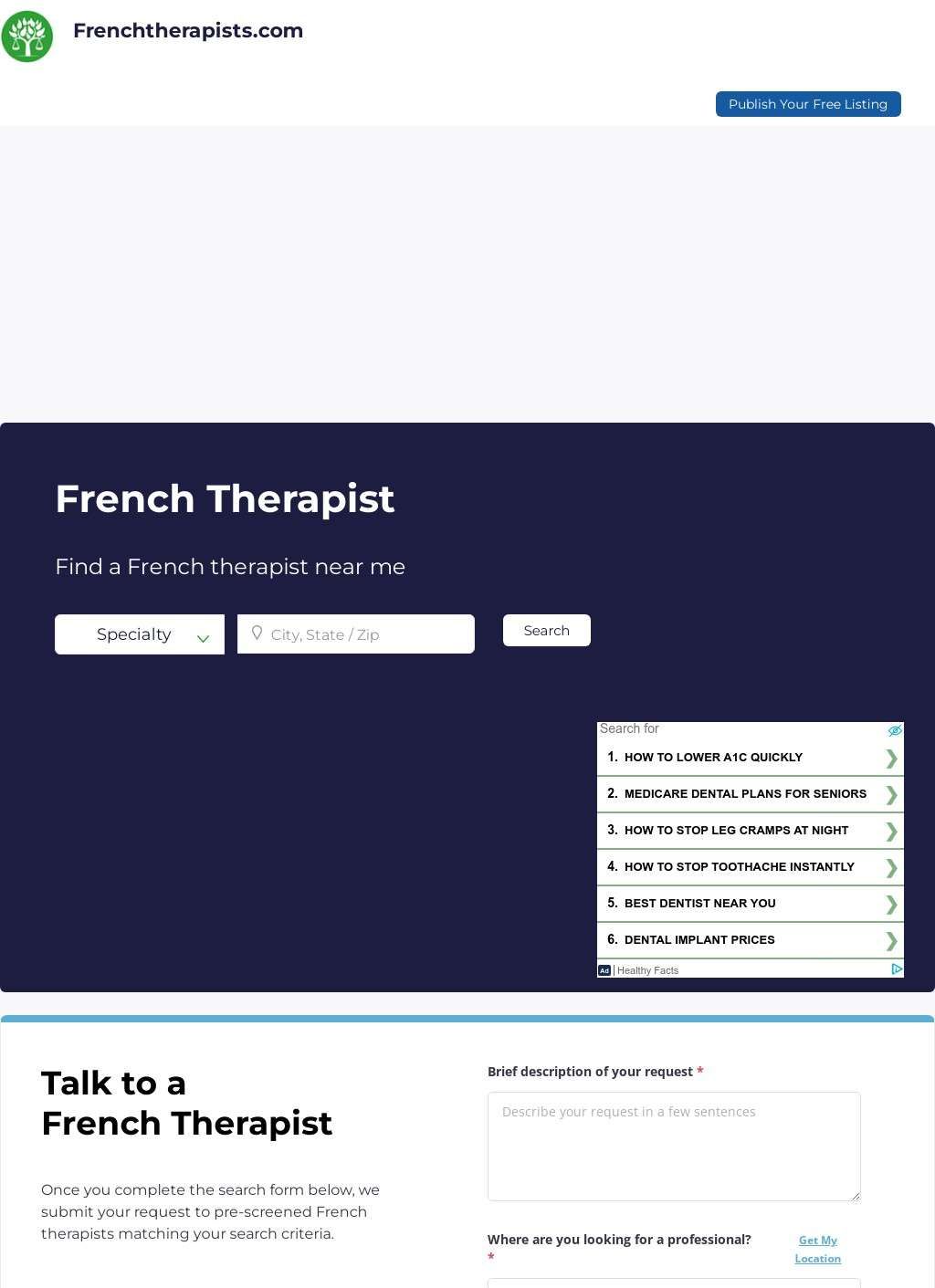
Finding a therapist is hard enough. Finding one who can hold the session in French, and who is licensed in your country, narrows the field to something most general directories are not built for. French Therapists exists specifically for that gap: it is an online matching service connecting patients with French-speaking mental health professionals across the United States, Canada, and France. The whole platform is organized around a single language requirement, and every feature follows from that.
Specialties and population groups
The specialty coverage on French Therapists is wider than you might expect from a niche service. Listings cover anxiety, depression, addiction, eating disorders, and stress, along with named therapeutic approaches such as cognitive behavioural therapy and general psychotherapy. The population coverage stretches across age groups too: individuals, couples, families, children, adolescents, and the elderly each get their own filter. A parent hunting for a French-speaking child therapist and a couple wanting joint sessions are both served, which means the matching is doing real differentiation instead of funnelling everyone toward the same generalists. Telehealth options show up in the listings as well, which matters for anyone in a region where local French-speaking providers are scarce. Once a clinician offers remote sessions, geography loosens considerably.
Telehealth options for remote access
French Therapists says it pre-screens the professionals it lists, validates their license information where applicable, and reviews the listings annually. For a category where credentials are the whole point, that annual pass and the license check are worth paying attention to. A patient choosing a therapist is making a consequential decision, and a platform that takes on the credential-checking step is doing something many open listing sites skip. That claim still stands without independent confirmation, so a cautious user would do well to verify a chosen therapist's license directly through the relevant state or provincial board before booking. That step costs nothing and is sound practice with any clinician directory, including French Therapists.
License verification and annual review
The mechanics of getting connected through French Therapists run in two directions. A user can fill out a central request form describing what they need, and French Therapists forwards it to pre-screened providers who match; a response is promised within two business days. Alternatively, a user who has already browsed the profiles can message a specific therapist directly through the platform. Those two paths cover the two ways people search for care: some want to describe their situation once and wait for matches, others have already spotted a name they want to approach. Either way, each profile shows credentials, experience, and specialties, which gives a visitor enough to compare two candidates before reaching out.
Two paths to connect with providers
The site also organizes browsing pages by condition and by geography, so a visitor can land on the anxiety listings or the entries for a particular state without touching the search box. A newsletter signup sits alongside those pages. These are modest additions, but they suggest a platform meant to be consulted more than once. One detail worth noting is that the French Therapists help center links out to heritageweb.com, which tells you the whole thing runs on Heritage Web's directory software rather than a purpose-built system. That explains the clean, familiar structure of the listing and profile pages, though it is unlikely to matter to a patient who is just looking for a therapist.
Browsing by condition and location
The contact situation on the platform side is spare. There is a contact page at /contact, but the landing page carries no phone number, no posted email, and no physical office address. All communication with French Therapists runs through the request form, and communication with the therapists runs through the messaging system. For an intermediary service, that is a defensible design: the form is the front door by intent, and a patient is meant to be passed to a clinician rather than to correspond with the platform's staff. A visitor who wants to confirm there is a responsive operation behind the listings has less to grab onto than a posted phone line would offer, and that is worth knowing before investing time in the process.
How does the platform handle contact?
Outside reputation is quiet. French Therapists does not appear to have gathered notable third-party reviews: no Google rating cluster, no Trustpilot presence, no significant commentary in either direction. That is not a damning result for a specialized service in a defined language niche. The people it helps may simply not leave public feedback about something as private as therapy, and volume on review platforms is largely a function of consumer-app scale. What it means practically is that French Therapists asks a user to take its vetting claims on faith, and a careful person will want to confirm the chosen therapist's license independently before going further.
Absence of third-party reviews
What French Therapists gets right is focus. It does one specific thing, finding French-speaking therapists in three countries, and it builds the search, the filters, the vetting process, and the two contact routes around that single purpose. The breadth within the niche keeps it from feeling cramped: a teenager, a grieving widow, and a couple in conflict can each find a relevant provider. The cross-border scope is the detail that sticks longest.
Cross-border search across three countries
A single search covering licensed French-speaking clinicians in the United States, Canada, and France is an unusual thing to find in one place, and it means someone who relocates between those countries could return to French Therapists in a new city and use the same tool again. The platform narrows a genuinely hard search down to a manageable shortlist, which is the most useful thing a matching service can do.