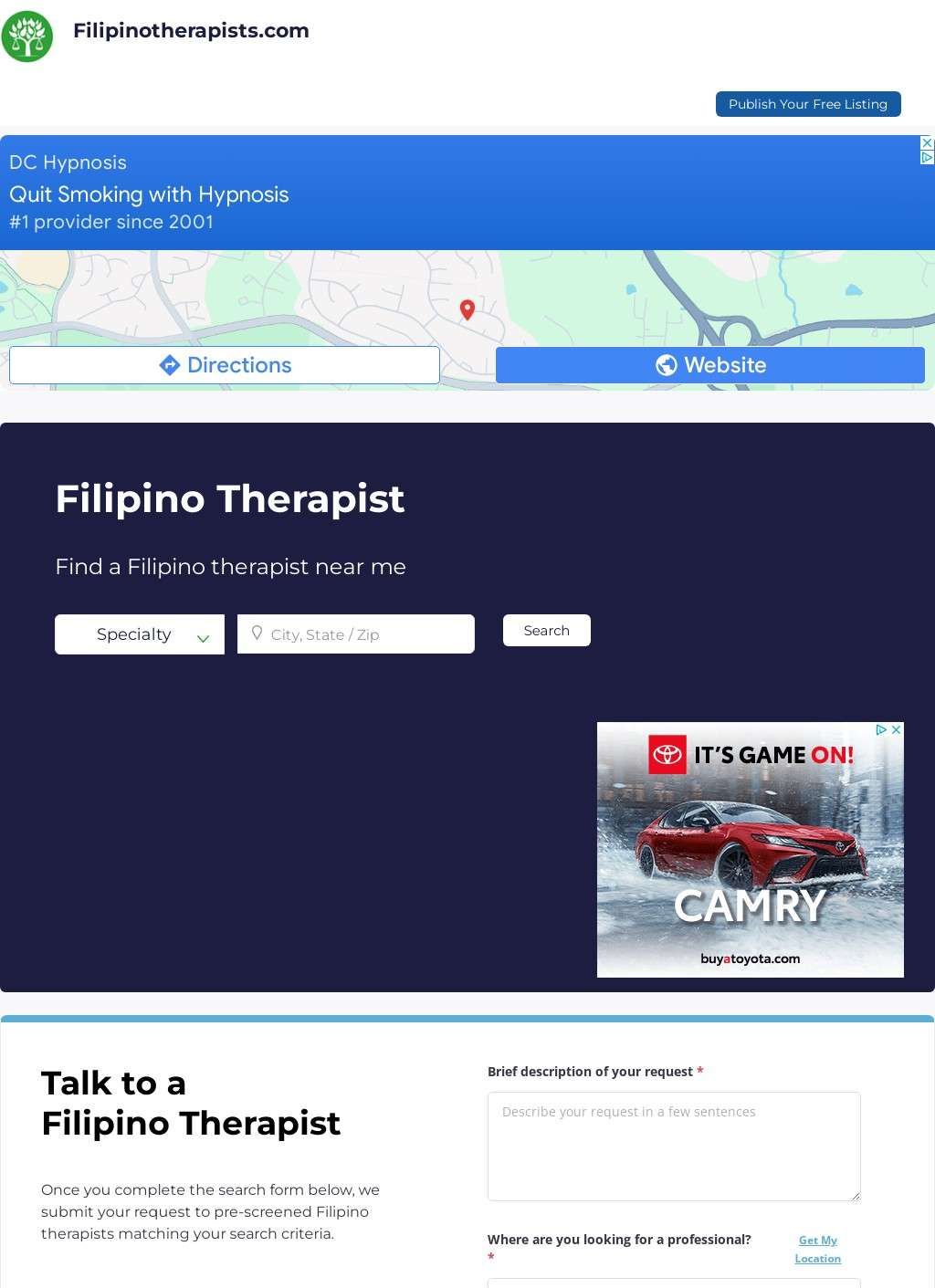
Finding a therapist who shares your language and understands the cultural weight behind what you are trying to say can take weeks of dead ends, especially if you want someone who speaks Tagalog or grew up inside the same family expectations you did. Filipino Therapists is built for exactly that gap. A user comes in, describes what they need (the specialty, the city or state, the age group involved), and Filipino Therapists routes that request to pre-screened professionals who match. Instead of scrolling page after page of generic listings, you describe the situation once and let the matching do the legwork.
Services and client populations
The reach is broader than the name might suggest. Filipino Therapists covers individual counseling, family work, and marriage counseling, and lists practitioners who treat anxiety, depression, addiction, and stress. Modalities named on the site include CBT and general psychotherapy, with telehealth options for people who cannot or would prefer not to travel to an office. Clients span the full age range: children, adolescents, adults, and the elderly. That last group is worth naming explicitly, because elder mental health is an area many directories quietly skip. Seeing it here points to the people behind Filipino Therapists having thought past the obvious twenty-to-forty demographic, and that kind of deliberate scope is a reasonable indicator of how seriously they took the design.
State and city directories
Geography is handled through sub-pages for individual states and cities, with California, New York, Texas, and Virginia among those carved out directly. For a service that leans on telehealth, that local structure still has practical value. Plenty of clients want someone licensed in their own state, or close enough to see in person if a session ever needs to happen face to face.
Quality assurance processes
Free directories tend to fill with stale or unverified profiles, so the question of how Filipino Therapists keeps quality up is a real one. The site addresses it in two stated ways: license validation where applicable, and an annual review of listings. An annual sweep is a fairly loose cadence in a field where a license can lapse mid-year, and neither commitment is a guarantee that every profile is current. Still, naming a review process at all puts Filipino Therapists ahead of many listing sites that check nothing after a profile goes live.
Free listings and client responsibility
Therapists publish for free, which has a predictable upside and a predictable cost. More practitioners list when there is no fee, so a searcher has more people to choose from. The cost is that the burden of judgment shifts onto the client, who should read each profile carefully and confirm credentials independently. Filipino Therapists gives you the individual profiles and a direct messaging feature to start that vetting, which is the right tool for a searcher's hands, but it is a starting point. It is not a substitute for independent due diligence.
Cultural focus on Filipino Americans
The cultural focus is the real reason most people will land on Filipino Therapists rather than a mainstream platform. Culturally sensitive care and Tagalog-language access are stated priorities, and for a Filipino American working through grief, family conflict, or the particular strain of being caught between two sets of cultural expectations, talking to someone who already gets the context can shave whole sessions off the process. That value is narrow and genuine, and Filipino Therapists does not pretend to be anything wider than what it is.
On the practical side, contact runs through a form linked in the footer. There is no public phone number listed; a gap that is less consequential for a matching directory than it would be for a direct service provider. More relevant are the response commitments: direct messages to a therapist are promised a reply within 24 hours, and general requests within two business days. Concrete numbers like those are easier to hold a service accountable to than vague reassurances, and Filipino Therapists is right to state them plainly.
A note on infrastructure: the platform runs on HerITageWeb, with a help center at help.heritageweb.com. For most users that is invisible, but it means support and account questions have a defined home rather than vanishing into a void.
How should you verify a therapist's credentials?
No notable third-party reviews of Filipino Therapists turned up in any search, and that is worth stating plainly. The responsiveness claims and the screening process have not been stress-tested publicly by a large pool of past users, so a first-time visitor is, to some degree, taking the site at its word. That is the honest limitation here, weighed against a concept that addresses a real and underserved need.
Submit a request describing your specialty, location, and age group, message a couple of matched profiles, and ask each therapist directly to confirm their current license. The match costs nothing; the verification you do yourself is what makes it useful.