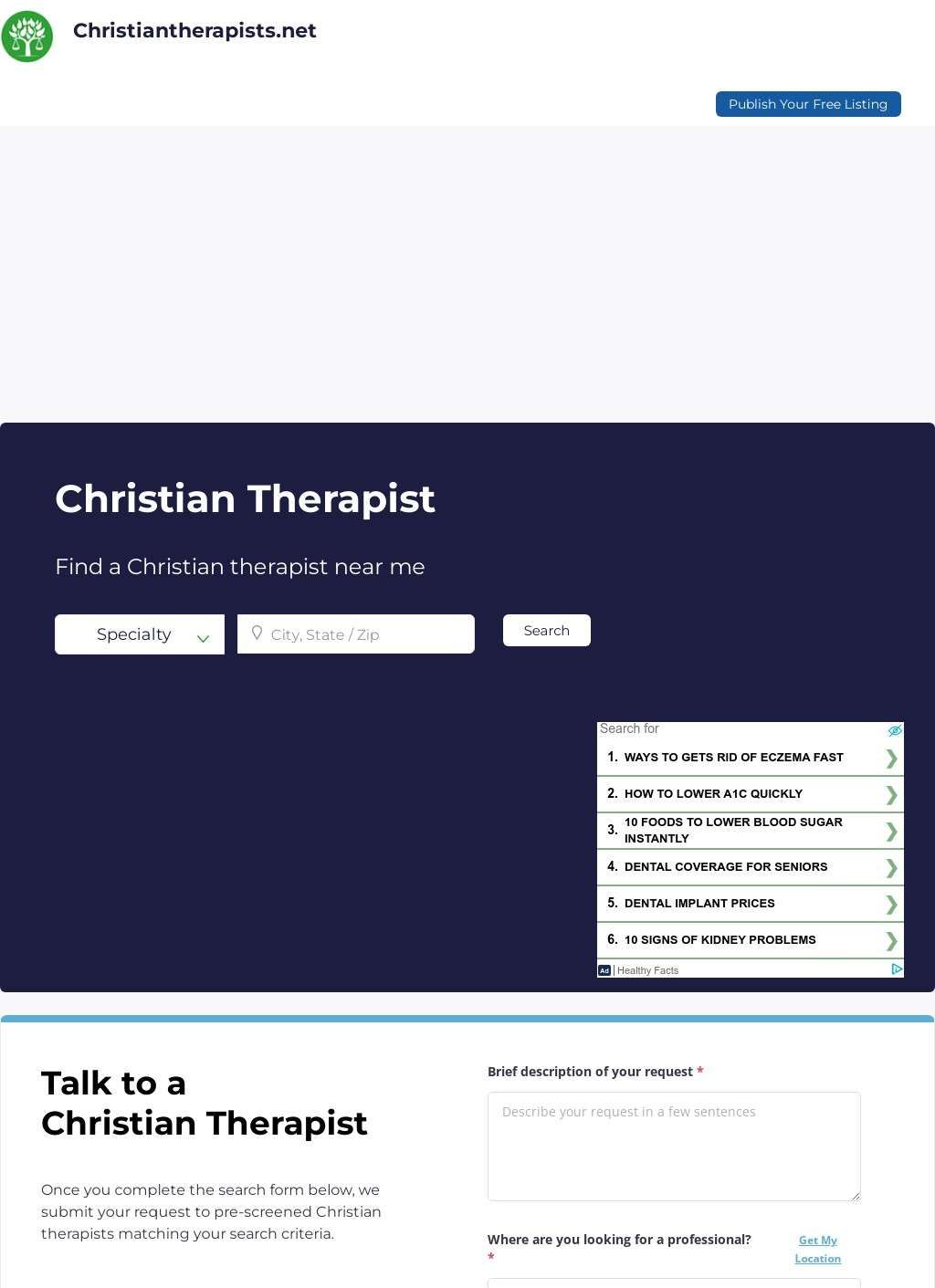
Type a short note about what you are facing and where you live, hit submit, and the site runs your description against a database of pre-screened professionals. That is the whole mechanism. No money moves in either direction: the person searching pays nothing, the therapist who wants to appear pays nothing to be listed. Free on both sides, which fits a referral mission better than a revenue one. So the verdict is a qualified yes, and a narrow one. Christian Therapists is useful to exactly one kind of person: someone for whom shared faith between client and counselor is the deciding factor. If that is you, this beats sifting general directories and guessing each therapist's beliefs from their website copy. If it is not you, there is little here that a broader platform does not already do better.
Browsing therapists by specialty and location
The form is one entry point. You can also browse straight by specialty or by location. Coverage spans major US cities, a nationwide option, and Christian Therapists claims some reach beyond the United States too. Whether a given small town has any listing at all is anyone's guess from the homepage, but the structure is there. The specialty list is the part that earns respect. It is granular in a way these niche sites usually are not: addiction, anxiety, depression, grief, eating disorders, marriage and family work, relationship counseling, child and adolescent care, and telehealth all stand as their own categories. These work as genuine filters, not decorative tags slapped over one undifferentiated pile of names. For a niche this size, Christian Therapists has put unusual care into the taxonomy.
Each therapist profile lists credentials plus whatever extra the professional decided to publish. You read the name, scan the qualifications, and message the therapist directly through a tool built into the profile page. At that handoff, Christian Therapists steps out. Everything after is between you and the counselor. Christian Therapists introduces, then gets out of the way, and it does not pretend the introduction is the same as the care.
Messaging therapists directly through profiles
Here is what separates this from a plain aggregator. Therapists are pre-screened, license information is validated where applicable, and every listing gets reviewed once a year. Annual reviews are tedious, thankless work, and plenty of directories skip them outright. Skipping them is how a site ends up cheerfully sending people to a practice that shut its doors two summers ago. A yearly cycle says someone here treats the database as a thing to tend, not a seed dropped once and left to rot.
That "where applicable" hanging off the license-validation claim deserves a second look, though not as a weasel word. Licensure rules differ by state and by profession, and any directory promising blanket verification of everything is overstating its hand. The qualifier just reflects how messy real regulation is. Fair enough. The harder catch is that none of the screening can be checked from outside. A visitor takes the site's word for its own method, with no independent audit to lean on. That is not fatal in this corner of the world, but it does mean a Christian Therapists profile should not be mistaken for a credential check you ran yourself.
Weighing license verification limits
The footer carries Privacy, Terms, a Disclaimer, and a HIPAA compliance page. On a platform where the thing people type into the box is, almost by definition, sensitive, a stated HIPAA posture is the floor, not a flourish. Not every site in this space bothers to publish one, so credit where due. The help portal for the site itself sits at help.heritageweb.com, linked in the footer next to social accounts on Facebook, X, LinkedIn, and Instagram. No phone number or email shows up on the main page. Reaching the team behind Christian Therapists means going through that help portal. The channel that actually counts, though, is the messaging tool on each profile, because the therapist is the person you need, not the operator behind the directory.
Privacy policies and HIPAA disclosures
Go looking for what users have said about christiantherapists.net and you turn up the site's own pages plus a scatter of unrelated hits. Google, Trustpilot, Yelp, the BBB: no rating counts on any of them. Nothing positive, nothing negative, nothing at all. A quiet referral platform tucked into one specialty corner of mental health care does not always leave a visible trail, and an empty one is not proof of anything bad. It does leave you without a single past user to tell you whether the screening at Christian Therapists delivers once a real person needs it.
And that absence sits awkwardly, because the entire pitch rests on the screening being good. The annual review and the careful license-validation wording read like genuine operational commitments. They also read like exactly the sort of claim a site would make whether or not it followed through, and there is no way from the outside to tell the two apart. You can verify a given therapist yourself through a state licensing board once you have the name, which blunts the problem at the individual level. What stays unanswered is the systemic question: across the whole database, how many stale or inactive listings slip past the yearly sweep. The site's own account is the only evidence on offer, and that is a real limit on how much trust the directory has earned, not a detail to gloss over.
Checking reputation across review sites
Telehealth gets its own category, not a buried footnote. Someone in a rural county, or in a city where faith-aligned counselors are simply scarce, is not stuck with whatever happens to be down the road. Build a directory strictly around physical proximity and you quietly exclude a chunk of the very people Christian Therapists is reaching for. Treating remote sessions as a first-class filter mirrors how therapy is sought and delivered now, and it widens the platform's practical reach by a lot.
So: a free, faith-filtered, annually maintained directory with HIPAA disclosures, real specialty depth across more than ten categories, telehealth in the mix, and a complete blank where outside reputation would be. The profile-level messaging and the pre-screening are the two features that lift Christian Therapists above a flat roster of names. For the right person the payoff is plain: faith alignment becomes the organizing principle from the first click, deleting a slow guessing step that general directories force on everyone. The platform knows what it is. It states its scope flatly on the About page and never strains to also be a content library or a community forum.
What no outside party can settle is how dependably those annual reviews catch the listings that have gone dark, and how rigorous the first screening really is when the operator's own description is the sole record of it. For a service whose only job is to put qualified, currently practicing professionals in front of you, that uncertainty bites at the exact spot where it hurts most.