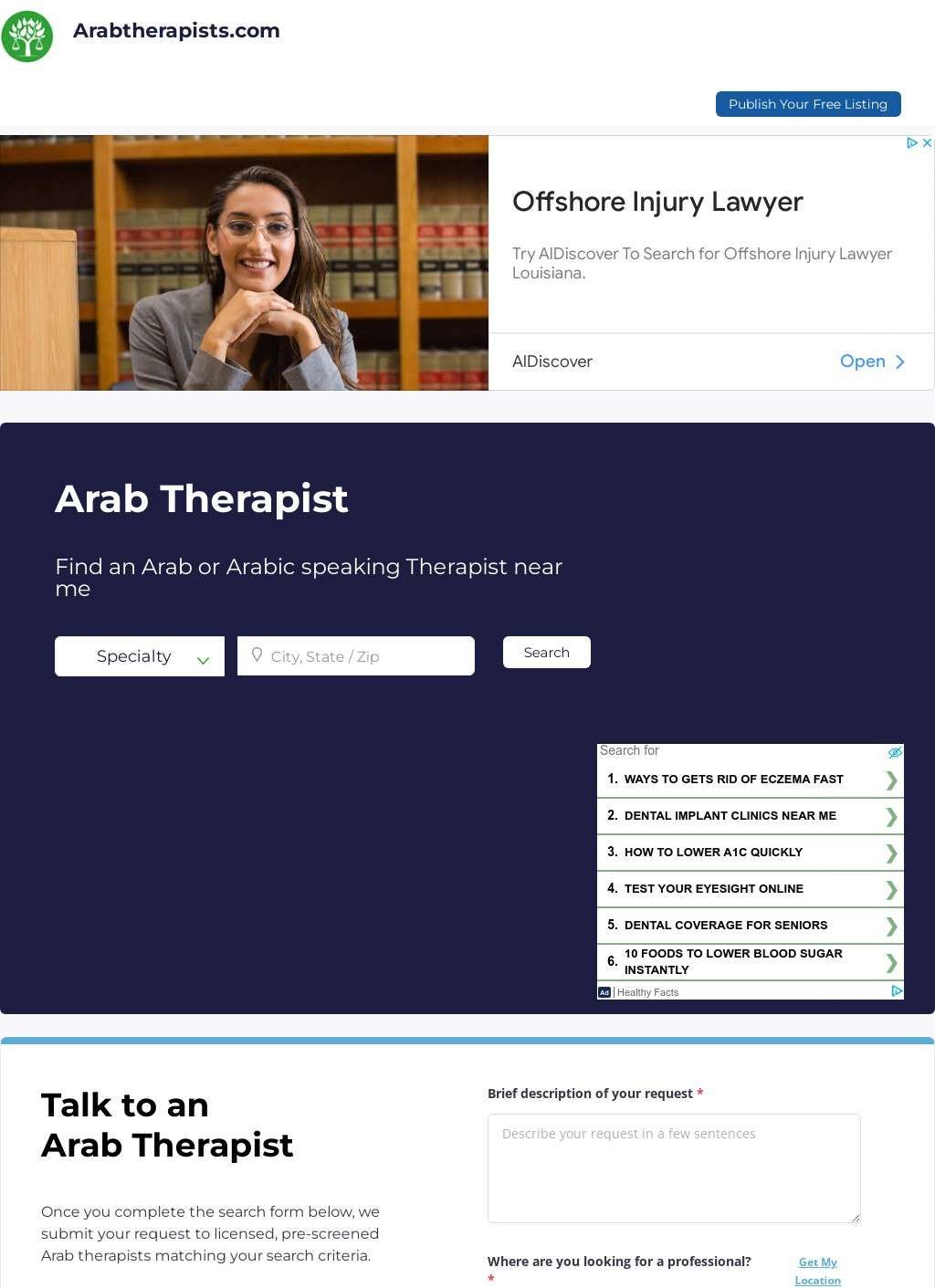
Type a city, state, or zip into Arab Therapists and the site hands you a shortlist of Arabic-speaking mental health practitioners near you, sorted by the kind of care you need. The practice-area filter splits into Adult, Child and Adolescent, Adolescent, and Child 1-12, a more granular age breakdown than the typical therapist finder bothers with. Underneath that sit the broader groupings: Counseling in its several forms, Psychologist and Psychotherapy, CBT, Hypnosis, and a long Specialized Therapies column covering addiction, anger, anxiety, depression, eating disorders, grief, personality disorders, sex, stress, substance abuse treatment, support groups, and telehealth. The premise is narrow on purpose. Arab Therapists is built for people who want a clinician who shares their language or cultural background, and the whole search runs around that one filter.
That focus is what makes the site worth taking seriously. Language and cultural fluency matter in therapy in a way they do not in, say, plumbing, and a general-purpose directory rarely lets you filter for a clinician who understands the family dynamics or religious context a client might be describing. Arab Therapists picks a real gap and organizes itself cleanly around it. The Counseling category alone breaks into Family, Individual, Marriage, Relationship, and Crisis Intervention, so a person looking for marriage help does not wade through addiction listings to get there.
A request form instead of profile browsing
The centerpiece is a request form the site calls "Talk to an Arab Therapist." Instead of clicking through profile after profile, a visitor writes a short description of what they are dealing with, adds their location, name, phone number, and email, and submits it. Arab Therapists then forwards that request to licensed, pre-screened practitioners who match the search criteria, and those clinicians follow up directly. For someone in distress, that is a lower-friction path than cold-reading a dozen bios and guessing who fits. It shifts the effort of matching from the client to the network.
Before sharing personal details
There is a tradeoff baked into that design. Handing over a phone number and a description of a mental health need means trusting the platform with sensitive information before knowing which therapist will see it. Arab Therapists says requests go only to pre-screened, criteria-matched practitioners, which is reassuring on paper, though whether that promise holds in practice is not something the page itself can prove. The convenience is genuine. The privacy questions are the price of it.
The form also doubles as the site's main way of reaching anyone. There is no phone number, street address, or general email visible on the homepage, and no obvious contact page. That is a real gap: if a submitted request goes unanswered, or someone has a question that is not "please match me with a therapist," it is unclear where they turn. A single form is a narrow front door for a service that deals in something as serious as mental health.
The business model behind paid leads
Arab Therapists is a two-sided operation, and the therapist side is where its business model shows. Practitioners register through a "Manage Listings" area, and there is a "Paid Leads" section, which spells out plainly how the platform makes money: it routes client requests to therapist members, and those leads are monetized. That is a common and legitimate structure for a matching service, and the site is open about it instead of hiding the mechanism. Registered users also get notifications, referrals, and account settings, features that point at the therapist accounts more than the client ones.
Check the screening and license claims
On quality control, Arab Therapists makes several specific claims worth weighing. It states that every listed therapist and psychologist is pre-screened, that license information is validated where applicable, and that listings are reviewed once a year. Therapists are also invited to publish free listings, which suggests the paid element is for lead delivery rather than mere presence. Annual review and license validation are the right things to promise for a directory of clinicians, and they raise the bar above a self-serve listing wall where anyone can post. The claims would need independent confirmation, but stating them shows the operators know where the credibility of a service like this lives.
The lead-generation angle does color how a client should read the matches, though. When a platform earns per lead, the incentive is to pass requests to paying members, and a visitor cannot easily tell whether the therapists surfaced are the best fit or simply the ones subscribed to leads in that area. That applies to nearly every service in this space, Arab Therapists included, but it is worth keeping in mind once the follow-up calls start.
One point stands apart from the rest: the platform pre-screens listings and validates licenses before publishing them. In a field where unvetted listings can point vulnerable people toward unqualified practitioners, screening is not a nicety. If Arab Therapists holds to it consistently, that single practice is the strongest thing it has going for it.
Does Arab Therapists have outside reviews?
On reputation, the picture is bare. A search for outside reviews of Arab Therapists turned up nothing notable. What does surface is easy to confuse with it: a similarly named service, arabtherapy.com, carries testimonials and a reviews page, but that is a separate business, and its feedback does not belong to Arab Therapists. A directory called Mind Diagnostics showed a 4.7-star profile, but that was an individual therapist unrelated to this platform. There is no independent track record to lean on, positive or negative. The service may simply be young or low-profile, but a prospective user has no third-party evidence to go on, only the claims Arab Therapists makes about itself.
That absence weighs more here than for many other services. Trusting a platform to route you or a family member to a therapist calls for some sign that others have used it and been treated well. Arab Therapists does not yet offer that from the outside, so the full weight of trust falls on its pre-screening promises and on whichever clinician calls back.
Weighing strengths against gaps
Set against comparable tools, Arab Therapists is well organized and clear about what it does. The taxonomy is thorough, the specialty and age filters are more detailed than average, and the request form is a sensible way to cut down the search burden on someone who may not have the energy for it. The cultural and language niche is genuine and underserved, and building a whole service around it is a reasonable idea executed with care.
Where it falls short is verification and reach. The near-total lack of direct contact information, the reliance on one form as the only visible channel, and the empty outside-reputation column all pull against the confidence the screening claims are trying to build. None of that makes the service untrustworthy; it means a new user is being asked to take the platform largely on faith. For someone seeking an Arabic-speaking therapist, Arab Therapists is worth trying, since the alternative is sifting a general directory with no cultural filter at all. Go in clear-eyed: submit the form, see who follows up, vet that clinician's license, and treat the match as a starting point rather than a guarantee. The idea behind Arab Therapists is strong; the proof that it delivers is still mostly the platform's own word.