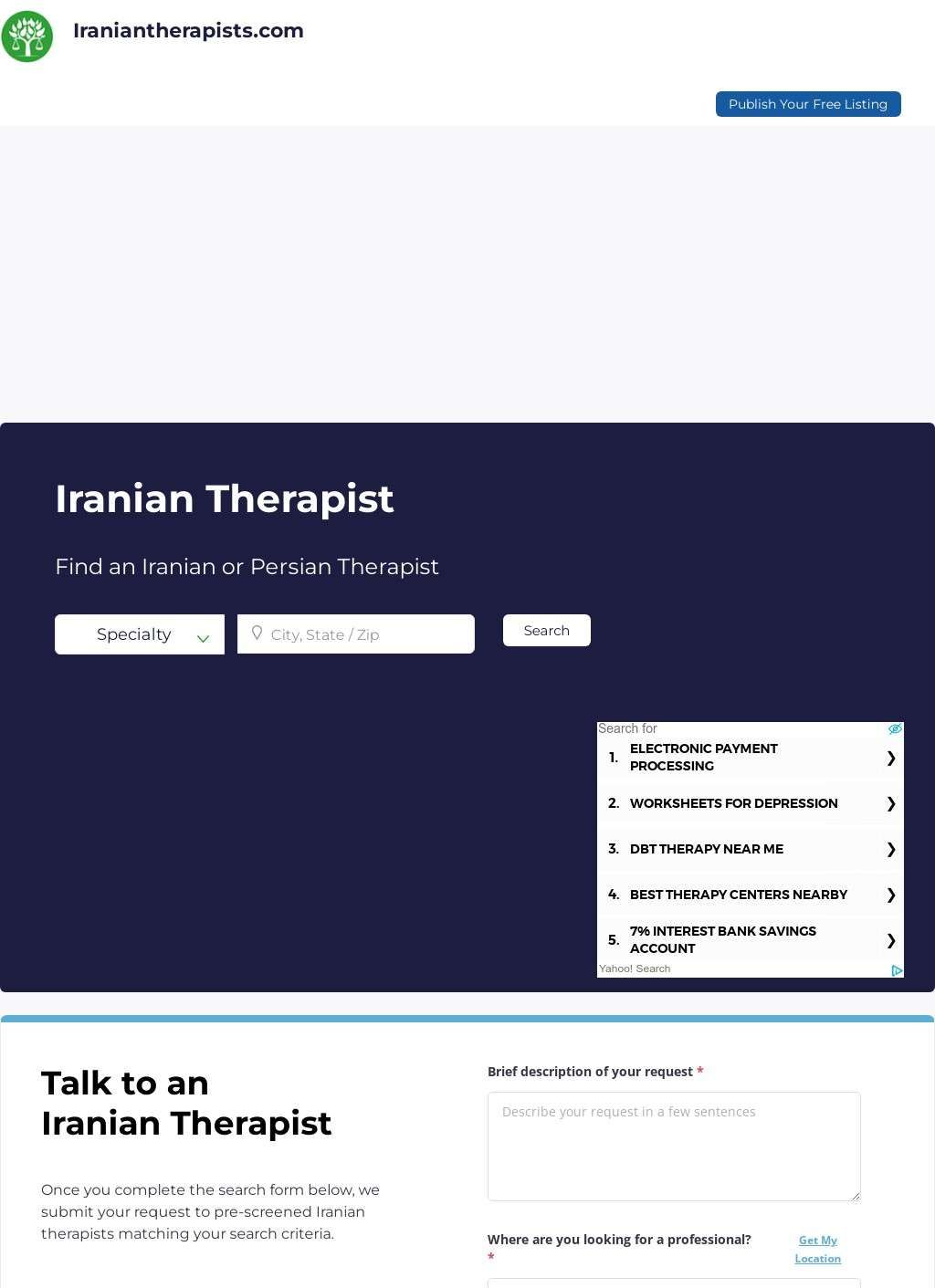
Built around a single, deliberate premise, Iranian Therapists is an online matching service and directory that connects people with Iranian and Persian, Farsi-speaking mental health professionals across the United States, Canada, and Iran. Someone who grew up speaking Farsi at home, or who wants a counselor who understands the cultural weight behind a family conflict, can describe what they are going through and be paired with a practitioner who shares that background. That cultural-match angle is the whole reason Iranian Therapists exists, and it shapes everything from the search filters to the way clients are invited to submit a request.
Search filters by specialty
The browsing setup is more structured than a flat list of names. You can move through the roster by specialty, with categories covering individual therapy, family and marriage counseling, child and adolescent work, cognitive behavioral therapy, and general psychotherapy. There is a second way in, organized around the issue a person is dealing with: anxiety, depression, addiction, eating disorders, grief, and ordinary stress all have their own paths. A third route sorts by geography, listing US cities alongside options for Canada and Iran. For a visitor who does not yet know whether they want a CBT specialist or simply someone nearby who speaks the language, having three separate doors into the same pool is genuinely useful.
Extending reach through telehealth
Telehealth is part of what Iranian Therapists offers, and that extension is meaningful for a service spread across three countries and a diaspora that does not cluster neatly in a few zip codes. A Farsi-speaking client in a small town may have no local option at all, so the remote-session listings widen the practical reach well beyond the cities named on the page. That detail does more work than it first appears, because the entire value of cultural matching collapses if the only matched therapists are an hour's drive away.
Comparing self-directed search and requests
Two paths run side by side on Iranian Therapists. The first is self-directed: a filtered search form lets you narrow by specialty, condition, and location and then reach out to a therapist directly through messaging. The second is the request system, where you write up your situation and Iranian Therapists returns matches from what it describes as pre-screened therapists. The pre-screening claim is the sort of thing that pays off enormously if it holds, since vetting is exactly the labor a person in distress is least equipped to do for themselves. The page states it plainly without walking through the criteria, so a cautious user would want to confirm what screening actually involves.
Messaging before a first session
Direct messaging is a sensible touch. A client can open a conversation, gauge the fit, and decide whether to go further, rather than handing over a phone number and hoping someone calls back. For first contact around something as personal as therapy, a written exchange lowers the stakes considerably. A newsletter signup rounds out the tools, which suggests the operators want an ongoing relationship with visitors rather than a one-time handoff.
The audience Iranian Therapists serves
The audience here is clear enough: people of Iranian or Persian heritage, and Farsi-speaking clients more broadly, who place a premium on a therapist understanding the unspoken parts of their lives. Concepts of family obligation, immigration strain, generational distance, and shame around mental health do not always translate cleanly into a session with a counselor from a different background. Iranian Therapists is open about serving that specific audience and does not pretend to be a general therapy portal, which is a point in its favor.
Is contact information hard to find?
Where the experience gets harder to evaluate is contact transparency. There is no phone number, no street address, and no direct email to be found. What you get instead is a general help form and a documentation link. For a service that brokers something as sensitive as mental health connections, that is a noticeable gap. A form is a reasonable front door, but the absence of any phone line or physical address leaves a visitor with no way to reach a human quickly if a match goes wrong or a question is urgent. People sharing details about their anxiety or grief tend to want a visible, accountable point of contact, and Iranian Therapists does not provide one readily.
Checking outside reviews and reputation
Outside reputation is another area where Iranian Therapists offers little to go on. A search turned up no notable third-party reviews on the usual platforms: no Google ratings, no Trustpilot or Yelp presence tied to this specific site. What did surface were several competing directories with confusingly similar names, including iranianpsychologists.com, iranianpsychologist.org, and iranian-therapists.com. That crowded naming space is worth flagging, because a user could easily land on a near-identical address and assume it is the same operation. Without outside reviews, a prospective client has little independent confirmation and has to judge the service largely on what the site itself presents.
Taken together, the offering from Iranian Therapists is coherent and the niche it fills is a genuine one. The specialty, condition, and location filtering is well thought out, telehealth extends the reach considerably, and the cultural focus answers a need that mainstream platforms handle poorly. The soft spots are accountability and proof: limited contact options and no external track record.
Weighing Iranian Therapists against Psychology Today
Weighed against a mainstream platform like Psychology Today, which carries far deeper verification, public credentials, and a long review history, Iranian Therapists is narrower but more culturally precise. Psychology Today will list more practitioners and more reassurance around vetting, yet it cannot promise the Farsi-speaking, heritage-aware match that is the entire point of Iranian Therapists. That trade-off is a meaningful one, and the answer depends on how central cultural and linguistic fit is to the person searching. For many in the Iranian diaspora, that fit is precisely what has made finding a therapist difficult in the first place, and Iranian Therapists addresses it more directly than any general directory does.