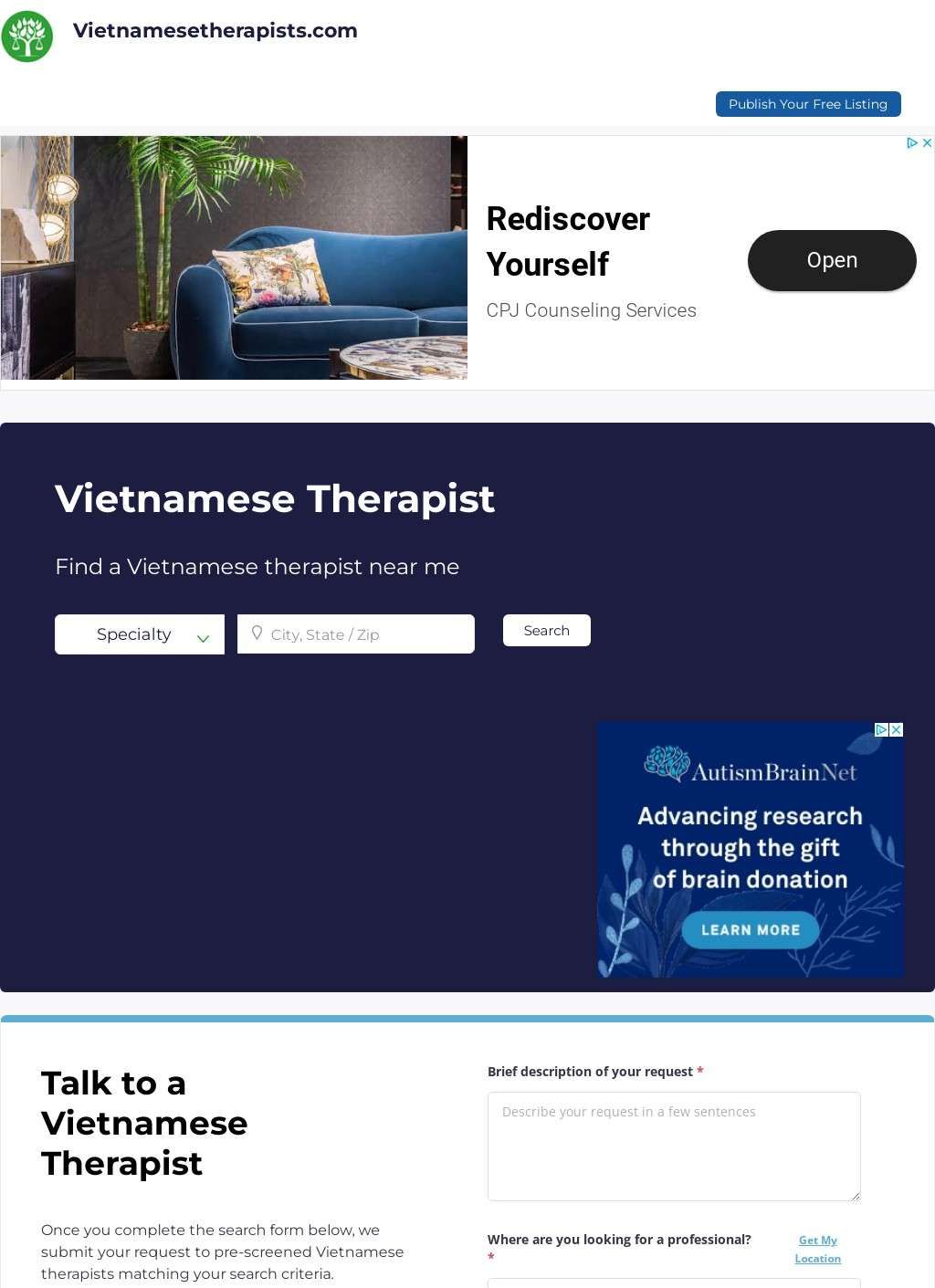
No therapist on Vietnamese Therapists pays to be listed, and no client browses a roster of profiles either. The whole thing runs on a single request form. You describe what you need, where you are, and what kind of help you are after, and the site passes that to Vietnamese-speaking professionals it has already vetted. That setup makes Vietnamese Therapists more of an introduction service than the searchable provider list most mental health sites turn out to be, and it shapes everything about how the platform feels to use.
How the request form replaces a searchable directory
The reason for narrowing to Vietnamese-speaking counselors is not cosmetic. Therapy depends on a client being able to say uncomfortable things precisely, and a second language gets in the way of that for a lot of people, especially around family, shame, grief, or the kind of generational tension that runs through many immigrant households. A counselor who shares the language, and usually the cultural shorthand behind it, removes a layer of translation that would otherwise sit between a person and their own words. Vietnamese Therapists is built entirely around closing that gap, which is a clearer reason to exist than many referral sites can offer.
Why Vietnamese language matters in therapy
Coverage is wider than the name might suggest. In the United States Vietnamese Therapists organizes its listings by state and then by city, with California, New York, Colorado, Illinois, Georgia, and Pennsylvania among the locations that have their own pages, alongside others. It also reaches into Canada and Vietnam itself, which makes it useful both for diaspora communities and for people back home looking for help in their own language. The structure runs country to state to city, so a person in a specific metro area can drill down instead of wading through a national list that has nothing near them.
Locations and clinical services available
The clinical range is broad without being vague. Individual therapy sits next to family counseling and marriage counseling, and there is room for addiction, anxiety, depression, and stress management. Psychotherapy is named as its own category, and the platform extends to child and adolescent therapy as well as support for elderly clients. Including both ends of the age range addresses something practical: a Vietnamese-speaking family often needs help for a teenager and an aging parent in the same household, and both can be served through one channel. Telehealth is listed as an option too, which widens the practical reach well past whichever cities happen to have a physical practitioner.
Free listings with annual credential verification
For the therapists themselves, listings are free to publish. Vietnamese Therapists says it validates license information and reviews the listings once a year. Free entry plus annual revalidation is a sensible middle ground. It keeps the directory populated without a paywall that would exclude smaller or newer practitioners, while the license check and yearly review push back against listings going stale or a credential lapsing unnoticed. Whether that screening is as thorough in practice as it sounds can only be judged once actually talking to a matched therapist, but the stated policy is more than many comparable sites bother to publish.
How the matching works is worth slowing down on, because it defines the experience. There is no public profile grid to scroll. You fill in the "Talk to a Vietnamese Therapist" form with your criteria, and Vietnamese Therapists forwards the request to pre-screened therapists who fit. The work of comparing one practitioner against another happens behind the curtain, inside whatever process Vietnamese Therapists uses to decide which names get the request. That keeps the credential-sorting off the client, which is genuinely helpful when someone is already stressed and needs to reach a competent person who speaks their language. The flip side is that you cannot vet anyone yourself before submitting. You are trusting the platform's screening rather than reading a bio, checking a specialty, or forming a first impression from a practitioner's own words.
That trust requirement runs straight into the site's weakest area, which is its own transparency. There is no phone number anywhere on the homepage or the location pages, no email address, and no physical mailing address. Contact happens through the request form, plus a generic contact link tucked into the footer. For a service pitching itself as the bridge between vulnerable clients and the right professional, the absence of any reachable contact point is fair to flag. Someone handing over details about their mental health reasonably wants to know who is on the other end, and the form-only approach gives little back before asking for that faith.
A few clues about that operator do surface. Help resources for Vietnamese Therapists live at help.heritageweb.com, which points to the platform being built on or affiliated with HeritageWeb infrastructure. A monthly newsletter signup is offered as well, which is one of the few ongoing touchpoints the site gives a visitor who is not ready to submit a request yet. Neither substitutes for a clear way to reach a human, but the HeritageWeb connection at least suggests there is an established outfit behind the front end, not an anonymous landing page thrown up overnight.
The credibility question is harder to answer than usual, because there is almost nothing external to lean on. A search for Vietnamese Therapists turns up the site's own location pages and little else. No Google rating, no Trustpilot or Yelp presence, no Facebook reviews, no BBB file, nothing that shows real clients reporting back on whether the matching actually delivered a good counselor. That absence does not prove the service is bad. Niche referral platforms rarely accumulate public review trails the way restaurants do, and mental health is among the last things people post about under their own name. The silence around Vietnamese Therapists says more about the subject than about service quality. Still, it means a prospective user has no independent voices to weigh, only the platform's own description of how it operates.
The honest position is mixed. The premise is strong, the need is genuine, the geographic and clinical coverage is broad, and the stated vetting policy is reasonable. Against that sit two soft spots: contact information that is harder to find than it should be, and a complete absence of outside feedback. Neither sinks the idea, but together they mean someone using Vietnamese Therapists is largely taking the platform at its word. The experience will rest on the therapist who comes back, and nothing on the site lets you preview that.
Set against a general directory like Psychology Today, the trade is clear enough. Psychology Today lets you read full profiles, see photos, filter by insurance, and message a therapist directly, but its Vietnamese-speaking results are scattered through an enormous English-first index and you do the cultural filtering yourself. Vietnamese Therapists handles that filtering by default, treating language and cultural context as the starting point rather than an afterthought. The gap in outside feedback and the limited contact options are genuine drawbacks, but they do not cancel the value of having one dedicated channel for this language and this community. Judged on what the site publishes, the premise is sound and the coverage is honest about its scope.