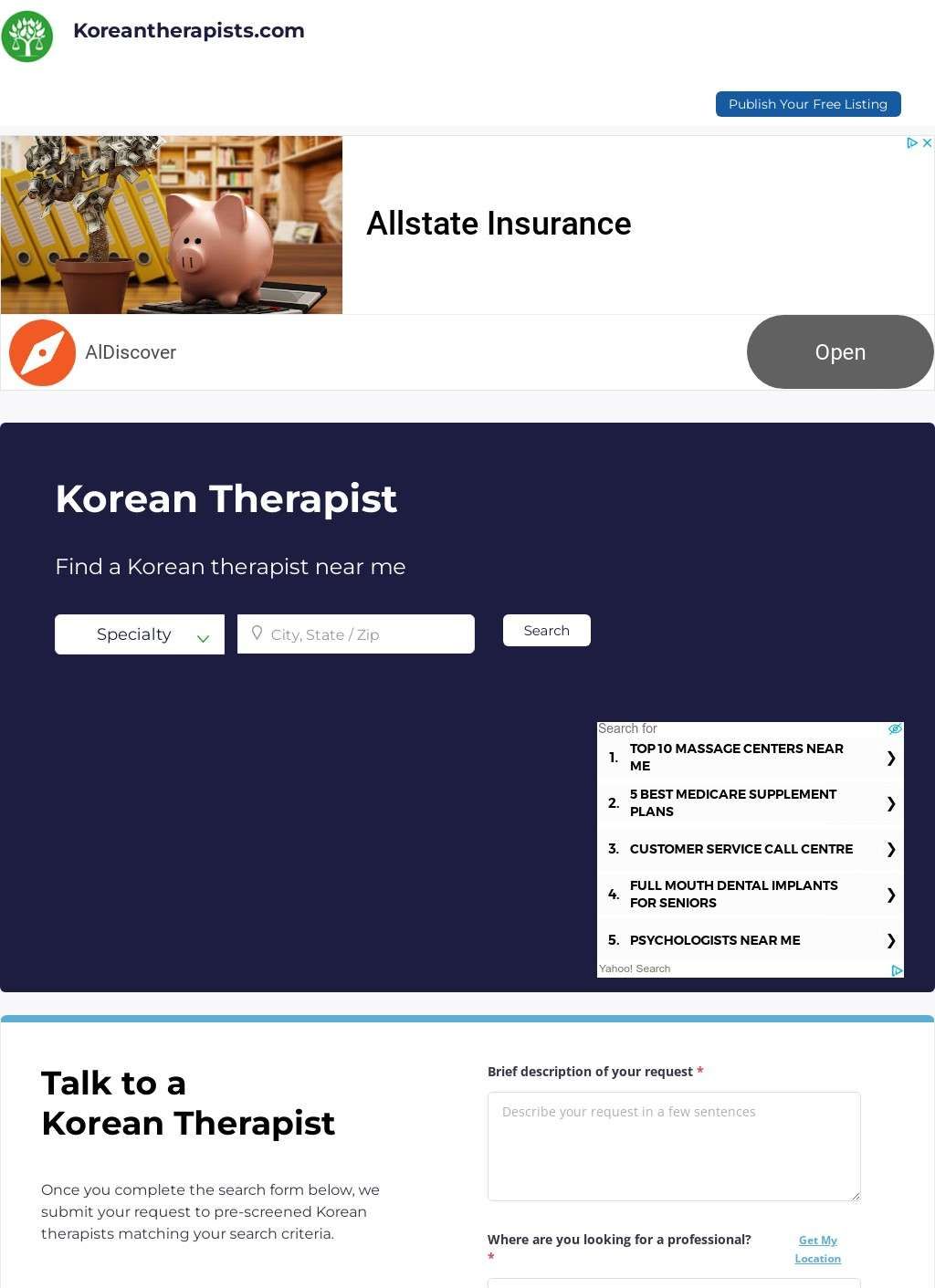
Korean Therapists runs a search form that asks for a practice area, a specialty, and a location, then promises to route the request to matching providers within two business days. That two-day window is the spine of how the whole site works: a person fills in what they need help with (anxiety, depression, addiction, family or marriage counseling, child and adolescent issues, stress, eating disorders) and the platform forwards the request to therapists who fit. It is a narrow, deliberate setup, built for people who want a counselor who speaks Korean or understands the cultural context, across the United States, Canada, and South Korea. Korean Therapists does not try to be a catch-all finder, and that restraint shapes everything else about it.
Focusing on Korean-speaking therapists
What gives the directory its reason to exist is that focus. Plenty of general therapy finders carry a filter for language somewhere in their advanced options, but the entire premise here starts from Korean and Korean-speaking clinicians and works outward. For someone who wants a therapist they will not have to explain their family dynamics or cultural assumptions to, that starting point has a practical value that a buried language filter cannot replicate. The practice areas listed cover the bulk of what people actually search for, and the geographic reach across three countries with sizable Korean communities is sensible.
Behind the vetting claims
The vetting claims are where Korean Therapists tries to set itself apart, and they deserve a close look because they are specific rather than vague. Korean Therapists says it validates license information where applicable, checks judiciary and disciplinary records in each therapist's state of licensure, and reviews listings annually. Those are concrete promises. License verification and a disciplinary-record check are exactly the things a careful person would want done before trusting a stranger with their mental health, and stating that listings get re-reviewed once a year shows the directory is not treating its database as a fire-and-forget upload. The word "pre-screened" gets thrown around loosely on a lot of sites, so it is worth noting that here it comes attached to an explanation of what the screening involves.
Limits of self-reported screening
That said, the claims are claims. A visitor has no easy way to confirm that the disciplinary checks happen as described, or how thorough the annual review really is, and the site does not show any third-party accreditation or audit backing up the process. This is not a knock unique to Korean Therapists, since most directories ask you to take their word for their own diligence, but it is the kind of thing to keep in proportion. The vetting language is a reason to give the platform more trust than a bare list of names, not a guarantee.
Free profiles and messaging tools
Therapists themselves can publish free listings, which is the engine that fills out the directory. Profiles carry credentials and specializations, and there is a messaging system that lets a prospective client contact a provider directly through the platform instead of hunting down a phone number elsewhere. A spotlight section puts individual therapists forward, which gives the site a bit of editorial texture beyond a flat search index. For a clinician, a free listing on Korean Therapists is a low-cost way to reach exactly the clients they are positioned to help, and that incentive should keep the database growing on its own.
No direct operator contact
The weakest part of the experience is operator contact. There is no phone number, no email address, and no physical office address shown on the homepage or the visible landing pages. Everything Korean Therapists handles runs through the on-site web form and the therapist-messaging tool. For reaching a therapist, that is fine, since the messaging system is the intended channel and it works for its purpose. But if something goes wrong with a search, a listing, or the routing itself, there is no obvious way to reach a human who runs the site. A directory that makes verification promises invites questions about those promises, and the absence of a direct operator channel leaves those questions with nowhere to go.
Where reviews are missing
A search for the directory by name turns up its own pages and a scattering of competitors and general platforms, Psychology Today, Inclusive Therapists, and Yelp pages for individual Korean therapists among them, but no ratings or review counts for Korean Therapists itself on Google, Trustpilot, Yelp, the BBB, or anywhere comparable.
That means a visitor cannot lean on a crowd of past users to gauge whether the routing and screening deliver as advertised. The platform is quiet enough that its track record has to be taken on the strength of what it says about itself, which circles back to those vetting claims being asked to do heavier lifting than they would on a better-established platform. Korean Therapists asks for a fair amount of trust up front, and the way it attempts to earn that trust is by being specific about its process rather than pointing to a wall of testimonials it does not have.
None of that makes Korean Therapists a weak resource. The proposition is clear, the practice areas are the right ones, the cultural specificity is genuine, and the stated screening process at Korean Therapists is more detailed than what many open directories bother to describe. The free-listing model and the direct messaging keep friction low on both sides. The honest caveats are the unverifiable nature of the vetting and the missing operator contact route, and a careful user should weigh both before treating any single profile as fully vouched for.
Set against a general-purpose option like Psychology Today, the comparison comes down to what a person is optimizing for. Psychology Today has the enormous database, the established reputation, and a deep filter set, but its Korean-language results are a subset of a much larger pool and it does not center cultural fit the way this site does. Someone whose main requirement is a Korean-speaking, culturally fluent counselor and who values the explicit license-and-disciplinary screening will likely find Korean Therapists the more direct path, and can always cross-check a promising name against the bigger platform. On the published evidence, this is a focused, credible starting point, with eyes open about what it cannot yet prove.