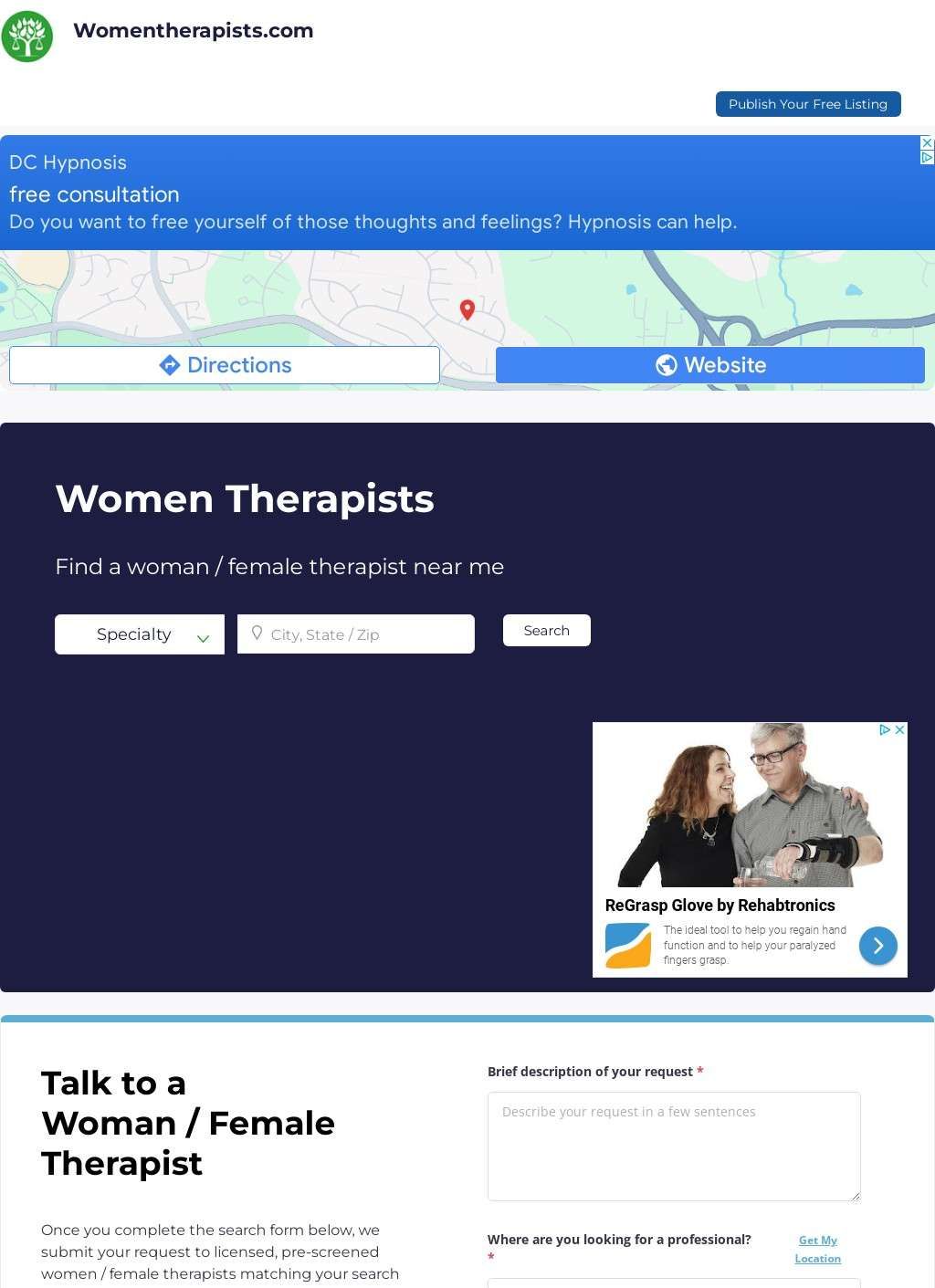
You want a female or female-identifying therapist, you have a state and a specialty in mind, and you would rather not phone five offices to find out who takes new clients. That is the situation Women Therapists is built for, and to its credit, it answers it directly.
How the matching system works
The platform runs two ways. A client fills out a request and gets matched with pre-screened practitioners by location; filtering narrows by state, city, and specialty, with coverage across major U.S. metros. A therapist pays to list her profile, sets how much detail shows, and controls where she appears on the site. The clinical range is wide: individual therapy, family and marriage counseling, anxiety, depression, addiction, anger management, eating disorders, grief, cognitive behavioral therapy, psychotherapy, telehealth, and crisis intervention. The operator behind it is Heritage Web.
License validation and annual review
Two features pull it above a plain name-and-credential lookup. First, Women Therapists says it validates licenses where applicable and re-reviews listings annually. Annual re-review is not standard on referral platforms, so it is a real differentiator if the practice matches the promise, which is a thing no listing page can prove on its own. Second, a prospective client can message a listed therapist directly through the platform instead of bouncing every inquiry back through a central intake form. Many referral sites force that detour; this one does not, and the difference in friction is genuine.
Platform support and account issues
Contact at the platform level is where the model gets less convenient. There is no primary phone number on the homepage. Everything routes into Heritage Web's FAQ and support system at help.heritageweb.com, which handles both client and therapist questions. The reasoning is visible enough: the operator runs the infrastructure, while phone numbers and addresses sit on individual therapist profiles, where a client actually needs them. Each profile carries contact and location details. So the matching layer works, but anyone with a billing or account problem has to find their way through Heritage Web's portal to resolve it.
Pricing for therapists
On pricing, Women Therapists offers a free tier or paid plans billed monthly or annually, with the annual rate 20 percent lower than monthly. That much is laid out plainly, so a practitioner can weigh the cost without a sales call.
Checking independent reviews
Here is the part that should give a paying therapist pause. Searches for independent ratings turned up nothing beyond the site's own pages: disclaimer, pricing, security policy, and the state and city directory pages. No review count surfaced on Google, Trustpilot, Yelp, or the BBB. For a service that has presumably operated long enough to assemble a practitioner base, that absence is hard to wave off. It does not prove anything is wrong. It does mean every claim about the platform's quality, including the license validation and the annual re-review, currently rests on what Women Therapists says about itself and no one else.
Who should use this service?
That split decides the verdict, because the two audiences carry different risk. For a client looking for care, the mechanics are the point, and the mechanics deliver: the specialty-and-location filter works, direct messaging works, and the cost of trying it is essentially zero since the search side is free to use. There is little reason not to run a search and judge the actual matches. For a therapist deciding whether to pay, the calculus is harder. The vetting and re-review story is appealing on paper, but with no third party confirming that Women Therapists sends real referrals or that its screening means what it claims, the free tier is the only sensible place to start. Paying upfront on self-reported numbers, with nothing external to check them against, is a bet, not a decision.
Women Therapists fills a specific gap, female and female-identifying clinicians sorted by specialty and location, and it does so with real tools rather than a static list. The product itself is sound. The evidence around it has not caught up. Use the search if you need a therapist; if you are a therapist weighing a listing, stay on the free tier until the platform gives you something to verify beyond its own description.