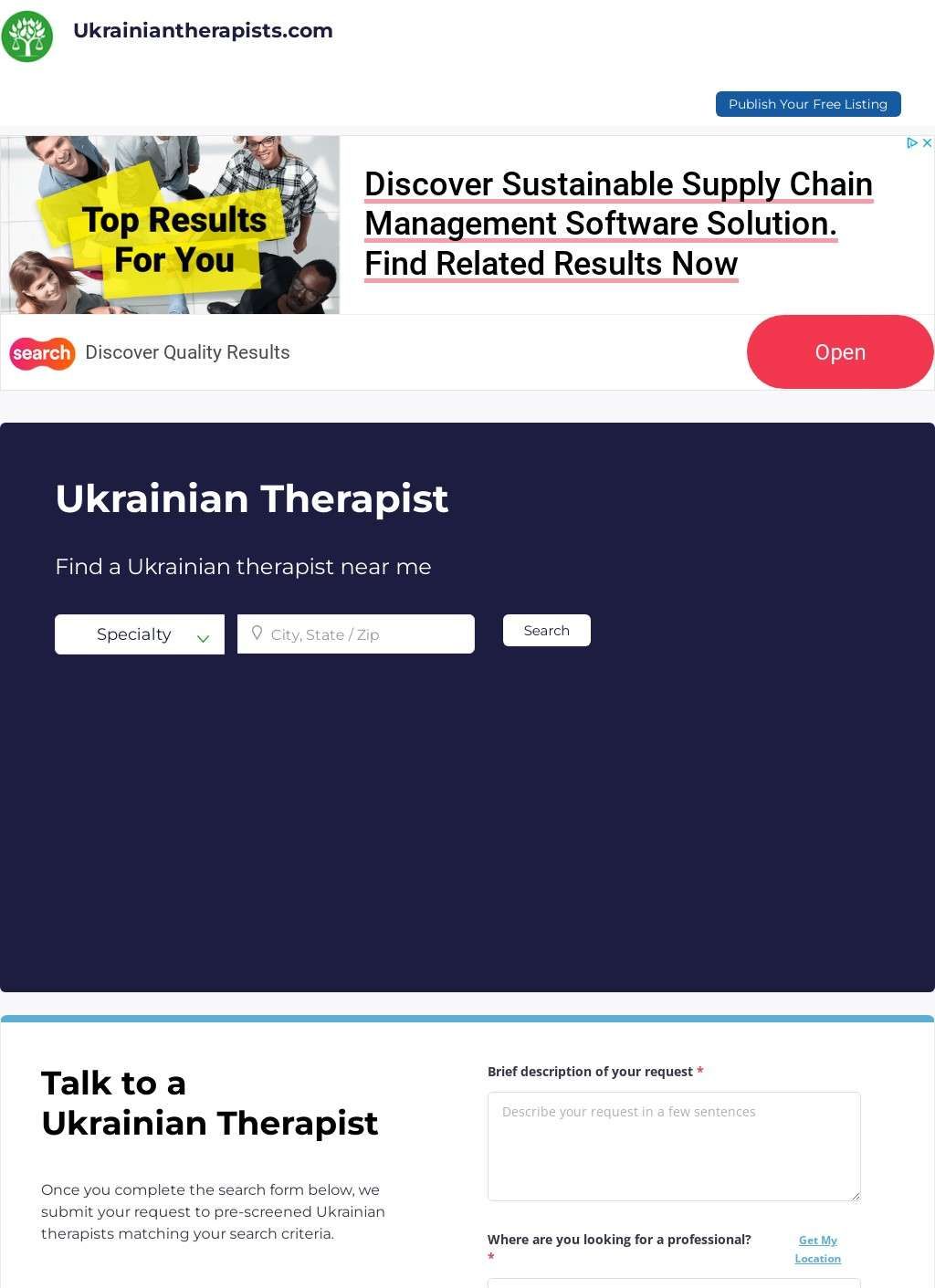
Finding a therapist who speaks your language is hard enough. Finding one who also understands the particular weight of displacement, war, and a culture most practitioners outside it have never encountered is something else entirely. Ukrainian Therapists was built around exactly that gap. It is a directory and matching service connecting clients with Ukrainian or Ukrainian-speaking therapists and psychologists across the United States, Canada, the United Kingdom, and Ukraine itself. The focus is deliberately narrow, and that narrowness is what gives the service its purpose.
Browse or request matching services
The service runs two ways. You can browse listings yourself, sorted by specialty and location, with US cities grouped under their states and separate sections for Canada, the UK, and Ukraine. Or you can let Ukrainian Therapists do the matching: fill in a request form describing what you need, and the inquiry goes to pre-screened practitioners who fit your criteria. The stated turnaround is two business days. That window is honest, not engineered to sound reassuring, and Ukrainian Therapists is upfront about naming it instead of implying something faster.
Practice areas and age groups
Coverage runs to more than twenty practice areas. Anxiety and depression are listed, as expected, alongside addiction, family counseling, and general psychotherapy. The range extends across age groups too: adults, children, adolescents, and elderly clients all have a place in how Ukrainian Therapists is organized. That breadth is more significant in a specialist directory than in a general one. The whole appeal of a Ukrainian-focused service collapses if it can only help one slice of the population. Here it does not. A parent looking for help for a teenager and an older person seeking support in their own language can both use the same tool, and neither has to guess whether the directory is built for someone else.
Telehealth availability across regions
Telehealth status appears on individual profiles, which is a practical detail given that the audience is partly a diaspora scattered across large countries. A Ukrainian speaker in a small Canadian town may have exactly zero local options in their language, so a clearly marked remote-session flag turns Ukrainian Therapists from a regional tool into something usable continent-wide. The location browsing reinforces this: a searcher can start from where they live and narrow down, or accept that the right match might be a video call away instead of a drive.
Vetting and credential validation
The credibility of any matching service rests on its vetting, and Ukrainian Therapists makes specific claims. The site states that every listed therapist is pre-screened, that license information is validated where applicable, and that listings are reviewed annually. Those are concrete, testable promises, not vague reassurance. The phrase "where applicable" is doing quiet work, since licensing regimes differ between the US, Canada, and Ukraine, and a blanket claim of verification across all three would be harder to believe than the hedged version the site actually uses.
Free listings and annual reviews
Listing for therapists is free, which cuts both ways. Free entry lowers the barrier for genuine practitioners who want to reach Ukrainian-speaking clients, widening the pool a searcher can draw from. It also means the screening process alone stands between a real clinician and someone less qualified. The annual review cycle is the safeguard Ukrainian Therapists leans on. Once a year is reasonable for a niche project of this kind, but it does mean a therapist's circumstances could shift for months before the directory catches up. A client should still confirm credentials directly before booking, which is good advice for any therapist directory regardless of how careful the host is.
For practitioners, Ukrainian Therapists provides an account dashboard to manage listings, a monthly newsletter, and an affiliate program. Together these point to a project that is actively maintained, not left idle, which is not something you can assume with niche community sites. A therapist can update their own entry, so information stays fresher than it would if every change needed to pass through an administrator. The newsletter is a small thing, but it points to an operator planning to keep talking to its audience over time instead of setting the site up once and walking away.
One structural detail is worth noting. The support infrastructure runs through help.heritageweb.com, placing Ukrainian Therapists on the HeritageWeb platform. That is not a problem in itself, since many solid directories run on shared platforms, but it explains some of the design conventions and makes clear that the technical backbone is a third party, not something bespoke. The project leans on platform tooling for operations, which can be a strength for reliability and a ceiling on how far the experience can be customized.
Independent feedback is another matter, and there is very little publicly available. A search turns up no notable third-party reviews of Ukrainian Therapists on the usual platforms. This is common for tightly focused directories that never accumulate the kind of public footprint a local restaurant does, and it is not damaging on its own. But it does mean a prospective user cannot lean on a crowd of past experiences to confirm or push back on the site's own claims. You are trusting the stated process and your own verification of any individual therapist, with no independent chorus to corroborate.
What Ukrainian Therapists gets right is specificity. It knows exactly who it serves and builds everything around that: language, culture, the geography of where Ukrainians have settled, and the age spread of a whole community rather than a single demographic. The matching service is a genuine convenience for people who would otherwise spend hours guessing whether a name on a general list speaks their language. The free listing model and the maintained dashboard point to people who want a working tool.
The open question is whether the screening claims hold in practice, and from the outside that cannot be confirmed. Ukrainian Therapists states that it pre-screens, validates, and reviews, and those are the right commitments to make. But with no third-party reviews to corroborate and the verification happening behind a form on a shared platform, a first-time visitor takes the most important promise largely on faith. For a service handling people at their most fragile, that is the part worth sitting with before going further. The published evidence is consistent and the structure is coherent; what is missing is any outside confirmation that the process works as described.