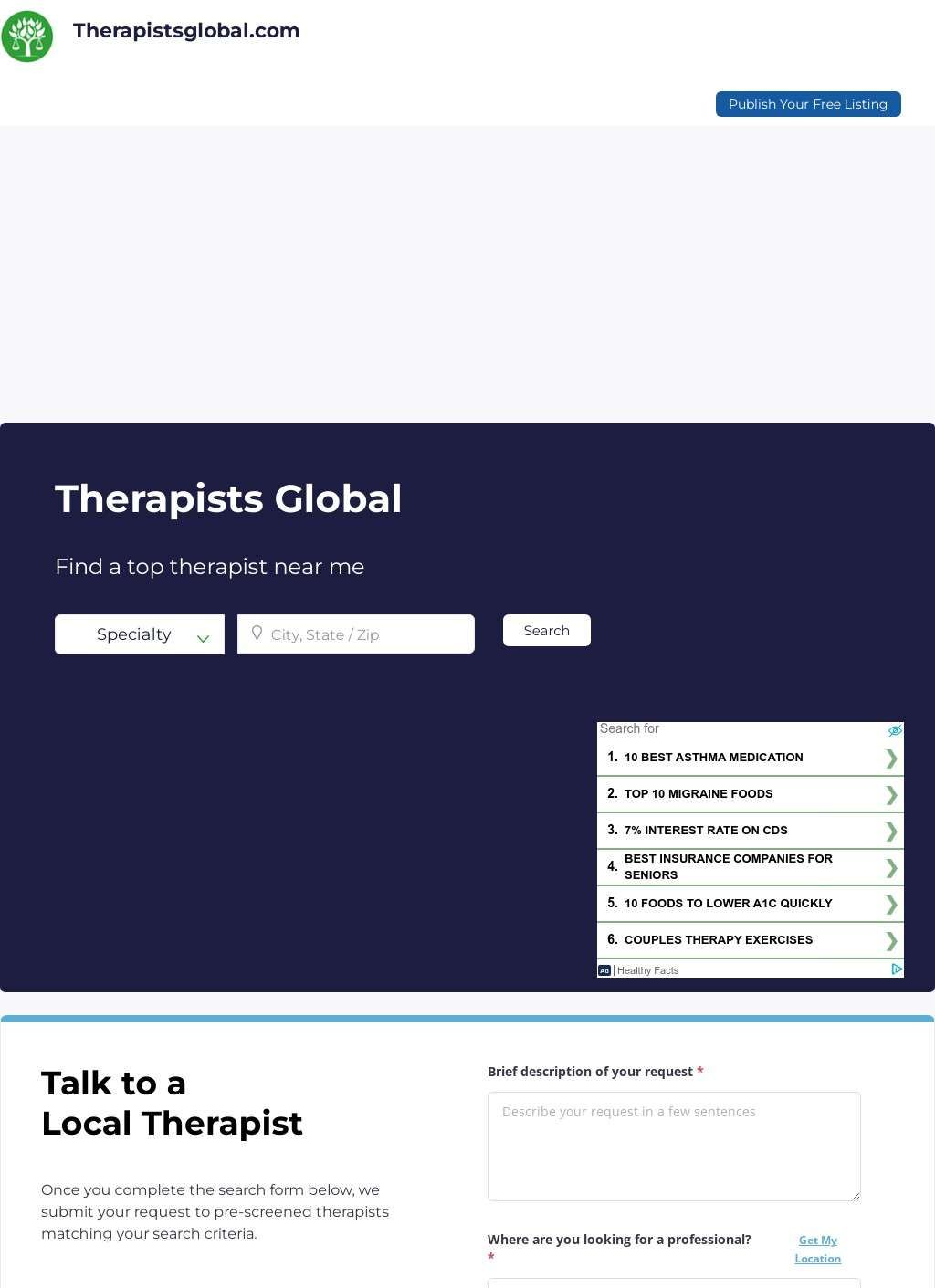
Someone deciding to find a therapist usually starts in a fog: they know roughly what they are dealing with, anxiety that will not quit, a marriage going sideways, a drinking problem they have stopped pretending about, but they have no idea how to tell a qualified professional from a name on a search result. Therapists Global aims squarely at that moment. It is a worldwide directory of licensed therapists and psychologists, run by Heritage Web LLC, and the search is built around the two questions a person in distress can actually answer: what is wrong, and where am I. You pick a specialty, anxiety, depression, addiction, trauma, family counseling, among others, and narrow by city, state, or zip, and Therapists Global returns practitioners who match.
License checks behind every listing
What lifts it above a plain list of names is the vetting it claims to do before anyone appears. Listings are pre-screened by hand, professional licenses are checked at the point of submission, and Therapists Global says it re-verifies those credentials every year. For a category where the cost of a bad match is high and the average user has no way to audit a license number, that annual re-check is the most meaningful promise on the site. It is a claim, not something an outside visitor can independently confirm, but it is a specific and falsifiable one, which counts for more than vague reassurances about quality.
Ways to reach a therapist
The contact path between user and clinician works in a couple of ways. There is a "Talk to a Local Therapist" request form that routes an inquiry out to pre-screened practitioners, useful for someone who would rather describe their situation once and let suitable people respond. There is also a direct messaging system, so a person who already spotted a profile they like can reach that clinician without going through an intermediary. Telehealth availability is flagged on profiles, which is relevant for anyone in a rural area, anyone housebound, or anyone who simply prefers sessions from home. Therapists Global also states it handles data in a HIPAA-compliant way, a detail that belongs on any platform asking people to disclose mental health concerns through a web form.
Tools built for therapists
The other half of Therapists Global faces the professionals, and it is built like a working business tool rather than a vanity listing. There is a free tier, so a therapist can establish a presence at no cost, and paid tiers billed either monthly or annually, with a 20 percent discount for paying yearly. Behind a listing sits a dashboard for managing the profile, plus a paid leads marketplace and a referral program for clinicians trying to grow a caseload.
How pricing tiers affect visibility
That structure tells you something about how Therapists Global sustains itself. Free listings keep the database broad enough to be useful to searchers, while the paid leads and upgraded plans are where the revenue comes from. It is a familiar model and a defensible one, though a prospective searcher should understand that a more prominent profile may reflect a paid plan as much as a better-fit clinician. The pre-screening claim is what keeps that from being a real problem, assuming it holds in practice across the listings a given search surfaces.
Documentation for all of this lives at a help center hosted under help.heritageweb.com, the parent company's own support property. Pricing, Terms, an About page, and a Contact page are all present and reachable from the main navigation, so the commercial terms take no digging to find.
Contacting the company itself
On the question of how reachable the operator itself is, the picture is mixed. A contact page exists, which is the baseline, but the homepage shows no phone number and no street address, and the help center hands off to an external Heritage Web support portal. For a service handling sensitive health information, a visible phone line or postal address would do more to settle a cautious user than a form and a third-party help desk. None of that is disqualifying, plenty of online platforms run lean on direct contact, but it is the one area where a person weighing trust has less to go on than they might want.
Checking reviews and reputation
The reputation side is genuinely quiet. A search for therapistsglobal.com turned up no notable third-party reviews or ratings tied to this specific service. There is a Trustpilot page with a couple of reviews for a similarly named therapistsg.com, but that points to a Singapore-based operation and has nothing to do with this one, so treating it as evidence either way would be a mistake. No outside track record is available, which means a visitor cannot lean on crowd feedback here and has to judge Therapists Global on what it shows and on the credibility of Heritage Web, which has operated since 2011.
Testing the service yourself
Taken together, the substance of Therapists Global is in the matching and the vetting. The search by specialty and location maps onto how worried people actually think, the screening and annual license re-check address the core fear of ending up with someone unqualified, and telehealth flags widen who can be served. It reads as a serious attempt at the problem. The caveat is that its trustworthiness rests on its own stated processes more than on any visible verdict from the people who have used it, and without external ratings to cross-check, the entire value proposition rests on the pre-screening claim. Send a couple of inquiries through the request form and judge the quality of responses; that is a more reliable test than anything this page can provide.