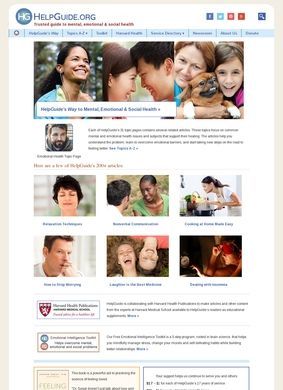
Helpguide is a nonprofit mental health and wellness reference at helpguide.org, built around free, evidence-based articles that people can read without paying or registering. The catalogue runs to more than forty topic areas, and the breadth is the first thing worth noting. Someone arriving with a question about anxiety, depression, bipolar disorder, PTSD, OCD, ADHD, an eating disorder, schizophrenia, or addiction will find a dedicated section for each on Helpguide, written in plain language meant for a general reader and not a specialist.
Mental health conditions and everyday wellness
The coverage does not stop at diagnosable conditions. There is a substantial body of material on everyday wellness: exercise, nutrition, sleep, heart health, weight management, and support for people living with cancer. That last grouping is telling, because it places physical health beside mental health instead of pretending the two run on separate tracks. A reader who came in worried about sleep can move sideways into anxiety or stress without leaving the site or hitting a paywall.
Relationships get their own attention too, with guides on communication, friendship, love, sexual health, and domestic abuse. Pairing the lighter material on friendship and love with serious, safety-critical content on abuse is a deliberate editorial choice, and it is handled without sensationalism. Life-stage content fills out the rest, spanning parenting, the particular pressures teenagers face, healthy aging, and end-of-life care. Few self-help reference sites stretch across that many corners of a person's life, and Helpguide treats them as connected concerns rather than isolated silos. The structure assumes, sensibly, that the questions people bring to a mental health resource rarely arrive one neatly labelled topic at a time.
Guided meditation audio with written scripts
What separates Helpguide from a plain article library is the set of practical aids sitting alongside the text. The site publishes guided meditation audio together with the written scripts, covering body scan exercises, mindful breathing, and gratitude practices. That pairing is useful in a concrete way: a person can listen, or read and work at their own pace, depending on what suits them in the moment. It turns advice into something a person can actually do, with browsing becoming the lesser half of the experience.
Finding professional therapist support
There is also a Find a Therapist directory for readers who decide self-help is not enough and want professional support. Including that route is a sensible piece of honesty. Educational content has limits, and pointing people toward clinical help when they need it shows the site understands where its own usefulness ends. A lot of wellness publishers would rather keep a visitor reading; routing them out toward a professional instead is the more responsible call, and it sits well with the nonprofit framing.
Clinical review and nonprofit funding model
On the question of trust, the model behind Helpguide does most of the reassuring. The articles are written and reviewed by a Professional Advisory Council of clinicians, so the guidance is not anonymous web copy but material with named professional oversight. That review layer separates a credible health reference from the wider sea of unsourced advice online. Helpguide carries no advertising and runs on donations. That funding choice has a real effect on the reading experience, because nothing on the page is steering you toward a product or a sponsor. For a subject where bad or commercially motivated advice can do genuine harm, the absence of ads and the presence of clinical review are the two things that count most.
Scope and limitations of the service
It helps to be clear about what Helpguide is and is not. It is a general-public information service, global in reach and broad by design. It does not diagnose, it does not treat, and it does not replace a conversation with a doctor or therapist. Read with that framing, the depth is a strength. Read as a substitute for care, the same breadth could mislead someone into self-managing a condition that needs a professional. The site is reasonably upfront about this, and the therapist directory reinforces the point.
Helpguide has a clear online presence and a detectable external reputation. A search turns up references from psychology blogs and academic resource lists, though the volume of third-party user reviews on consumer platforms is limited. The nonprofit model and the named advisory council do a lot of the credibility work that a larger review footprint might otherwise provide.
As a free, ad-free, clinically reviewed starting point for understanding a mental health or wellness concern, Helpguide is hard to fault and worth bookmarking. Its weakness is the flip side of its ambition: covering forty-plus topics for a worldwide audience means the material stays general, so anyone with a specific or serious situation will need to take what they learn here into a proper clinical conversation. Used as orientation rather than diagnosis, Helpguide does what it promises.