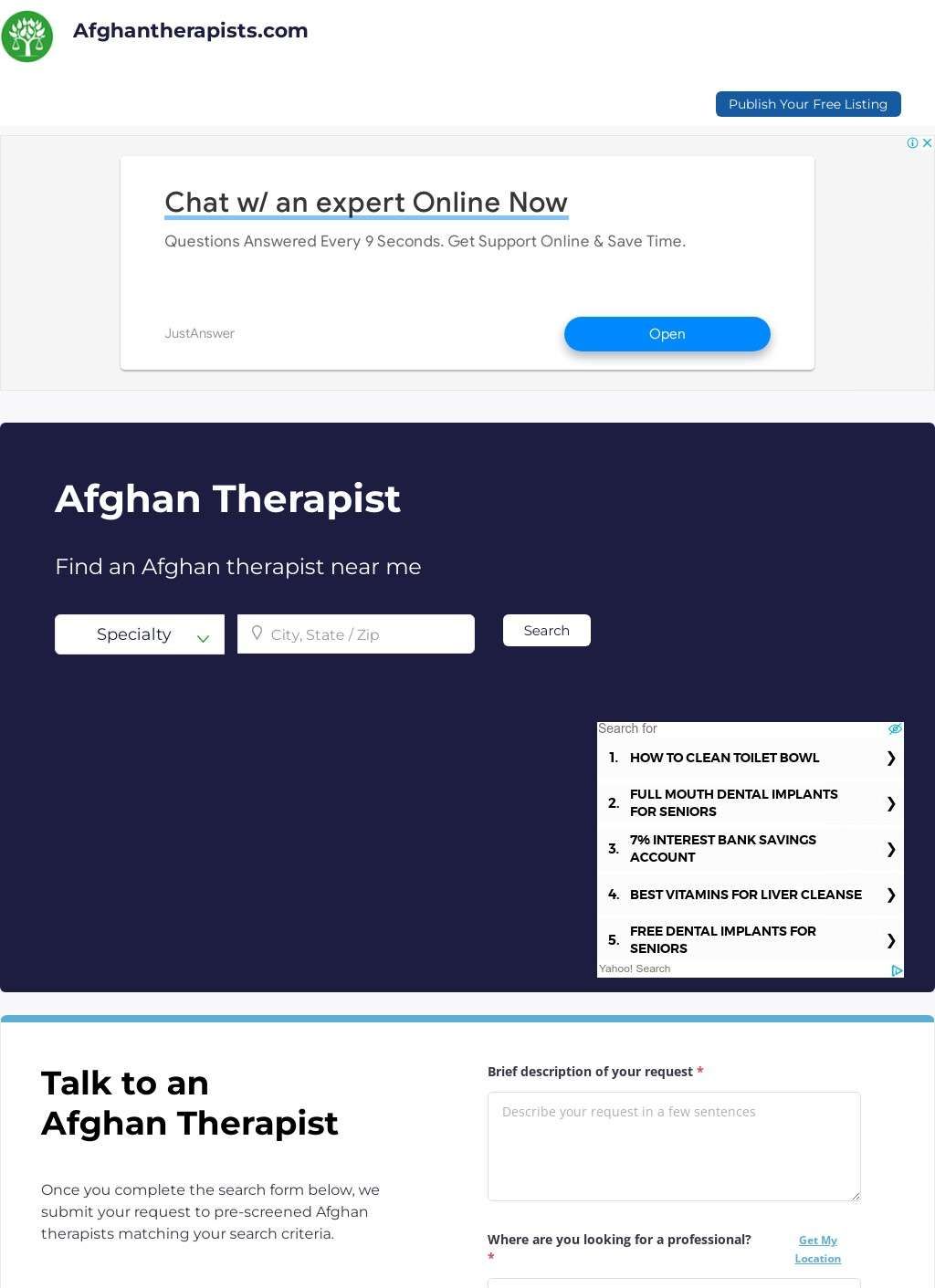
Finding a mental health professional who speaks Dari or Pashto, or who carries Afghan heritage, is genuinely hard. Afghan Therapists is built around that single problem: match a client to a therapist who shares their language and cultural background, for individual counseling, marriage work, or treatment for anxiety and depression. The whole site is organized around that goal. Providers can be browsed by specialty, by country, and by city, and each listing shows a name, a location, the years a therapist has been licensed, and the areas they handle. That last detail, years licensed shown openly on the profile page, is something most directories of this kind do not bother to surface.
Services and specialties offered
The service menu is broad without being vague. Individual counseling and family therapy sit alongside marriage counseling, psychotherapy, cognitive behavioral therapy, addiction treatment, and dedicated handling of stress, anxiety, and depression. Telehealth is available, which matters a great deal for a community scattered across borders, since an Afghan family in a small American town may have no in-person Dari-speaking therapist within a day's drive. Coverage is described as international, with a separate U.S. section living at the /us path. A person can either browse providers directly or submit a request and let the site route them toward a pre-screened match.
Annual license verification
That word pre-screened is where Afghan Therapists stakes its credibility. The site says it validates therapist licenses every year, and the About page repeats that annual verification as the foundation of the model. A yearly re-check is a stronger commitment than a one-time signup gate, where a license could lapse the day after a profile goes live and nobody would notice. Whether the check is performed at the scale claimed is something a visitor cannot confirm from outside, but the policy is stated plainly and tied directly to why the directory exists.
From a shared template network
Afghan Therapists is one of more than 300 niche professional publications run by a single operator, each aimed at a specific cultural or linguistic group. That fact pulls in two directions at once. A shared backend means the matching system, the license-verification routine, and the request forms have been stress-tested across hundreds of parallel sites; the operator has clearly built infrastructure, not a weekend project. At the same time, a directory assembled from a common template risks treating the Afghan community as a slot to be filled, with cultural specificity reduced to a name swap and a language tag.
The page itself does not fully settle that question. The specialties listed are standard therapy categories any business directory would carry, without anything tuned to the particular pressures an Afghan diaspora client might bring, such as displacement, intergenerational trauma, or the strain of practicing faith and family roles in a new country. The cultural match Afghan Therapists sells is linguistic and heritage-based, which solves a real problem, though it stops short of demonstrating depth on the issues that often drive someone to seek a therapist who shares their background in the first place.
Linguistic match solves real problems
That linguistic match alone does solve something concrete. Therapy done in a second language loses nuance fast, and for older Afghan clients especially, a Dari or Pashto session is the difference between being understood and merely being processed. If the provider pool is staffed and the licenses hold, the core service is sound.
Provider inventory remains invisible
That last condition is the catch, because the pool is exactly what an outside visitor cannot verify. The number of therapists actually listed, how many cities have any coverage at all, and whether a request submitted today returns a live match or a dead end are all invisible until you go through the form. A directory of this type is only as good as its filled listings, and the structure can look complete while the inventory behind it is sparse in practice.
Contact and reputation gaps
On the contact side, Afghan Therapists provides no phone number, no public email address, and no physical address on its landing page. A Contact link sits in the footer, but reaching anyone runs entirely through on-site request and submission forms. For a service handling something as sensitive as mental health, where a person may want to ask a question before trusting a system with their details, the form-only model is a real friction point. It is efficient for the operator and a little opaque for the user.
Outside reputation adds no weight either direction. A search for reviews of Afghan Therapists as a platform surfaces nothing. The results that appear point to an unrelated individual physician with a similar name and to general writing about Afghan mental health, none of it connected to this directory or its operator. There is no independent body of user experience to weigh, no rough rating to lean on, no thread of someone describing whether the matching worked for them. Afghan Therapists has to be judged on what it presents, and what it presents is competent and clearly organized.
Structure meets community needs
For what it sets out to do, Afghan Therapists is put together with more care than a quick-template operation would typically show. The browse-by-city structure is sensible. The stated annual license check is the right kind of commitment rather than a passive one. Telehealth extends the reach in exactly the way this community needs. Showing years-licensed on each profile is a concrete mark of seriousness, the kind of field a directory includes when it expects users to compare providers rather than just click the first name they see.
The gap that remains is one the site cannot close from the outside. Across 300-plus near-identical publications, with no third-party reviews and a provider list a visitor cannot inspect until they hand over a request, the published evidence is enough to call the premise sound and the structure well-built. It is not enough to say whether Afghan Therapists has meaningful coverage in any given city. Afghan Therapists is a reasonable starting point for anyone with no other Dari- or Pashto-speaking options nearby. Whether Afghan Therapists delivers in practice depends on geography and on whether the therapist pool behind the interface is populated where it counts.