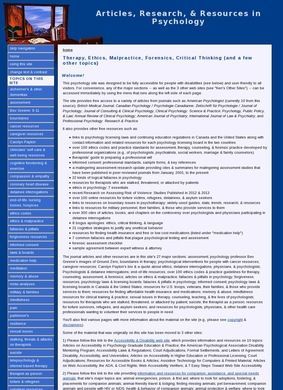
Where does a clinician turn when a thorny ethics question lands on the desk at the end of a long day and the textbook on the shelf is silent on it? Pope, Ken PhD points to one practical answer: a free, plainly built website that has been collecting full-text articles, ethics codes, and clinical forms in one place for years. The man behind it is a licensed psychologist with a diplomate in clinical psychology, graduate degrees from Harvard and Yale, and an independent practice that goes back to the mid-1980s. He has put his name on more than a hundred peer-reviewed articles and chapters. The site is the working library that grew out of that career.
Free access to full-text articles
The first thing worth saying is that nothing here is locked behind a paywall or a sign-up wall. Pope, Ken PhD has made the full text of journal articles available right on the page, drawn from publications that include American Psychologist and the British Medical Journal. For a graduate student without deep library access, or a counselor in solo practice who lost institutional logins after leaving a hospital job, that openness changes what is reachable on a Tuesday night.
Ethics codes and licensing links
The deepest part of the collection is the reference material on professional conduct. Pope, Ken PhD has gathered over a hundred ethics codes and professional practice standards in one spot, alongside links out to licensing boards and professional organizations across the United States and Canada. Anyone trying to confirm what a specific board expects, or to compare how two disciplines frame the same duty, can do the cross-checking without hunting across a dozen separate organizational websites.
Clinical forms and checklists
That breadth is paired with documents a practitioner can use directly. There are sample clinical forms, including informed consent templates and expert witness agreements, plus checklists meant to be worked through rather than just read. These are the unglamorous pieces of running an ethical practice, the paperwork that protects both client and clinician, and having vetted examples to adapt saves real time and reduces the odds of leaving something out. Pope, Ken PhD has clearly organized the collection by topic rather than by publication date, which makes navigation faster than it would be on a typical aggregator page.
Twenty-seven topic sections covered
The subject range is wide for a site run by one person. Material is sorted into more than 27 topic sections, and the list reads like the harder corners of the field: malpractice, psychological assessment and testing, boundary issues in therapy, sexual issues in professional contexts, the psychology of detainee interrogations and torture, suicide prevention, memory and trauma, forensic work, military and veteran mental health, and end-of-life care. Some of these are areas other resource sites avoid because they are uncomfortable or legally fraught. Pope, Ken PhD does not skip them.
Books and research studies profiled
Beyond the reference shelf, the site profiles the books Pope, Ken PhD authored and co-authored, and it carries research studies as well as the journal articles already mentioned. This gives the place a second use. It works as a quick way into the scholarly record on a given question, a starting point before someone moves on to a university database or a citation index. The writing and curation come from a single recognizable author with a long publication history, which is more than can be said for a lot of anonymous aggregator pages covering the same ground.
Identifying the intended readers
The intended readers are easy to spot from the material itself. Psychologists, counselors, social workers, and psychiatrists are the core, but the forensic and expert-witness content clearly also serves attorneys and people preparing to testify, and students and academic researchers will find the open articles useful for coursework and literature reviews. It is a professional and academic tool first. A member of the public looking for a therapist to book an appointment with is in the wrong place, and the site does not pretend otherwise.
Reputation without star ratings
A search for independent reviews or ratings of kspope.com turns up nothing on the usual consumer platforms. What surfaces instead are unrelated people who happen to share the name, a Canadian lawyer and a painting contractor among them, plus scholarly profile pages on ResearchGate and Academia.edu that point back to Pope, Ken PhD and his published work. So the credibility rests on the author's documented academic record and the citable nature of the sources he reproduces, not on a star rating. For a reference library, that is arguably the more relevant kind of credibility anyway.
Limited contact information available
The honest caveat is about reachability. The site lists Ken Pope as its creator and credits VioletSky Design for the build, but it offers no phone number, no postal address, and no contact form. For a static reference archive that nobody is buying anything from, this matters less than it would for a service business, but it is a real limit. Anyone hoping to consult Pope, Ken PhD professionally, or to verify that a given document is current, will need to track him down through other channels.
One more practical note: because the content leans on codes, standards, and forms that get revised over time, a careful user should treat the reproduced documents as a strong starting reference and confirm the latest version with the issuing board before using it in a live case. The collection points the way; it does not replace the official source of record. Pope, Ken PhD built it as a gateway, and that is exactly how to use it.
Taken together, what Pope, Ken PhD has built is a genuinely useful stop for psychology students, early-career counselors, or attorneys prepping a forensic matter who need open access to ethics codes, clinical forms, and full-text articles without a subscription. Pull the relevant code or consent template from the topic index, then go straight to the originating board or journal to confirm the current version before it shapes a decision.