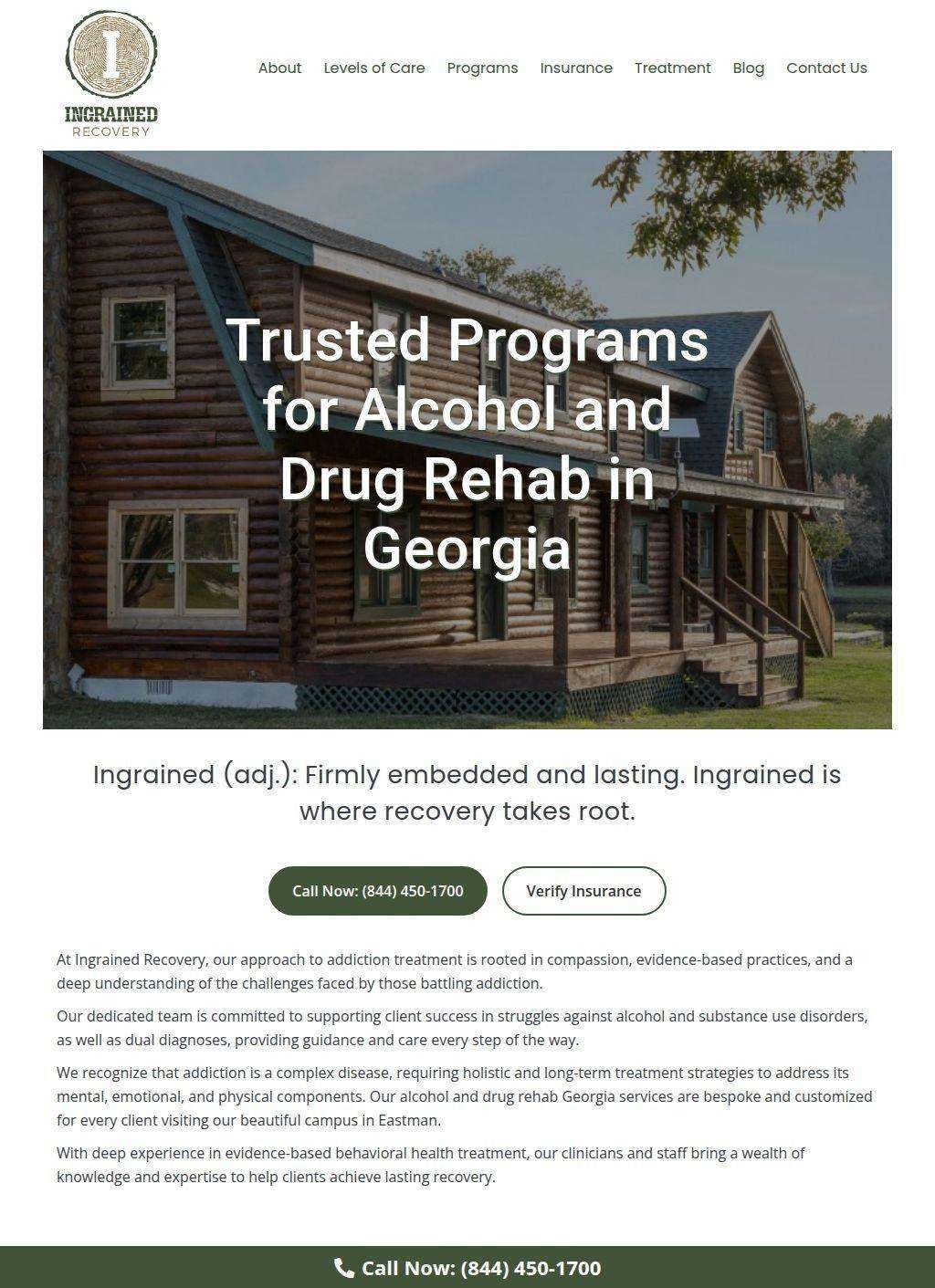
Fifty acres in Eastman, Georgia is where Ingrained Recovery has planted itself, a private campus an hour or more from anything resembling a city, and that physical isolation is the through-line of everything else the place does. The address sits at 3352 Antioch Church Rd, and Ingrained Recovery leans into the rural setting with equine-assisted therapy, the kind of feature that only makes sense when you have land and horses to put a person near. For someone trying to get clean away from the people and places tied to their use, distance is a clinical tool, not a marketing line.
Structuring a full continuum of care
The clinical spine is more conventional than the ranch framing might suggest, and that is to its credit. Ingrained Recovery runs a full continuum: medical detox supervised by a physician and nursing staff, residential inpatient rehabilitation, a partial hospitalization program, and an intensive outpatient track. The point of stacking those levels is that a client can step down through them without changing providers, moving from round-the-clock care to a lighter structure as they stabilize. Medication-assisted treatment is part of the picture too, which does a great deal of work for opioid and alcohol cases where withdrawal is dangerous and cravings derail people who are otherwise motivated.
Substances and conditions treated
What Ingrained Recovery treats is stated plainly, and the list is sobering. Alcohol use disorder sits alongside dependencies on heroin, fentanyl, methamphetamine, and benzodiazepines. Fentanyl and benzo detox in particular are not things to attempt without medical supervision, so the in-house physician- and nurse-supervised detox is the load-bearing piece of the offering here. Ingrained Recovery also handles dual diagnosis, meaning it treats the co-occurring mental health conditions, including depression, anxiety, and trauma, that so often sit underneath a substance problem. Group therapy, individual counseling, and family support round out the day-to-day, with aftercare planning meant to carry past discharge.
Adding equine and family therapy
Holistic and equine work get genuine billing instead of a footnote, and the research backing horse therapy lags well behind the marketing around it. That said, pairing it with real medical detox and MAT keeps it in its proper place as a supplement, not a substitute. Ingrained Recovery also offers couples and family programming, which acknowledges that addiction rarely sits inside one person alone. The range of services here is wide, and for a single 50-acre campus it is a lot to deliver well.
Checking the reputation gap online
The public track record for Ingrained Recovery is close to nonexistent, and honesty requires saying so. Birdeye shows a single review, a one-star, from someone who said Ingrained Recovery was not accepting the public at the time they tried. Yelp lists the place but records no reviews at all. Ingrained Recovery turns up in the rehab directories on drugabuse.com, ProjectKnow, recovery.com, and alcohol.org, plus a Bizoforce listing, but none of those surface an aggregated star rating. A prospective client searching for independent validation will come up nearly empty.
Reading a single negative review
That single negative data point deserves a fair reading. A lone one-star tied to a complaint about not being open yet reads more like a facility early in its life than a pattern of bad care. But the absence of any counterweight is its own fact. A treatment center asks people to hand over weeks of their life and often thousands of dollars at one of the most vulnerable moments they will face. Doing that on the strength of a website alone, with no chorus of former patients to consult, is a harder ask than it would be for almost any other kind of service.
The directory presence at least confirms that Ingrained Recovery exists and sits indexed by the platforms that vet rehabs, which is not nothing. Those sites generally require a facility to be licensed and verifiable before listing it. Ingrained Recovery describes itself as a licensed drug and alcohol treatment center, and the directory listings are consistent with that claim. It is a floor, not a recommendation.
On reaching the place, the basics are handled well. A phone number, (844) 450-1700, sits prominently on the Ingrained Recovery homepage alongside the physical address, which is exactly what someone in crisis needs to find in the first few seconds. No public email is listed, but for an intake-driven program that is normal and arguably sensible: a phone call routes a person into triage faster than an inbox ever would. Social profiles on Facebook, Instagram, X, and LinkedIn are linked from the site. The primary path is a call or a contact form, and the call route is the right one to feature for this kind of help.
Insurance coverage claims explained
The money side is presented the way most of this industry presents it, which is to say optimistically. Ingrained Recovery names the major carriers it works with: Aetna, Blue Cross Blue Shield, Cigna, UnitedHealthcare, and the military's TRICARE. Naming TRICARE is worth noting, because veterans carry a heavy share of the substance and trauma burden and many facilities do not bother with that paperwork. The site cites coverage potential of up to 100 percent for detox and rehab, and that phrasing is where anyone should slow down. "Up to" is doing real work there. Actual out-of-pocket cost depends entirely on a person's specific plan, deductible, and prior-authorization outcome, and no center can promise full coverage sight unseen. Treat that figure as a reason to verify benefits directly, not as a quote.
Choosing a rural treatment location
The geography itself deserves a moment. Eastman, Georgia is not a place most prospective clients will already know, and the decision to locate Ingrained Recovery there is a deliberate one. Rural placement reduces access to old using environments, old contacts, and the ambient stress of city life, but it also means family visits are logistically harder and that the step-down to outpatient may require a person to relocate back into their home community mid-treatment. Those are not flaws unique to Ingrained Recovery; they are the ordinary trade-offs of any rural residential program. Worth knowing before a family makes travel and accommodation plans.
Weighing all of it, Ingrained Recovery comes across as a clinically serious program let down, for now, by a nearly absent track record from outside sources. The service menu is comprehensive and correctly ordered, the medical detox is physician-supervised, the insurance relationships are broad, and the rural campus has defensible logic behind it. None of that is in question. What is missing is the one thing most families lean on hardest when choosing addiction care: the testimony of people who have been through Ingrained Recovery and come out the other side.
Until that accumulates, the sensible move is to call, ask pointed questions about licensing, staff credentials, and what aftercare actually looks like in practice, and verify insurance coverage in writing. As a clinical proposition Ingrained Recovery looks sound; as a known quantity it is not there yet, and the gap between those two things is worth closing with direct questions rather than the site's own reassurances.
Important pages
Business address
Ingrained Recovery
3352 Antioch Church Rd,
Eastman,
GA
31023
United States
Contact details
Phone: 8444501700