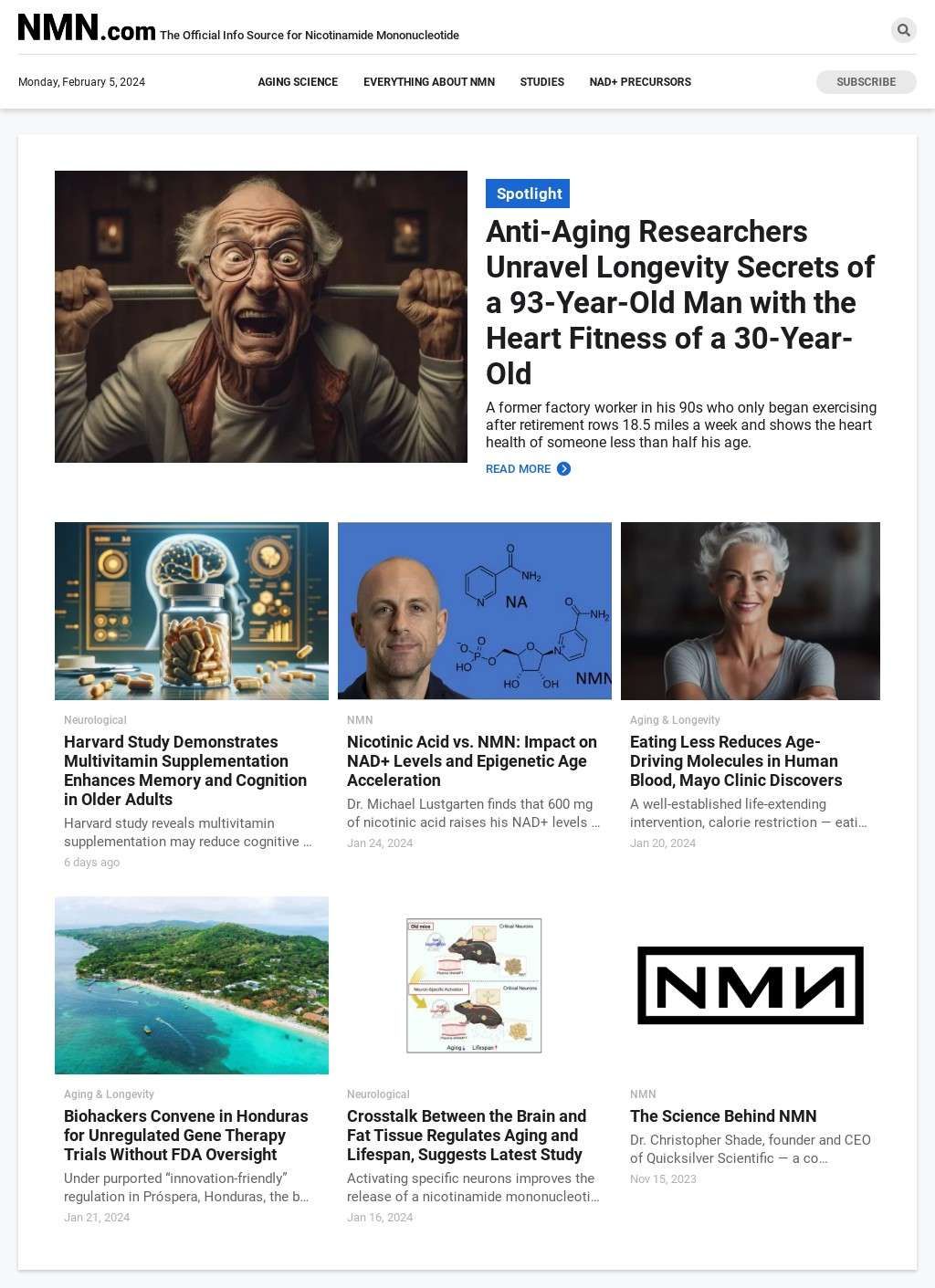
Where does someone go to read the actual science behind nicotinamide mononucleotide without a checkout button waved in their face every two paragraphs? NMN offers one answer. It is an educational site run under the ALSET Foundation, and it sells nothing. That single fact reshapes how the whole thing reads: the pages exist to explain NAD+ and longevity research, not to move bottles of powder.
Research summaries organized by category
The core of the offering is a body of research summaries split across fourteen study categories. Aging sits alongside cardiovascular, neurological, and metabolism groupings, with several more that let a reader narrow in on the angle relevant to them. On top of those summaries there is a running news feed covering anti-aging and longevity developments, so NMN is not a static reference frozen at one moment. It updates as new work appears.
Where beginners and experienced readers start
A newcomer to the topic gets a proper on-ramp. There is an overview section that walks through what NMN is, the claimed benefits, dosage discussion, and the state of human trials, which is the part most product pages skip entirely. People who already know the basics will probably head straight for the comparisons, the clearest being NMN versus NR, a distinction that trips up a lot of shoppers who assume the two compounds are interchangeable. NMN lays that out without a sales motive, which is rarer than it should be.
Filtering studies from 2018 to 2026
The archive is where the site earns its seriousness. Studies are filterable by year, running from 2018 through 2026, which means someone can trace how the evidence base has shifted over time instead of being handed a single cherry-picked paper. That chronological filter is a small thing to build and a genuinely useful thing to have. It rewards the reader who wants to check whether a finding from a few years back has been confirmed or complicated by later work.
Disclaimer separates information from medical advice
Credit is also due for the disclaimer. NMN states plainly that its content is informational and not medical advice. In a field where supplement marketing routinely blurs the line between a lab result in mice and a promise to the person reading, that restraint is worth noting. It reflects an editorial posture that takes the science more seriously than the sale, which tracks with the no-products model.
Account features and subscription options
Around the reading material sit a few account features: registration and login, a subscription option, and a donation function. The donation route fits a foundation-run project, since the bills get paid somehow when nothing is being sold. The subscription presumably gates or organizes deeper access, though NMN does not spell out exactly what a subscriber gets beyond what a casual visitor can already read. Anyone weighing the paid tier will want to test the free pages first to judge whether the extra is worth it.
Checking the site's social media presence
Social presence is consistent under the @nmndotcom handle, spanning Twitter, LinkedIn, and SoundCloud. The SoundCloud channel is the unusual one for a science-summary site and hints at audio or podcast-style material, which suits people who would rather listen to longevity research discussion than read it. Maintaining the same handle across all three keeps the brand legible and gives a reader a quick way to gauge how active the project is between site updates.
Contact options and reachability gaps
On reachability, the picture is mixed but not alarming. A contact page sits in the navigation, so there is a defined route to get in touch. What is absent from the landing experience is a phone number or a physical address, and no direct email surfaced there either. For an educational nonprofit project that is less of a red flag than it would be for a company taking your money, but a reader who wants clear accountability behind the science will need to click through to that contact page to find out who is answering.
Searching for outside reviews of NMN
One honest gap is outside validation. A search for reviews of NMN as a site turns up almost nothing about nmn.com itself. The noise around the NMN keyword is dominated by supplement brands such as Doctor's Best, ProHealth, and Wonderfeel, plus product roundups on Fortune, Healthline, and iHerb. None of that coverage points at NMN as a destination or rates it as a reference. That absence cuts two ways. There is no chorus confirming the site is trustworthy, but there is also no trail of complaints, which is what you would expect from a resource that never asks for a sale and so never generates an angry buyer.
What NMN offers is a focused reference: deep on one molecule, organized by research category and year, clear about its informational limits, and free of the commercial pressure that warps most pages on the subject. The trade-off is transparency about the people behind it. Who writes the summaries, what their qualifications are, and how editorial decisions get made are questions the site does not visibly answer, and no third-party coverage fills that gap. Readers who trust their own judgment and want the studies laid out cleanly will find NMN genuinely useful. Readers who need a named expert standing behind every summary will find the evidence too sparse to act on.